Keep our news free from ads and paywalls by making a donation to support our work!

Notes from Poland is run by a small editorial team and is published by an independent, non-profit foundation that is funded through donations from our readers. We cannot do what we do without your support.
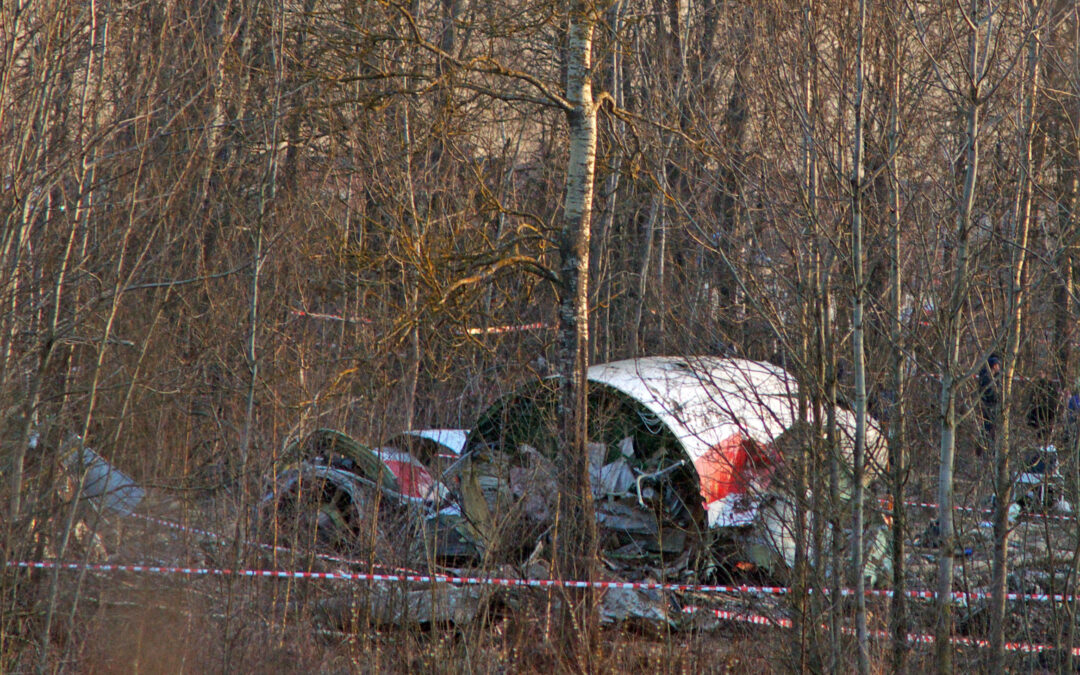
After a ten-year-long investigation, prosecutors have concluded that Poland’s government in 2010 – which was led by current Prime Minister Donald Tusk – was not guilty of “diplomatic treason” in its response to the plane crash in Russia that killed President Lech Kaczyński.
The national-conservative Law and Justice (PiS) party – which ruled Poland from 2015 to 2023 and is led by Lech’s twin brother, Jarosław – has always rejected the findings of official Polish and Russian investigations into the crash, which found it to have been an accident.
Instead, PiS claims that the disaster, which claimed the lives of 96 people, many of them senior Polish state officials, was caused deliberately by Russia and then covered up with the help of Tusk’s government.
However, while PiS launched various investigations during its time in power, it has never substantiated its claims. And prosecutors now say that there is no evidence that diplomatic treason, a crime that carries a potential prison sentence of up to ten years, took place.
Uprzednio wygrałem sprawę cywilną z posłem @OficjalnyJK, który w efekcie musiał wpłacić 50,000zł na siły zbrojne broniącej się Ukrainy.
Teraz potwierdzenie @PK_GOV_PL: nie było żadnej zdrady dyplomatycznej ani żadnej intencji jej popełnienia.
Oczywiście żaden z kłamców… https://t.co/VKZHlF5xkX— Radosław Sikorski 🇵🇱🇪🇺 (@sikorskiradek) August 5, 2026
Wednesday’s announcement by the National Prosecutor’s Office was welcomed by Radosław Sikorski, the current foreign minister, who held the same role in 2010. He condemned the “Smolensk liars”, such as Jarosław Kaczyński, who he suggested had exploited the tragedy for their own benefit.
“They brainwashed millions of people, divided families, stirred up hatred within the nation,” he wrote. “They’ll burn in hell for it. But the power, money and satisfaction they gained from spitting on their rivals – that’s theirs.”
The idea that Smolensk was an assassination of Lech Kaczyński has been a core part of PiS rhetoric. In 2022, for example, Jarosław Kaczyński said that the decision was made “at the highest level of the Kremlin” and Tusk’s government then “covered up” the incident as part of a “macabre reconciliation with Russia”.
Smolensk was an “attack decided at the highest level of the Kremlin”, says Jarosław Kaczyński ahead of the 12th anniversary of the crash.
Donald Tusk's government then “covered up” the incident as part of a “macabre reconciliation with Russia”, he adds https://t.co/5ae0gHJj3B
— Notes from Poland 🇵🇱 (@notesfrompoland) April 4, 2022
The investigation into diplomatic treason – a crime consisting of acting to the detriment of Poland while authorised to represent the country in relations with foreign states or organisations – was launched in August 2016, less than a year after PiS had come to power.
Among the individuals who had formally notified prosecutors of a potential crime was PiS deputy leader Antoni Macierewicz, who from 2015 to 2018 served as defence minister. He has been the foremost proponent of conspiracy theories around the Smolensk air disaster.
In their notifications to prosecutors, Macierewicz and the others accused Tusk and other officials of, in their relations with Russia, deliberately choosing a legal basis for an investigation into the crash that was unfavourable to Poland by giving it no real influence over how it was run.
However, prosecutors now say that, after ten years in which they questioned 488 witnesses, gathered extensive documentation and requested legal assistance from several countries, they have “concluded that no crime of diplomatic treason was committed”.
In a statement explaining the decision, the National Prosecutor’s Office said that the legal basis chosen for cooperating with Russia on an investigation – Annex 13 of the Convention on International Civil Aviation – was, in fact, “the most advantageous solution” for Poland.
It ensured the participation of Polish representatives in the Russian-led investigation, including access to the wreckage and crash site. Other legal options would have offered no greater benefits and involved significant risks, concluded the Polish prosecutors.
They acknowledged that Russia “subsequently failed to fulfil some of its obligations arising from the adopted procedure”, but said this should have no bearing on assessing the decisions that were previously made on setting up the investigation.
The defence ministry will notify prosecutors of 41 suspected crimes linked to a commission established by the former PiS government to investigate the 2010 plane crash in Russia that killed President Lech Kaczyński https://t.co/aEAlmk9lDM
— Notes from Poland 🇵🇱 (@notesfrompoland) October 24, 2024
The prosecutors also found that, not only did Polish officials choose the best legal solution, but there was also “no evidence indicating that individuals authorised to act on behalf of Poland, including the prime minister and members of the Council of Ministers, acted with the intent to harm Poland”.
Given that the crime of diplomatic treason requires intent, this finding further reinforced the decision to drop the investigation. However, the prosecutors note that their decision can still be appealed.
At the time of writing, neither Kaczyński, Macierewicz, nor other senior PiS figures had commented on the prosecutors’ announcement.
However, it is likely they will point to the fact that the current national prosecutor was appointed by Tusk’s government after it had removed the previous PiS-era incumbent in a legally questionable move.
The Supreme Court has issued a ruling that effectively found that the government unlawfully replaced a senior prosecutor earlier this year
However, the justice minister says the ruling has no legal force as it was issued by illegitimately appointed judges https://t.co/9fCE6d18uy
— Notes from Poland 🇵🇱 (@notesfrompoland) September 27, 2024
In 2020, in a separate civil case, a court ordered Jarosław Kaczyński to apologise for accusing Sikorski of “diplomatic treason” in relation to the Smolensk crash. Two years later, after Kaczyński had refused to comply with the ruling and Sikorski published the apology himself, Kaczyński was ordered to pay the costs.
In 2024, an investigation by Tusk’s government found that the PiS administration had wasted tens of millions of zloty on a commission, headed by Macierewicz, that was tasked with re-investigating the Smolensk disaster.
It notified prosecutors of dozens of suspected crimes relating to the functioning of the commission. Macierewicz, however, accused the government of spreading “lies and disinformation” designed to “protect Putin”.
Jarosław Kaczyński has been ordered to pay 700,000 zl (€150,000) to publish an apology to ex-foreign minister @sikorskiradek.
Kaczyński has yet to comply with a 2020 order to apologise for accusing Sikorski of "treason" in relation to the Smolensk crash https://t.co/o0XkTWFgDR
— Notes from Poland 🇵🇱 (@notesfrompoland) December 3, 2022
Notes from Poland is run by a small editorial team and published by an independent, non-profit foundation that is funded through donations from our readers. We cannot do what we do without your support.
Main image credit: Serge Serebro/Vitebsk Popular News/Wikimedia Commons (under CC BY-SA 3.0)

Daniel Tilles is editor-in-chief of Notes from Poland. He has written on Polish affairs for a wide range of publications, including Foreign Policy, POLITICO Europe, EUobserver and Dziennik Gazeta Prawna.