Keep our news free from ads and paywalls by making a donation to support our work!

Notes from Poland is run by a small editorial team and is published by an independent, non-profit foundation that is funded through donations from our readers. We cannot do what we do without your support.
By Daniel Tilles
If Mateusz Morawiecki cuts his final ties with PiS and forms a new party, it may help broaden the opposition’s appeal by offering voters a more moderate, centre-right option.
While the strings have not yet been fully cut, Poland’s main opposition party, the national-conservative Law and Justice (PiS), is splitting in two.
A group of 40 MPs led by former Prime Minister (and PiS deputy leader) Mateusz Morawiecki have now formed a separate parliamentary caucus of their own, after last week refusing to sign a pledge of loyalty and quit the association they had formed – as had been demanded by PiS leader Jarosław Kaczyński.
Former Polish PM @MorawieckiM says 41 lawmakers aligned with him will form their own parliamentary caucus, deepening a split in conservative opposition party @pisorgpl.
The proposed group would become the third-largest bloc in Poland's Sejmhttps://t.co/coOdpS7pia
— Notes from Poland 🇵🇱 (@notesfrompoland) July 29, 2026
The move means that Morawiecki’s caucus, known as Development Plus (Rozwój Plus), is now the third largest in parliament, while PiS, which is down to 147 MPs, has lost its status as the biggest.
For now, most of Morawiecki’s followers officially remain members of the PiS party, a situation that will only change if they either resign or are thrown out following a disciplinary process that could take weeks.
But unless either or both sides make major concessions, it seems only a matter of time before Development Plus becomes a separate party.
A lot of international reporting has suggested that these developments will harm Poland’s right-wing opposition and boost the re-election chances of Prime Minister Donald Tusk’s more liberal coalition at next year’s parliamentary elections. In fact, PiS’s split could well help the opposition win a majority.
Over the last year, PiS has found itself in an increasingly difficult position. Its support in the polls has fallen below 25%, the party’s lowest level in 14 years. Meanwhile, combined support for two far-right opposition groups – Confederation (Konfederacja) and Confederation of the Polish Crown (KKP) – has risen to over 20%, threatening PiS’s longstanding dominance on the right.
In response, Kaczyński has pushed his party in a more rightward direction, picking a hardline figure, Przemysław Czarnek, as PiS’s prime ministerial candidate in March.
That signalled that PiS was aiming to compete head to head with the far right on many issues, taking tougher positions on Ukraine, the EU, migration and climate policy. In many cases, that meant disowning the legacy of the PiS government led by Morawiecki from 2017 to 2023.
It also meant that the party was ceding the centre ground, something Morawiecki, who represents the more moderate, technocratic side of PiS, was particularly concerned about (alongside his own waning influence).
When in power, PiS launched a revolution in Poland's energy transition. But now, in opposition, it has disowned those achievements and returned to an emphasis on coal.
This could be a missed opportunity to win back centrist voters, writes @OrzelBartlomiej https://t.co/8cGvubn7N2
— Notes from Poland 🇵🇱 (@notesfrompoland) June 29, 2026
Should Morawiecki now, as expected, launch his own centre-right party, focused on economic development, it would appeal to moderate conservatives who are opposed to the Tusk government but put off by the far right and PiS’s own hardline turn.
Inevitably, some of the support for Development Plus would come at the expense of PiS – but not all of it, and possibly not even most of it. An example of something similar happening can be seen elsewhere among the opposition.
Until last year, KKP was part of Confederation. However, its leader, Grzegorz Braun, was expelled after announcing a run for the presidency against Confederation’s official candidate, Sławomir Mentzen. In June 2025, KKP formed its own parliamentary caucus.
Since then, support for Confederation has remained stable at around 13-14%, while KKP has risen to over 9% in the polls. So, by splitting, the two groups actually increased the size of their potential electorate, with KKP successfully appealing to an even more radical pool of voters than Confederation.
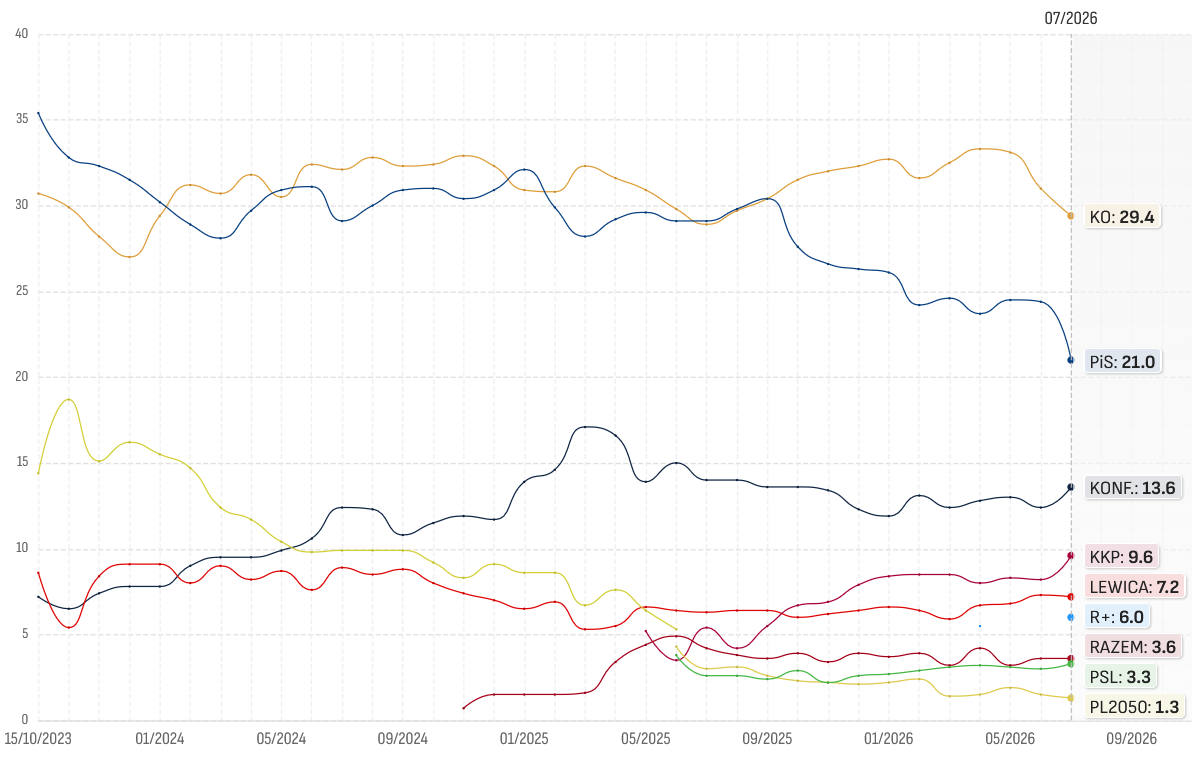
Monthly polling averages for Poland’s main political groups, including the first few polls that contain Morawiecki’s potential party (labelled as “R+”), source: eWybory.eu
It is possible that Morawiecki could do the same in the opposite direction – his new party winning over moderate conservatives while PiS continues to appeal to its most loyal supporters as well as competing with the far right.
There certainly seems to be fertile ground for such a party. Regular polling by the state research agency CBOS shows that the proportion of Poles with a negative view of Tusk’s government rose to its joint-highest level this month, at 48%, while only 29% have a positive view.
The last time that positive views outnumbered negative ones was in February 2024, the second full month of the current ruling coalition’s time in power.
Lipiec przynosi dalszy spadek notowań rządu we wszystkich uwzględnionych w badaniu aspektach.
📙Komunikat "Stosunek do rządu w lipcu"▶️ https://t.co/Oksekkxx0a#rząd #tusk #gospodarka pic.twitter.com/fu8xT487Qb
— CBOS (@CBOS_Info) July 17, 2026
Among those who voted for Tusk and his allies in 2023, dissatisfaction is strongest among moderate conservatives. Both Tusk’s centrist KO and one of his coalition partners, The Left (Lewica), are polling only slightly below the proportion of votes they received in that year (30.7% and 8.6%, respectively).
However, the most conservative part of the coalition, the centre-right Third Way (Trzecia Droga) alliance, has fallen from 14.4% of the vote in 2023 to only around 4-5% today for the two parties that constituted it, Poland 2050 (Polska 2050) and the Polish People’s Party (PSL) (which last year decided to go their separate ways).
An IBRiS poll for Polsat News in April this year found that, whereas 84% of KO voters and 57.1% of Left voters have a positive view of Tusk’s government, that figure falls to 42.5% for Third Way voters, a majority of whom (51.6%) have a negative opinion.
PSL and Poland 2050, the two parties that make up the Third Way alliance, have confirmed that they are splitting and will stand separately at the next elections.
They will, however, remain part of @donaldtusk's ruling coalition https://t.co/NduEJY25eE
— Notes from Poland 🇵🇱 (@notesfrompoland) June 18, 2025
Moderate conservatives’ disillusionment with the government, combined with PiS’s shift away from the centre ground, gives a clear opportunity for Morawiecki. And Tusk’s coalition itself showed in 2023 the advantages for the opposition in offering a broader set of options.
While some – in KO in particular – had pushed for centrist and left-wing parties to stand jointly on a single list at that year’s elections, instead they campaigned as three main blocs. That gave voters opposed to the PiS government a genuine choice, and likely played a big part in the record turnout that helped bring Tusk’s coalition to power.
It is similarly possible now that a four-branched opposition, ranging from Morawiecki on the centre right, through PiS and Confederation, to Braun on the radical right, could together win a parliamentary majority.
Polls currently show those four groups with combined support of around 50% (though polling regarding support for Morawiecki’s prospective party should for now be treated with caution).
Jestem dumny z tego, co wspólnie zrobiliśmy dla Polski. I wiem jedno – nasza misja wciąż trwa💪🇵🇱#RozwojPlus pic.twitter.com/xOnxKDoroS
— Mateusz Morawiecki (@MorawieckiM) July 31, 2026
However, even if they do win a majority, it is far from certain what would happen then.
In 2023, the three opposition blocs were, although standing separately, clearly aligned with one another and focused on removing PiS from power. When they together won a parliamentary majority, it was absolutely clear they would form a coalition government.
By contrast, today’s opposition is deeply divided. Confederation and KKP regularly attack PiS. It is not at all clear that Confederation would be willing to form a coalition government with PiS, while Kaczyński has explicitly ruled out working with the pro-Russian, anti-American Braun.
Meanwhile, Morawiecki’s split has followed months of bitter infighting within PiS, which has often been carried out in public. The manner in which he and his allies are now departing the party means that relations with PiS are likely to remain difficult.
The national-conservative opposition PiS party's newly named candidate for prime minister has made overtures to the far-right Confederation.
But he also ruled out Grzegorz Braun, an even more radical far-right figure, serving in a PiS-led government https://t.co/i3zOZJWdUN
— Notes from Poland 🇵🇱 (@notesfrompoland) March 9, 2026
It would therefore be hard for the opposition to form a government, even if they do win a majority. In this situation, the role of President Karol Nawrocki may be vital.
Though elected with the support of PiS last year, he was technically an independent and maintained good relations with Confederation and even, to some extent, Braun (who endorsed Nawrocki after being eliminated in the first round).
When Morawiecki this week announced the “ten pillars” of Development Plus’s programme, he made clear his loyalty to Nawrocki: the second of those pillars is “respect for the president”.
Nie ma silnej Polski bez wielkich ambicji. Nie ma wielkich ambicji bez ludzi, którzy je zdefiniują i będą gotowi wziąć odpowiedzialność za ich realizację.
Bezpieczeństwo. Rozwój. Suwerenność. Ambicja. Tożsamość. Patriotyzm. To nie hasła wyborcze, ale fundamenty państwa, które… pic.twitter.com/G0YBbfhLye
— Mateusz Morawiecki (@MorawieckiM) July 28, 2026
Many on the right hope that Nawrocki can play a role next year in helping the opposition present a more united front during the election campaign.
It is also the president who decides who gets the opportunity to try to form a government after the elections. That role would be of particular significance if, as is very possible, Tusk’s KO emerges as the biggest individual party but the opposition together may be able to form a parliamentary majority.
Given that we are still over 14 months away from the elections, and Morawiecki has not even yet officially split from PiS, it is still far too early to make confident predictions.
However, while Morawiecki’s likely departure is clearly a personal blow to Kaczyński – and a sign of the 77-year-old’s waning influence over not only the Polish right but even his own party – it may conversely provide a boost to the opposition as a whole.
Notes from Poland is run by a small editorial team and published by an independent, non-profit foundation that is funded through donations from our readers. We cannot do what we do without your support.
Main image credit: Slawomir Kaminski / Agencja Wyborcza.pl

Daniel Tilles is editor-in-chief of Notes from Poland. He has written on Polish affairs for a wide range of publications, including Foreign Policy, POLITICO Europe, EUobserver and Dziennik Gazeta Prawna.