Keep our news free from ads and paywalls by making a donation to support our work!

Notes from Poland is run by a small editorial team and is published by an independent, non-profit foundation that is funded through donations from our readers. We cannot do what we do without your support.
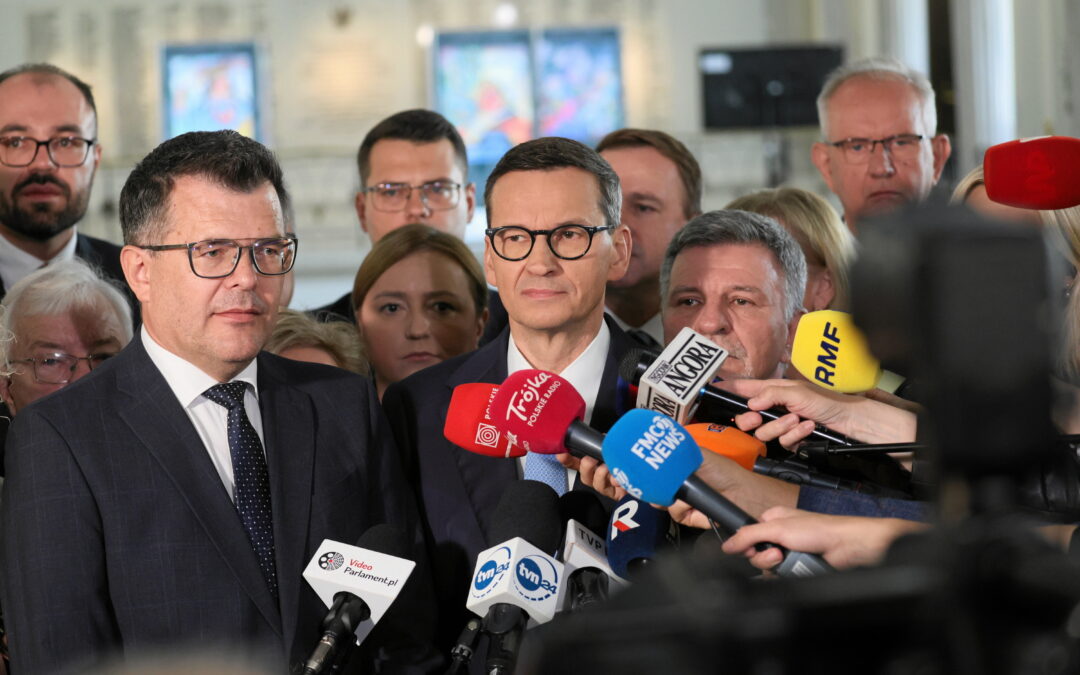
Former Polish Prime Minister Mateusz Morawiecki says that 40 MPs and one senator aligned with him will form their own parliamentary group, deepening a split in the opposition national-conservative Law and Justice (PiS) after a dispute over party direction and loyalty declarations.
The move marks the most serious internal challenge in years to PiS, which ruled Poland from 2015 to 2023, and follows months of tensions between Morawiecki’s more moderate faction and those who have pushed the group in a hard-right direction.
Once formally established, Morawiecki’s caucus would become the third-largest bloc in the Sejm, Poland’s lower house of parliament. Meanwhile, PiS’s caucus will no longer be the biggest.
Powstanie klub parlamentarny „Rozwój Plus”. Morawiecki zdecydował#PAPInformacjehttps://t.co/IftRdgpIPw
— Polska Agencja Prasowa/Polish Press Agency (PAP) (@PAPinformacje) July 29, 2026
One of Morawiecki’s allies, Marcin Horała, told reporters that the creation of the caucus did not mean they were leaving PiS, but “simply setting up a parliamentary group so that we can get on with our work”. He noted, however, that PiS’s parliamentary group “has stopped treating us as its members”.
Morawiecki, meanwhile, said that his group remained ready to cooperate with PiS as a “second lung” of the party’s broader political camp, but suggested that the party was moving in a different direction.
He said that parts of PiS’s messaging were increasingly influenced by “dissidents and schemers” as well as hardline factions, including Sovereign Poland (Suwerenna Polska), a former coalition partner to PiS that merged into the party in 2024.
Reacting to Morawiecki’s announcement, party chairman Jarosław Kaczyński said the former prime minister had carried out a planned split of the party despite his efforts to reach a deal.
“Until the end I made efforts to reach an agreement; unfortunately, Mateusz Morawiecki clearly had his own political plan in mind, carried out on the basis of a split in PiS,” Kaczyński wrote on X.
The announcement follows a dispute that began after Morawiecki launched his Development Plus (Rozwój Plus) association in April. The former prime minister insisted the association was intended to complement PiS with a pro-development agenda rather than rival it.
However, critics within PiS viewed it as an attempt by Morawiecki to build an alternative power base that could eventually evolve into a separate party ahead of the 2027 parliamentary election.
Seeking to end the standoff, the party ordered PiS lawmakers to resign from all outside political associations by last Thursday, or face “consequences” including “the loss of membership in PiS”.
On Friday, Kaczyński said that “30-something MPs” had failed to comply and had therefore effectively resigned from the party, adding that Tuesday’s meeting of the party’s political committee would simply confirm this fact.
Poland's right-wing opposition PiS party is set to split after a more moderate faction of over 30 MPs loyal to deputy leader @MorawieckiM refused to sign a loyalty pledge demanded by leader @OficjalnyJK, who says that means they have effectively resigned https://t.co/TuqYpGI5ak
— Notes from Poland 🇵🇱 (@notesfrompoland) July 24, 2026
On Tuesday, the party announced that instead, the committee had referred the cases of 44 members, who either failed to submit the required declarations or submitted them on the wrong form, to the party’s disciplinary officer for individual review, delaying a final decision.
“From a formal and legal perspective, Mr Mateusz Morawiecki has not yet been removed from the list of members,” PiS spokesman Rafał Bochenek said on Tuesday.
PiS disciplinary officer Karol Karski told the Polish Press Agency (PAP) he would examine each case individually.
“I am open to speaking with each of them so they can present their positions,” Karski said. “At this point, I can initiate proceedings against the individual in question, refer the case to a peer disciplinary tribunal with a motion for punishment – this could include a temporary suspension or expulsion from PiS.”
Support for PiS has fallen to its lowest in 14 years, as the party grapples with internal division, the rise of far-right challengers, living in President Nawrocki's shadow, and the unpopularity in Poland of PiS ally Donald Trump, writes @danieltilles1 https://t.co/QRScBpEQQG
— Notes from Poland 🇵🇱 (@notesfrompoland) March 2, 2026
PiS has for the last two decades been the dominant force on the Polish right, including periods leading governments in 2005-2007 and 2015-2023. However, since losing power at elections in 2023, when the party won 35% of the vote, the party has seen its average support in polls fall to around 23-24%, the lowest level in 14 years.
Meanwhile, it has been challenged by the rise of the far right, where two parties, Confederation (Konfederacja) and Confederation of the Polish Crown (KKP), now together poll at a similar combined level of support to PiS.
In response, Kaczyński in March named a hardline figure, Przemysław Czarnek, as PiS’s candidate for prime minister in next year’s elections. Czarnek was seen as someone who could appeal to far-right voters, while also potentially working with the far right if a coalition was needed after the elections.
The national-conservative opposition PiS party has named its candidate to be prime minister if it wins next year’s parliamentary elections.
Przemysław Czarnek is a hardline conservative who played a prominent role in PiS's campaign against "LGBT ideology" https://t.co/sSJLON00hW
— Notes from Poland 🇵🇱 (@notesfrompoland) March 7, 2026
However, there has been no rise in support for PiS since Czarnek was named, prompting growing concern from more moderate figures within the party, led by Morawiecki.
They argue that PiS has wrongly disowned many of the successes of its time in office before 2023, and they fear that its rightward shift damages its chances of winning over more centrist voters.
Adam Szłapka, the spokesman of the current more liberal government, said KKP leader Grzegorz Braun was “the ultimate playmaker in this whole game”, who had helped push far-right rhetoric into the political mainstream.
“The worst thing about this whole situation is that Poland’s largest opposition party has, in effect, started to adopt Grzegorz Braun’s agenda from A to Z,” Szłapka told broadcaster TVN24.
Ostatecznym rozgrywającym w całej tej rozgrywce nie jest ani prezes Jarosław Kaczyński, ani Mateusz Morawiecki, tylko Grzegorz Braun – ocenił w #JedenNaJeden w TVN24 rzecznik rządu Adam Szłapka. W rozmowie z @AgataAdamek komentował sytuację w PiS.
Czytaj więcej 💻⤵️… pic.twitter.com/TmJQk7izpG
— tvn24 (@tvn24) July 29, 2026
Notes from Poland is run by a small editorial team and published by an independent, non-profit foundation that is funded through donations from our readers. We cannot do what we do without your support.
Main image credit: Slawomir Kaminski / Agencja Wyborcza

Alicja Ptak is deputy editor-in-chief of Notes from Poland and a multimedia journalist. She has written for Clean Energy Wire and The Times, and she hosts her own podcast, The Warsaw Wire, on Poland’s economy and energy sector. She previously worked for Reuters.