Keep our news free from ads and paywalls by making a donation to support our work!

Notes from Poland is run by a small editorial team and is published by an independent, non-profit foundation that is funded through donations from our readers. We cannot do what we do without your support.
By Daniel Tilles
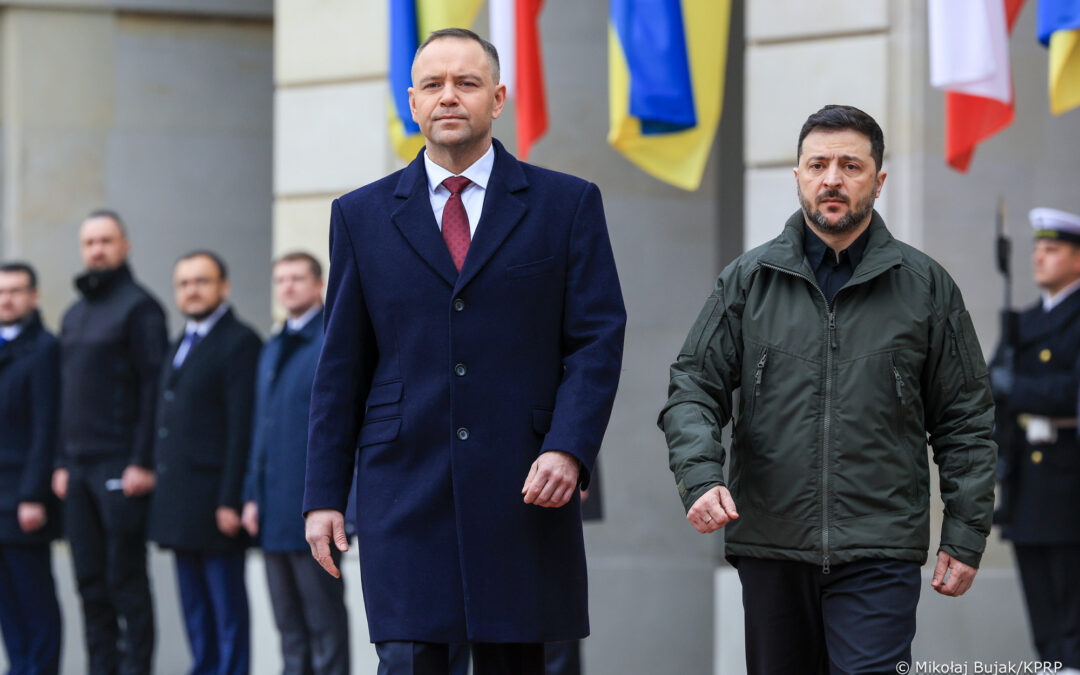
The current diplomatic dispute between Poland and Ukraine, which came to a head on Friday when Polish President Karol Nawrocki stripped Volodymyr Zelensky of Poland’s highest honour, has been a long time coming.
While Poland has been a strong supporter of Ukraine in its defence against Russian aggression, unresolved questions around the Volhynia massacres – in which Ukrainian nationalists killed tens of thousands of ethnic Polish civilians in World War Two – have always overshadowed their relationship and frequently caused tensions.
Poland regards the slaughter, whose victims were mainly women and children and which was carried out with extreme brutality, as a genocide. Ukraine rejects that label and also continues to honour many of the leaders and groups responsible for the massacres due to their role in fighting against Moscow-backed Soviet rule.
Polish President Nawrocki has announced that he will strip @ZelenskyyUa of Poland’s highest honour in response to him naming a military unit after a group that massacred Poles during WWII
Ukraine's foreign minister condemned Nawrocki's "reckless" decision https://t.co/CEqj4aaHYg
— Notes from Poland 🇵🇱 (@notesfrompoland) June 19, 2026
In 2024, a deputy prime minister in Poland’s current government – which represents the more liberal side of Polish politics – said that Poland would not permit Ukraine to join the European Union until it “resolves” the issue of Volhynia.
“We want Ukraine to develop, but we cannot leave unattended a wound that has not healed,” said Władysław Kosiniak-Kamysz.
The following year, while campaigning for the presidency, Nawrocki – who is aligned with the right-wing opposition – likewise said that he “does not envision Ukraine in either the EU or NATO until important civilisational issues for Poland are resolved”.
“A country that is not able to account for a very brutal crime against 120,000 of its neighbours cannot be part of international alliances,” added Nawrocki.
As we are seeing now, these were not idle threats.
Poland will not allow Ukraine to join the EU until the issue of the Volhynia massacres in WWII is "resolved", says the Polish deputy PM
The massacres, in which Ukrainian nationalists killed ethnic Poles, have long caused tensions between the two countries https://t.co/cPEArLdvDL
— Notes from Poland 🇵🇱 (@notesfrompoland) July 24, 2024
For its part, Ukraine last year condemned Poland’s move to establish a remembrance day for “victims of the genocide”, saying that it “flies in the face of good neighbourly relations”.
It also criticised a law proposed by Nawrocki criminalising the promotion of ideologies associated with Second World War Ukrainian nationalist groups. Kyiv warned of “retaliatory measures” if it was introduced.
It should be noted that, alongside such tensions, there have been efforts at reconciliation. When Zelensky and Nawrocki’s predecessor, Andrzej Duda, jointly attended a commemoration of the anniversary of the Volhynia massacres, it was a powerful symbolic moment.
Another breakthrough came last year, when Kyiv permitted exhumations of the remains of massacre victims on its territory to resume after an eight-year ban.
In an important symbolic moment, the presidents of Ukraine and Poland have jointly marked the anniversary of the WWII Volhynia massacres, in which Ukrainians killed up to 100,000 Poles.
The issue has often caused tension between two otherwise close allies https://t.co/nwJOJU6A6y
— Notes from Poland 🇵🇱 (@notesfrompoland) July 9, 2023
However, such gestures have failed to address the underlying issue, which is fundamentally different – and deeply conflicting – national narratives regarding this period of history. This was on clear display earlier this year during a dispute between Poland and Ukraine’s state historical bodies.
In February, the head of the Ukrainian Institute of National Remembrance (UINR), Oleksandr Alfyorov, called “the Volhynia tragedy one of Poland’s state myths”. He then corrected himself, saying it was “not a myth, but one of the key elements of the Polish grand narrative”. By contrast, “for most Ukrainians, this is just a local episode of history”.
In response, Poland’s own Institute of National Remembrance (IPN) called Alfyorov’s comments “outrageous”, declaring that “the Volhynia genocide is a documented fact” and that the “murder of over 100,000 Polish citizens – mostly women, children and the elderly – is not an ‘episode’”.
It also criticised the fact that “the contemporary Ukrainian state builds elements of its identity on the cult of individuals and organisations responsible for these crimes”.
Given those unresolved differences, the issue was always a ticking bomb, waiting to explode if either side made a particularly controversial move.
The likelihood of this happening has increased as the Polish-Ukrainian relationship has frayed: in Poland, there is growing anti-Ukrainian rhetoric from right-wing politicians and declining sympathy among the general public; for Kyiv, Poland is no longer a major supplier of equipment and aid, as it was in the early stages of the war.
The initial blame for the spat that emerged this month rests with Zelensky, through his decision in late May to name a military unit after the Ukrainian Insurgent Army (UPA), which led the Volhynia massacres. The Ukrainian side said that he did so in response to a request from the soldiers themselves.
However, given how important and sensitive this issue is for Poland (whose leaders regularly raise it during bilateral talks, including when Nawrocki met Zelensky in December), the Ukrainian president and his advisors should have been aware his decision would cause anger. Indeed, in an interview on Sunday, Zelensky revealed that, at their first meeting, Nawrocki’s welcome gift for him was a book about the Volhynia massacres.
Ukraine's @ZelenskyyUa says that he "feels very positive" after meeting Poland's @NawrockiKn for the first time
Nawrocki said that Zelensky's visit to Warsaw was “a sign that we are together” and was “bad news for Moscow”, their common enemy https://t.co/WxuJpQRxKd
— Notes from Poland 🇵🇱 (@notesfrompoland) December 19, 2025
After Zelensky had sparked Polish anger by naming the unit after the UPA, the Ukrainian side then had almost three weeks in which it claimed to be seeking a diplomatic solution. However, those talks failed to yield any compromise.
Of course, Ukraine has every right to name its military units however it wants. But it must also accept that other countries have the right to be offended by its decisions and respond accordingly.
And to be clear, the decision was offensive. The UPA was responsible for a brutal campaign of ethnic cleansing against civilians. Ukraine’s response to Poland’s anger has not involved denying this, but instead trying to relativise the UPA’s actions.
It points, for example, to earlier anti-Ukrainian actions by the interwar Polish state. However, while these provide important context (of which Poles should be more aware and sensitive), they are not comparable to and do not justify the slaughter.
Ukrainians also note that Polish partisan units killed thousands of Ukrainians during the war. But those actions were on a much smaller scale and were largely retaliatory, in response to the slaughter of Poles, rather than being part of a deliberate, planned and coordinated ethnic-cleansing operation. That does not mean they were acceptable; but, again, they are not the same as the UPA’s actions.
Timothy Snyder in the very same interview:
"I'll repeat: this was a mistake on the Ukrainian side […] The problem is not only that it offends many Poles. More importantly, the current war should not be linked to World War II or to the UPA [Ukrainian Insurgent Army] That is the… https://t.co/o2d5SeOGVd
— Daniel Szeligowski (@dszeligowski) June 21, 2026
Yet while the crisis was triggered by Zelensky, it was radically escalated by Nawrocki when he announced, speaking to the media on the sidelines of a public event, that he would move to strip the Ukrainian president of the Order of the White Eagle.
Among the roughly 1,500 people to receive the award, only one has previously had it withdrawn – an interwar Polish politician convicted on trumped-up charges of plotting a coup – and in his case it was eventually restored.
Among those who have not had the order rescinded are fascist leader Benito Mussolini; Russian Empress Catherine the Great, who orchestrated the carving up of Poland in the late 18th century; and former German Chancellor Gerhard Schröder, a Putin ally.
Nawrocki’s announcement was, therefore, a major escalation of the dispute. And, after it became clear there would be no diplomatic solution, the Polish president had left himself little choice other than to follow through on his threat.
An opinion poll published on the day he announced his decision showed that 51% of Poles supported rescinding Zelensky’s honour, while only 36% were opposed. Among opposition voters (i.e. Nawrocki’s support base), 80% favoured withdrawing the order.
#Sondaż: Większość Polaków chce odebrać Zełenskiemu Order Orła Białego. Wyraźny podział politycznyhttps://t.co/qFWsALo3WK
— Rzeczpospolita (@rzeczpospolita) June 19, 2026
The only surprise was that Nawrocki did not, as many had expected him to do, wait until after the upcoming Ukraine Recovery Conference (URC) in Poland before announcing his decision.
Zelensky is supposed to be attending that event, which begins on Thursday this week. Indeed, Ukraine is the co-host of the conference alongside Poland. It now seems hard to imagine the Ukrainian president participating. Even if he does, his presence will be overshadowed by the diplomatic dispute.
And the fallout may have wider and longer-term consequences. Polish companies had hoped that URC would be a vehicle for winning a role in the postwar reconstruction of Ukraine. That now looks much harder.
Prime Minister Donald Tusk has been pushing for Poland to play a central role in the peace process, having been angered by France, the UK and Germany excluding other European countries. That, too, now looks much harder.
However, Tusk, who is an ardent domestic opponent of Nawrocki, will also seek to minimise the damage. While he and his government criticised Zelensky’s decision, they argued against stripping him of the order, warning that a Polish-Ukrainian dispute only benefits Russia.
The conflict between Poland and Ukraine's presidents is a "strategic mistake that will cost both sides", warns Polish Prime Minister @donaldtusk.
"In conversations with my European partners, I am trying to minimise the losses and reduce the tension" https://t.co/G9z5YZR8qr
— Notes from Poland 🇵🇱 (@notesfrompoland) June 21, 2026
In the longer term, the dispute could impact on Ukraine’s desired accession to the EU, something that cannot happen without the consent of every other member state. As noted above, both sides of Poland’s otherwise bitter political divide have indicated that they would not allow this to happen until Kyiv “resolves” historical issues.
It has always been unclear what exactly this would involve. Allowing exhumations was a big part of it. But it also seems likely that Poland would want a clear acknowledgement from the highest levels in Ukraine of the scale and nature of the massacres, as well as who carried them out.
Achieving that would always have been a challenge. Now, Zelensky’s unwillingness to even remove the UPA name from a military unit, compounded by Nawrocki’s escalation of the dispute, makes it even harder to imagine finding an acceptable compromise.
Notes from Poland is run by a small editorial team and published by an independent, non-profit foundation that is funded through donations from our readers. We cannot do what we do without your support.
Main image credit: Mikołaj Bujak/KPRP

Daniel Tilles is editor-in-chief of Notes from Poland. He has written on Polish affairs for a wide range of publications, including Foreign Policy, POLITICO Europe, EUobserver and Dziennik Gazeta Prawna.