Keep our news free from ads and paywalls by making a donation to support our work!

Notes from Poland is run by a small editorial team and is published by an independent, non-profit foundation that is funded through donations from our readers. We cannot do what we do without your support.
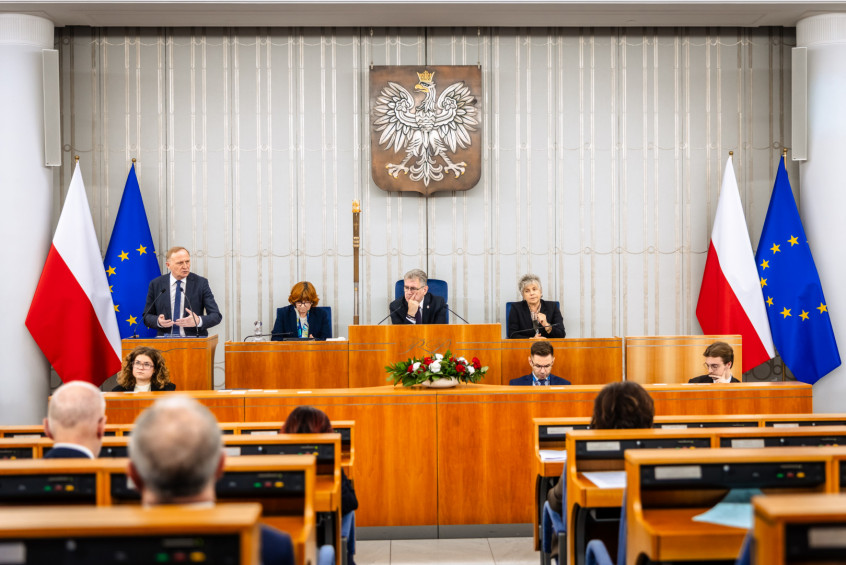
The government’s majority in the Senate has rejected opposition-aligned President Karol Nawrocki’s proposal to hold a national referendum on whether Poland should continue implementing the European Union’s climate policies, which he argues are too expensive.
Senators from the ruling coalition, however, dismissed the president’s proposed referendum question as “absurd” and the entire initiative as a political stunt intended to “destabilise the country and polarise society”.
Senat nie wyraził zgody na przeprowadzenie ogólnokrajowego referendum zaproponowanego przez prezydenta RP.
🟢Za: 32
🔴Przeciw: 62
⚪️Wstrzymało się: 1
Pytanie, jakie prezydent chciał zadać w referendum, brzmiało: „Czy jest Pan/Pani za realizacją polityki klimatycznej, która…— Senat RP 🇵🇱 (@PolskiSenat) May 20, 2026
Earlier this month, Nawrocki, a conservative Eurosceptic, announced that he had submitted a request to the Senate to hold a referendum, which would take place on 27 September and ask Poles the question:
“Are you in favour of implementing EU climate policy, which has led to an increase in citizens’ cost of living, energy prices and the cost of running business and agricultural activity?”
The president emphasised that his initiative was not intended to oppose environmental protection in general, nor Poland’s membership of the EU. Rather, he wants to “support the right of Poles to decide on the pace of change, its scope and the costs they incur”.
He argued that EU policies such as its flagship Green Deal and the Emissions Trading System (ETS) “mean higher energy prices, a decline in economic competitiveness and a reduction in agricultural production”.
The president has launched an initiative to call a referendum on whether Poland should continue implementing EU climate policies, which he argues incur excessive costs.
However, the idea is likely to be rejected by the government's majority in the Senate https://t.co/nLsLTR0b2k
— Notes from Poland 🇵🇱 (@notesfrompoland) May 7, 2026
Poland’s constitution grants the president the right to call a referendum. However, for him to do so, the proposal must receive the support of a majority of members of the Senate, the upper house of parliament, in a vote conducted with at least half of all senators present.
Given that the more liberal, pro-EU coalition of Prime Minister Donald Tusk has 63 members of the 100-seat Senate, it was always unlikely that Nawrocki’s initiative would be approved. And on Wednesday, the Senate indeed voted by a 62-32 majority, with one abstention and five senators absent, to reject the referendum proposal.
“You can debate climate policy, the costs of transformation or energy security,” said Senator Waldy Dzikowski, from Tusk’s centrist Civic Coalition (KO) party. “But the state cannot write a referendum question in such a way that its content suggests to citizens the only ‘correct’ answer.”
“This is not the standard of democracy; it is a political campaign financed by the authority of the state,” he added, quoted by news website Interia.
Senator Władysław Komarnicki, also of KO, likewise called the question “absurd” and said the whole initiative was intended to “destabilise the country, polarise society, introduce legal chaos and remove the current government”, reports news website Onet.
However, the ruling coalition’s position was criticised by Senator Aleksander Szwed of the national-conservative opposition Law and Justice (PiS) party, who said it was “proof that the current government trusts officials in Brussels more than its own citizens”.
The head of Nawrocki’s cabinet, Paweł Szefernaker, wrote after the Senate’s decision that the majority had “voted against the right of Poles to have their say on bills, jobs and the future of our economy”.
Meanwhile, the president’s chief foreign-policy aide, Marcin Przydacz, told broadcaster Republika that Nawrocki would “not abandon this issue” and has a “plan B” prepared that will be “revealed in due course”.
Thousands joined a protest in Warsaw against EU green policies organised by the Solidarity trade union.
The march, at which many anti-government banners were visible, was supported by the right-wing opposition and opposition-aligned President Nawrocki https://t.co/fnSLytRutW
— Notes from Poland 🇵🇱 (@notesfrompoland) May 20, 2026
During his campaign for the presidency last year, Nawrocki regularly criticised EU climate policies and supported Poland’s continued reliance on coal, which generates over half of electricity, by far the highest proportion in Europe.
The issue has recently returned to the political agenda, after the national-conservative opposition Law and Justice (PiS) party, which supported Nawrocki’s presidential candidacy, in March demanded that Poland unilaterally withdraw from the ETS.
However, the government notes that, as the ETS is part of EU law, failing to comply with the system would mean Poland facing large fines. The only other way to avoid it would be to leave the EU entirely, something the government accuses PiS and Nawrocki of wanting to happen.
Instead, the government says it is lobbying the EU and other member states to soften climate policies. It has claimed success in recent weeks, with some changes to the ETS already announced and others due to be unveiled later this year.
Poland's right-wing opposition wants to withdraw from the EU Emissions Trading System, saying it makes Poles "a cash machine for absurd leftist climate policies"@PStrzalkowski explains what costs ETS really brings, and what prospects there are for reform https://t.co/UxpMWpG1pE
— Notes from Poland 🇵🇱 (@notesfrompoland) May 4, 2026
Poland has among the highest electricity prices in the EU when adjusted for cost of living. However, analysts note that, while EU climate policies do contribute in part to those costs, a variety of other factors are also involved.
Poland’s coal supplies are among the most expensive in the world to extract, with billions of zloty spent annually in state subsidies to support unprofitable mining operations.
The country’s reliance on fossil fuels has also increased its exposure to external energy shocks, including those triggered by the wars in Ukraine and the Middle East.
Another factor in high prices is that Poland’s relative share of taxes in electricity prices is the second-highest in the EU, just above 40%, behind only Denmark (47.7%). Across the EU as a whole, taxes and fees accounted for 27.6% of electricity bills in the first half of 2025.
Poland has recorded the EU's third-fastest rise in household electricity prices this year.
The country now also has the bloc’s second-most-expensive electricity, when taking cost of living into account https://t.co/WNLdCfOP16
— Notes from Poland 🇵🇱 (@notesfrompoland) October 30, 2025
Notes from Poland is run by a small editorial team and published by an independent, non-profit foundation that is funded through donations from our readers. We cannot do what we do without your support.
Main image credit: Hubert Pielas/Kancelaria Senatu (under CC BY-SA 4.0)

Daniel Tilles is editor-in-chief of Notes from Poland. He has written on Polish affairs for a wide range of publications, including Foreign Policy, POLITICO Europe, EUobserver and Dziennik Gazeta Prawna.