Keep our news free from ads and paywalls by making a donation to support our work!

Notes from Poland is run by a small editorial team and is published by an independent, non-profit foundation that is funded through donations from our readers. We cannot do what we do without your support.
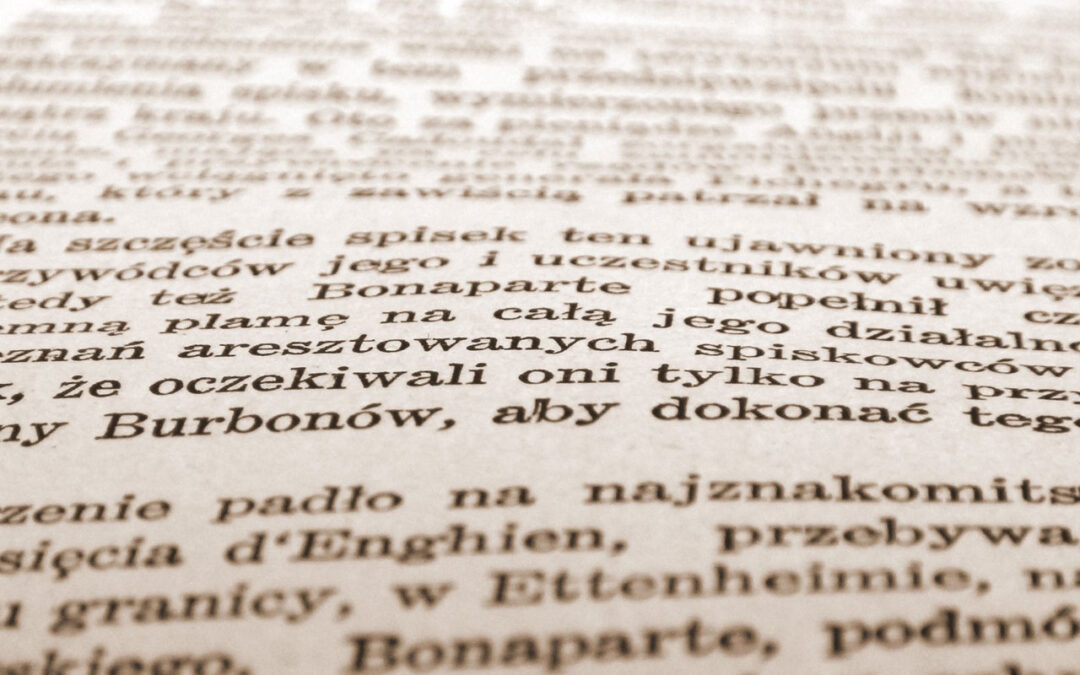
A series of changes to the official spelling of words has come into effect in Poland at the start of 2026, marking the biggest orthographic shakeup to the Polish language since 1936.
The Council for the Polish Language (RJP), which regulates the correct use of Polish, says that the reforms will help to simplify and standardise spelling, eliminating exceptions and reducing errors.
The reforms relate in particular to the use of capital letters for names of places and groups of people, while others relate to the often-thorny issue of whether compound words should be written together or separately.
Among the changes are:
- Demonyms referring to people from cities or districts should now be spelt with a capital letter, as those referring to nationalities already are – e.g. “Krakowianin” (Cracovian)
- Either lower case or upper case may be used for what the RJP calls “unofficial ethnic names” (some of which are used pejoratively), such as “Angol”/“angol” to refer to an Englishman (who should properly be called “Anglik”) or “Żabojad”/“żabojad” (literally “frog-eater”) for a Frenchman (who should properly be called “Francuz”)
- Brand names should be spelt with a capital letter also when referring to an individual specimen, e.g. “Zaparkował czerwony Ford” (“He parked a red Ford”)
- The prefix “pół-” (semi-) should be combined with the rest of the word in compounds like “półżartem” (half-joking)
- The prefix “nie-” (un-, non-, not) should always be combined with adjectives and adverbs, regardless of semantic interpretation – previously writers could opt to write the words separately based on the specific meaning
- Greater use of capital letters:
- in proper nouns denoting geographical names like parks, churches, estates, castles, bridges, squares, avenues, etc. – the exception being the word “ulica” (street), which remains lower case. For example: ulica Józefa Piłsudskiego, Aleja Róż, Brama Warszawska, Plac Zbawiciela, Park Kościuszki
- In the names of prizes, e.g. “Nagroda Nobla” (Nobel Prize)
Od początku nowego roku zaczną obowiązywać nowe zasady pisowni nazw ulic, placów i innych obiektów przestrzeni publicznej. ✍️
Na naszym kanale YouTube czeka już najnowszy odcinek, w którym tłumaczymy te zmiany w prosty i przejrzysty sposób: https://t.co/de0EwNPliD ✅… pic.twitter.com/WGiLgtI04U— Ortografia 2026 (@ortografia2026) November 14, 2025
The reforms, first announced in 2024, came into effect on 1 January 2026. But worried school pupils will have time to adapt, as the previous forms will still be accepted until the end of 2030.
The changes are the biggest introduced to Polish spelling since 1936, when reforms included switching to the use of “i” instead of “j” in many words (e.g. “Maria” instead of “Marja” and “fotografia” instead of “fotografja”)
The RJP says that the new changes “will bring benefits in the form of simplification and standardisation of the spelling of particular groups of words and combinations, elimination of exceptions, and the removal of rules whose application is problematic”.
The council hopes that, by saving writers from so much head-scratching about rules and exceptions, it will bring about “a reduction in the number of linguistic errors and, perhaps, enable writers to focus on aspects of text correctness other than spelling”.
“Look at the inconsistency in spelling when we wrote names of inhabitants of continents, states and regions with a capital letter but the residents of towns and villages in lower case,” said Ewa Kołodziejek, a professor at the University of Szczecin and member of the RJP, quoted by TVP.
“What was the reason for that? We don’t know. But now it is standardised.”
Bartłomiej Rosiak, a linguist from the University of Humanities and Economics in Łódź, believes that the influence of English and a tendency to use upper case may lead to further changes within the next few years.
“Poles love capital letters,” he told news website Onet, noting that many Poles write titles of books with capitals at the start of each word (other than conjunctions) when in fact only the first word should begin with a capital (e.g. the Polish title of Crime and Punishment should be Zbrodnia i kara).
“Many people even like to write song titles in capitals, because that’s what users of English do,” added Rosiak.
The war in Ukraine has led Poles to reconsider how they say "in Ukraine"
There has been a shift away from the traditional "na Ukrainie" (which some think makes a country seem more provincial) and towards "w Ukrainie" (which better emphasises independence) https://t.co/rZjgCDGFFB
— Notes from Poland 🇵🇱 (@notesfrompoland) March 4, 2022
But not everyone is convinced by the changes.
“Many of them are simply following the ignorance and stupidity of users of Polish – ‘to make it easier’”, wrote Łukasz Warzecha, a conservative political commentator, on X.
“The new spelling is supposed to become ‘less stressful’, meaning it’s supposed to be spelling more for idiots who aren’t capable of mastering more complicated rules,” he added, insisting that he did not intend to abide by the new rules.
A sign at a #BlackLivesMatter protest in Warsaw has sparked debate over the word "Murzyn", widely used in Polish to refer to black people but increasingly regarded as offensive.
We asked linguists, members of the black community and others for their views https://t.co/ehcioqcyLf
— Notes from Poland 🇵🇱 (@notesfrompoland) June 12, 2020
Notes from Poland is run by a small editorial team and published by an independent, non-profit foundation that is funded through donations from our readers. We cannot do what we do without your support.
Ben Koschalka is a translator, lecturer, and senior editor at Notes from Poland. Originally from Britain, he has lived in Kraków since 2005.