Keep our news free from ads and paywalls by making a donation to support our work!

Notes from Poland is run by a small editorial team and is published by an independent, non-profit foundation that is funded through donations from our readers. We cannot do what we do without your support.
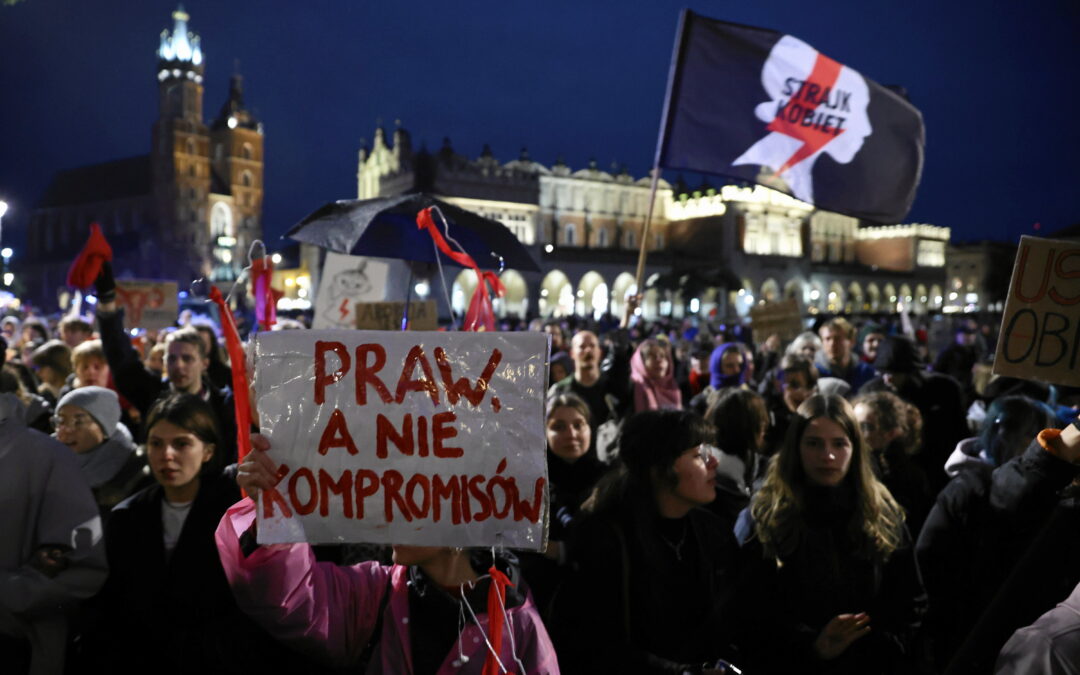
Protests took place in towns and cities around Poland on Thursday evening, demanding that the government fulfil its promise to liberalise the country’s strict abortion laws.
However, the demonstrations, which took place on the sixth anniversary of the Constitutional Tribunal (TK) ruling that introduced a near-total abortion ban, were nowhere near the scale of the massive protests that emerged back in 2020.
Było deszczowo, ale nie brakowało ludzi i emocji. Rzeszów pokazał czerwoną kartkę za aborcję rządzącej koalicji. pic.twitter.com/oJo8BiWXxS
— Paweł Preneta (@pawelpreneta) October 22, 2026
In Warsaw, a few hundred people gathered in the rain outside parliament, reported broadcaster RMF. Many held up red cards, a symbol used by the protesters to warn the government that it could be thrown out of power at next year’s parliamentary elections.
When Prime Minister Donald Tusk’s ruling coalition, which ranges from left to centre right, came to power in December 2023, it pledged to liberalise the abortion laws after eight years of rule by the national-conservative Law and Justice (PiS) party.
In particular, it wanted to reverse the 2020 TK ruling, which outlawed abortions in cases where a severe defect is diagnosed in the foetus. That means abortions can now only take place in two cases: where the pregnancy results from a crime (such as rape or incest) or if it threatens the mother’s life or health.
However, in the almost three years since, the government has failed to introduce any new legislation on abortion. One effort to do so in 2024 collapsed amid disagreements between more conservative and liberal elements of Tusk’s coalition.
Finally, earlier this week, the Sejm, the more powerful lower house of parliament, approved two abortion bills: one that would reverse the 2020 TK ruling; the other that would decriminalise providing help to women in obtaining unlawful abortions.
However, those measures do not go far enough for many of those attending Tuesday’s protests, who are seeking abortion on demand up to the 12th week of pregnancy.
In any case, both bills approved by the Sejm are likely to be blocked by President Karol Nawrocki, who is aligned with the right-wing opposition and has vetoed a record number of government bills. Nawrocki has made his opposition to abortion clear.
Parliament has approved two bills that would liberalise Poland's abortion laws
One would reverse the 2020 constitutional court ruling that introduced a near-total ban on abortion; the other would decriminalise helping women in obtaining unlawful abortions https://t.co/nVj8SQVIsv
— Notes from Poland 🇵🇱 (@notesfrompoland) October 21, 2026
In Wrocław, Poland’s third-largest city, around 1,000 people attended Thursday’s protest, according to police estimates cited by the Gazeta Wyborcza daily. Among the placards and banners was one showing Tusk with an extended, Pinocchio-style nose.
“It’s sad that we have to engage in this fight again,” said one of the organisers. “For so long, they ignored us, only coming when they needed votes. Now let’s show that we can’t be ignored.”
In Katowice, around 300 people gathered, according to the Polish Press Agency (PAP). In Poznań, around 400 or so protesters marched to the local headquarters of Tusk’s centrist Civic Coalition (KO) party, where they placed a symbolic red card and waved banners saying “You deceived Poland”.
Czerwona kartka za aborcje. W #Lodz w proteście w strugach deszczu protestuje kilkadziesiąt osób @RadioZET_NEWS pic.twitter.com/okU7QjnhFw
— Mateusz Szkudlarek (@m_szkudlarek) October 22, 2026
The 2020 TK abortion ruling triggered the largest protests seen in Poland since the communist era, with hundreds of thousands of people taking to the streets. That anger is seen as having played a major role in PiS losing power to Tusk’s coalition in 2023.
Opinion polls consistently show that most Poles want the abortion law to be liberalised, though there remain divisions over whether there should be a return to the pre-2021 status quo or a move even further, to introduce abortion on demand up to the 12th week of pregnancy.
In autumn 2027, parliamentary elections will take place, deciding who governs Poland for the next four years. Opinion polls currently show a fairly even split in support between Tusk’s coalition and the right-wing opposition.
Notes from Poland is run by a small editorial team and published by an independent, non-profit foundation that is funded through donations from our readers. We cannot do what we do without your support.
Main image credit: Jakub Wlodek / Agencja Wyborcza.pl

Daniel Tilles is editor-in-chief of Notes from Poland. He has written on Polish affairs for a wide range of publications, including Foreign Policy, POLITICO Europe, EUobserver and Dziennik Gazeta Prawna.