
Keep our news free from ads and paywalls by making a donation to support our work!

Notes from Poland is run by a small editorial team and is published by an independent, non-profit foundation that is funded through donations from our readers. We cannot do what we do without your support.
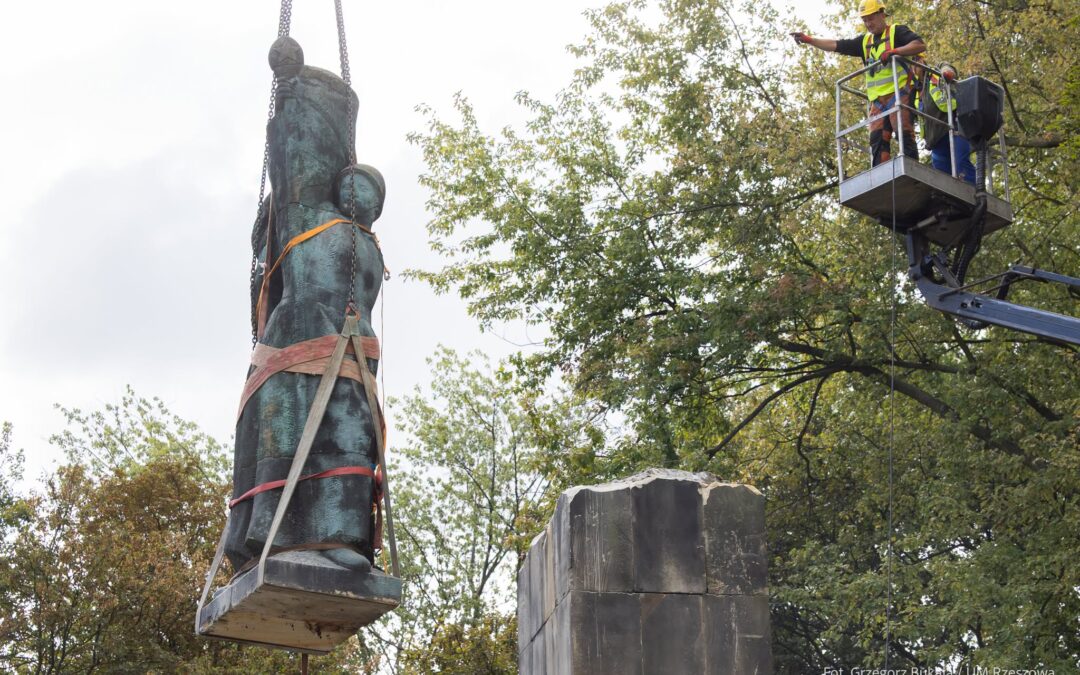
Russia has criticised the removal of a monument in the Polish city of Rzeszów expressing “gratitude” to the Soviet Red Army. It called the move “barbaric” and “sacrilegious”.
The monument – part of which will be moved to a nearby Soviet cemetery and another to a museum – has been the subject of a long-running legal and political battle, amid wider debate in Poland about “decommunising” public spaces, especially in the wake of Russia’s full-scale invasion of Ukraine.
⚡️Komentarz Ambasady Rosji w Polsce
23 września 2026 r. w Rzeszowie (województwo podkarpackie), decyzją władz polskich i z naruszeniem dokumentów rosyjsko-polskich dotyczących ochrony obiektów dziedzictwa memorialnego, rozpoczęto proces demontażu pomnika wdzięczności żołnierzom… pic.twitter.com/HYuNeLG5dy
— Russian Embassy, PL (@rusemb_pl) September 24, 2026
The Monument of Gratitude to the Red Army, standing 8.5 metres tall and weighing 6.6 tons, was erected in Rzeszów, southeast Poland, shortly after the end of World War Two, when the Soviets had pushed Nazi Germany out of Poland and then installed their own communist government.
It is located on Ghetto Victims Square, a public space also created after the war on the grounds of the city’s former Jewish cemetery, which had been destroyed by the German occupiers in 1942.
Poland’s Institute of National Remembrance, a state historical body, notes that the monument was erected just a few metres from where two Polish anti-communist resistance fighters who had been members of the wartime Home Army (AK) had been publicly hanged by the communists.
The monument’s plinth featured bas-relief sculptures depicting Red Army Generals Ivan Konev and Karol Świerczewski, soldiers, and industrial and agricultural workers carrying a hammer and sickle. At the top of the 8.5-metre column was a statue of a woman and child.
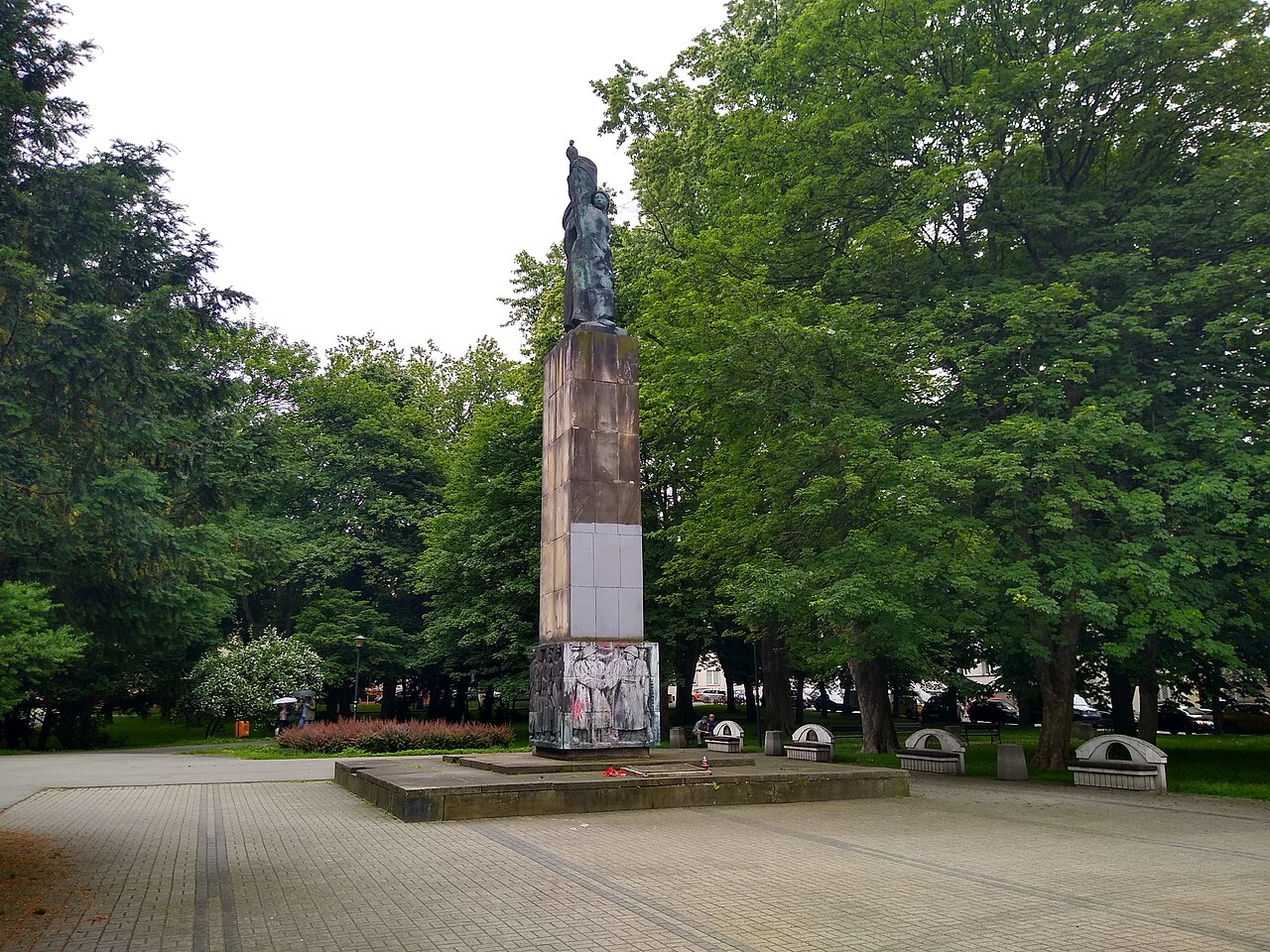
The monument in Rzeszów, before work to dismantle it began (credit: Patryk Duszkiewicz/Wikimedia Commons, under CC BY-SA 4.0)
In 2016, the then-ruling national-conservative Law and Justice (PiS) government introduced a law requiring local authorities to “decommunise” public spaces by removing objects and names that “propagate communism”. That triggered a legal battle in over the monument in Rzeszów.
The government-appointed provincial governor and the Institute of National Remembrance (IPN), a state historical body, moved to have it dismantled, arguing that the monument glorified communism.
But city hall – led by left-wing mayor Tadeusz Ferenc, who had been a member of the communist party before 1989 – challenged the decision. It argued that the monument did not promote communism and noted that its name, referring to gratitude to the Red Army, was not an official one.
In 2019, the provincial administrative court sided with the city and overturned the decision to remove the monument.
However, Russia’s full-scale invasion of Ukraine in February 2022 prompted many Polish municipalities that had not removed Soviet-era monuments to begin doing so.
In April 2022, Rzeszów’s current mayor, Konrad Fijołek, announced that his city’s monument would be removed from its current location and placed in a Soviet soldiers’ cemetery elsewhere in the city.
“In principle, I am not in favor of dismantling or demolishing monuments, as they are a testament to history,” said the mayor. “But in light of the current wartime reality, this monument should not remain in its current location. But we are not barbarians; we will not demolish the monument, but relocate it.”
However, the IPN opposed the idea of relocating the monument and refused to cover the costs of doing so. It wanted it to be liquidated entirely.
Another Soviet memorial has been demolished in Poland – the 43rd since Russia's full-scale invasion of Ukraine.
"We say ‘no’ to Russians who believe these lands somehow belong to their sphere of influence,” declared the Institute of National Remembrance https://t.co/aG9VQVlUQI
— Notes from Poland 🇵🇱 (@notesfrompoland) December 12, 2025
As a result, the city is paying 156,000 zloty (€35,700) for the monument to be removed, reports news website Wirtualna Polska. The bas-reliefs will go to the Soviet cemetery while the statue of mother and child will go to the city’s Museum of Technology and the Military.
Work to remove the monument began this week and is expected to last until November. Once the above-ground section has been removed, a special conservation committee, including a representative of Poland’s Rabbinical Commission for Cemeteries, will determine how to proceed with the monument’s foundation.
The beginning of the removal work prompted anger from Moscow, with the Russian embassy in Warsaw issuing a statement that called it a “sacrilegious step”. It demanded “the immediate cessation of work” and restoration of the monument to its previous state.
“With regret, we must state once again: the barbaric policy of the Polish authorities, consisting of destroying everything that serves as evidence of the invaluable feat of the soldiers and officers of the Red Army in liberating Poland from Nazi occupation, is being continued at an ever faster pace,” they continued.
Russia regards the Soviet Union’s driving of Nazi Germany out of Central and Eastern Europe at the end of World War Two as a “liberation”. However, many in the region reject that term, given that it involved bringing their countries under Soviet domination instead.
In its statement, the Russian embassy also claimed at the actions in Rzeszów are a “violation of Russian-Polish documents concerning the protection of memorial heritage sites”.
Moscow regularly claims that Poland’s removal of Soviet memorials violates a 1994 agreement between the two countries on respect for graves and other places of memory. It did so in August this year, when protesting the demolition of a monument in the town of Pyrzyce.
However, Poland points out that the agreement relates to graves and war cemeteries, not separate monuments and symbols, which can be legally removed.
Russia has criticised the "sacrilegious" demolition of a Soviet monument in Poland, calling it a “flagrant violation” of a bilateral agreement.
But Poland's @ipngovpl says it was a "propaganda object" that had to be removed under a "decommunisation" law https://t.co/73T99ZlPqU
— Notes from Poland 🇵🇱 (@notesfrompoland) August 4, 2026
Rzeszów is also home to one of the famous – or infamous, depending on one’s perspective – communist-era monuments in Poland, the 38-metre-tall Monument to the Revolutionary Struggle. It has become a landmark of the city.
In 2017, the IPN recommended that it be removed under the “decommunisation” law. The owners of the land upon which it sits also wanted to demolish it.
However, mayors Ferenc and Fijołek sought to protect the monument, and their efforts succeeded last year, when it was added to Poland’s list of protected monuments, preventing it from being destroyed.

Notes from Poland is run by a small editorial team and published by an independent, non-profit foundation that is funded through donations from our readers. We cannot do what we do without your support.
Main image credit: Grzegorz Bukała/UM Rzeszowa

Daniel Tilles is editor-in-chief of Notes from Poland. He has written on Polish affairs for a wide range of publications, including Foreign Policy, POLITICO Europe, EUobserver and Dziennik Gazeta Prawna.














.jpg)