Keep our news free from ads and paywalls by making a donation to support our work!

Notes from Poland is run by a small editorial team and is published by an independent, non-profit foundation that is funded through donations from our readers. We cannot do what we do without your support.
The Polish government has launched an information campaign on how to respond in the event of an air strike. It has also announced that 85,000 shelters are to be marked with clear signs across Poland and an evacuation plan is being developed.
The moves come amid growing concerns over Russia strikes in Ukraine near the Polish border. The prime minister and foreign minister have warned that Russia could be planning “something big” this year, without specifying what that might involve.
🟡 KOMUNIKAT | MSWiA publikuje instrukcję reagowania podczas zagrożenia atakiem z powietrza.
📄 Ministerstwo Spraw Wewnętrznych i Administracji udostępnia nową instrukcję postępowania na wypadek ataku z powietrza. To rozwinięcie treści zawartych w „Poradniku Bezpieczeństwa”,… pic.twitter.com/aw3h07mdeF
— MSWiA 🇵🇱 (@MSWiA_GOV_PL) September 25, 2026
On Friday, Poland’s interior ministry published information on how to respond to the threat of an air attack, expanding on a safety handbook sent to all 17 million households in the country earlier this year.
The new guidelines explain where to seek cover during an air raid, how to prepare homes and what to do if an attack occurs while people are at home, at work, outdoors or in a car.
They advise people to seek a shelter point, take a prepared evacuation backpack and any necessary medication, and use only stairs. If reaching a shelter would require spending a long time outdoors, people are advised to remain inside and move to a central room without windows.
Separately, the ministry has prepared guidelines for schools after some were criticised last week for evacuating children outside school buildings during alarms in the eastern province of Lublin.
W całej Polsce mają pojawić się obowiązkowe oznaczenia Punktów Schronienia. Specjalna aplikacja pokaże ich lokalizacje, a nowe oznakowanie ma ułatwić mieszkańcom znalezienie bezpiecznego miejsca w sytuacji zagrożenia.
Materiał 🎥 Michał Niewodowski pic.twitter.com/HVoo3ypETT
— 19.30 TVP (@1930_tvp) September 21, 2026
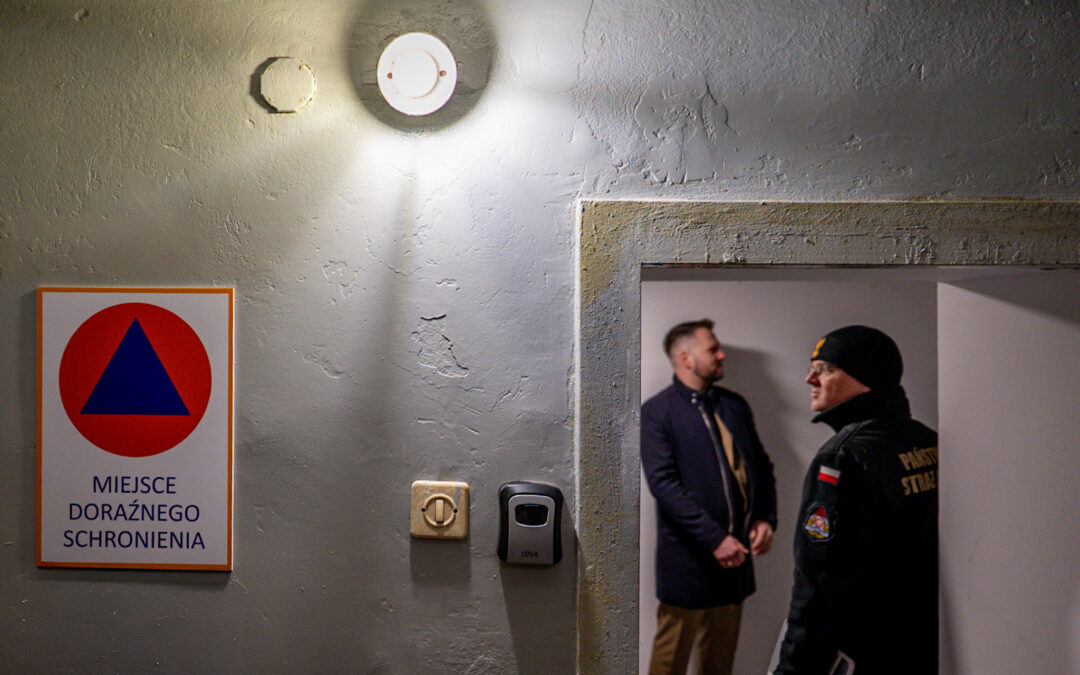
To make shelter points easier to identify, the interior ministry has prepared a draft regulation requiring local authorities and managers of designated sites to mark them clearly by the end of the year with a blue triangle on an orange background, as well as a green sign saying “Punkt schronienia” (“Shelter point”).
The locations can also be found using a mobile application launched last year. According to the ministry’s own data, Poland currently has about 85,000 shelter points, which could host 23.7 million people, or 64% of the country’s population.
A national plan is also being developed to coordinate potential evacuation as a result of war, a threat of war or a natural disaster. The plan is intended to establish evacuation routes and reception areas in advance, including how many people may need to be moved and where they could be accommodated.
“When a threat arises, we warn the Polish people and defend our security. It is only natural that we prepare for worst-case scenarios, while deeply believing that they will never come to pass,” interior minister Marcin Kierwiński told the Rzeczpospolita newspaper.
“Evacuation plans are being prepared…These plans rely heavily on the strength of the entire crisis response system. The more we strengthen that system, the more precise the plans will be,” Kierwiński added.
Poland has launched a mobile application and website that allows people to find their nearest shelter in times of war or other emergencies https://t.co/YE3rsltCj5
— Notes from Poland 🇵🇱 (@notesfrompoland) December 22, 2025
The evacuation plans have become the subject of false claims circulating on social media.
These posts allege that the government is preparing to forcibly displace Poles and ultimately eliminate the Polish nation, with some linking the alleged plan to an agreement between Berlin and Kyiv, reports the Onet news service.
They claim that evacuees would never be allowed to return, allegations the government quickly moved to debunk.
📢 STOP FAKE NEWS!
W sieci krążą fałszywe informacje, jakoby przygotowywany Krajowy Plan Ewakuacji miał oznaczać masowe wysiedlenie mieszkańców Polski ‼️To nieprawda‼️
🔎 FAKT: Krajowy Plan Ewakuacji określa procedury na wypadek wojny, zagrożenia wojną lub klęski żywiołowej.… pic.twitter.com/YNEqXF3StJ
— MSWiA 🇵🇱 (@MSWiA_GOV_PL) September 18, 2026
The measures are part of a broader effort to strengthen Poland’s civil protection system. Last week, Kierwiński said Poland plans to triple the current number of warning sirens in Lublin province to more than 1,000 by the end of 2026.
This follows a series of Russian attacks in western Ukraine, including a drone strike on a passenger train travelling from Kyiv to Warsaw about 2 km from the Polish border.
The recent escalation comes after several incidents in recent years involving violations of Polish airspace, including the entry of around 20 Russian drones on one night last year, as well as the explosion of a Russian missile in a field in eastern Poland earlier this year.
Prime Minister Donald Tusk warned last week that Russia’s further plans could include attacks designed to test NATO’s response. Those warnings were echoed yesterday by Poland’s foreign minister, Radosław Sikorski, who said that multiple sources suggested that “Russia is planning something big this year.”
“I think Putin needs a pretext for mobilisation, so they might carry out a false-flag attack to tell the Russians, ‘We are under attack, and that is why we must mobilise,’” he added.

Notes from Poland is run by a small editorial team and published by an independent, non-profit foundation that is funded through donations from our readers. We cannot do what we do without your support.
Main image credit: Śląski Urząd Wojewódzki w Katowicach (under CC BY-SA 4.0)

Alicja Ptak is deputy editor-in-chief of Notes from Poland and a multimedia journalist. She has written for Clean Energy Wire and The Times, and she hosts her own podcast, The Warsaw Wire, on Poland’s economy and energy sector. She previously worked for Reuters.