Keep our news free from paywalls by making a donation to support our work!

Notes from Poland is run by a small editorial team and is published by an independent, non-profit foundation that is funded through donations from our readers. We cannot do what we do without your support.
President Karol Nawrocki has vetoed a government bill that would have lowered income tax for millions of people earning around or slightly above average salaries, while increasing taxes on large companies and the highest earners.
Nawrocki, who is aligned with the right-wing opposition, argued that the income-tax cut would benefit only a small minority of workers, while the changes to corporate taxes would disproportionately affect Polish businesses, as international corporations could move profits abroad.
The government, however, rejected Nawrocki’s reasoning, accusing the president of siding with large corporations at the expense of ordinary working Poles.
❌ Prezydent RP Karol Nawrocki zawetował ustawę o reformie podatkowej. pic.twitter.com/tvXCVKnTMs
— Kancelaria Prezydenta RP (@prezydentpl) November 27, 2026
The legislation, which was due to come into force in 2027 – an election year – would have adjusted the income tax brackets, including an increase in the earnings threshold at which the lowest rate of income tax is paid and the introduction of a new rate between the lowest and highest earnings brackets.
Currently, there are two income tax brackets: the first taxes earnings of up to 120,000 zloty (around €26,850) at a rate of 12%; the second taxes earnings above that level at a rate of 32%.
There is also a tax-free allowance for earnings of up to 30,000 zloty. Meanwhile, anyone who earns more than 1 million zloty a year pays an additional “solidarity levy” (effectively a third tax bracket) of 4% on income above that amount.
Under the new proposals, the threshold for the first 12% tax bracket would be raised to 130,000 zloty. For earnings between 130,000 and 150,000 zloty, a new tax bracket of 24% would be introduced. Then earnings above 150,000 would be taxed at 32%.
According to the government’s estimates, 3.5 million workers would benefit from the reform. However, Nawrocki said that this means around nine out of every ten taxpayers would not benefit. He also claimed that in practice the reform
“This bill divides citizens. It gives to a few, while taking away from the majority,” said Nawrocki in a video published on social media.
The president also noted that the government had failed to deliver on its promise, made when coming to power in 2023, to double the tax-free income allowance to 60,000 zloty, a change that would have benefited a much broader group of taxpayers, including the lowest earners.
According to figures from Statistics Poland (GUS), a state agency, average monthly earnings at companies employing more than nine people were 9,405.19 zloty in October this year, the equivalent of almost 113,000 zloty a year.
The Polish government has approved a final version of the state budget for 2027, including planned middle-class tax cuts funded by higher rates on the richest.
The budget act and associated legislation still need approval from parliament and the president https://t.co/I2Gz0h6cHd
— Notes from Poland 🇵🇱 (@notesfrompoland) September 29, 2026
To finance the proposed relief, the legislation also included an increase in the corporate income tax (CIT) rate from 19% to 22% for companies and tax groups generating annual revenues above €50 million.
The solidarity levy paid by highest-earners would have also increased to 5%, while the earnings limit for qualifying for a simplified lump-sum tax on gross business revenue – commonly used by professionals such as lawyers, IT specialists and healthcare workers – would be lowered from €2 million a year to €250,000.
Nawrocki criticised the government for making the “entry into force of the tax relief contingent upon the simultaneous implementation of tax hikes.” He said that the higher corporate tax would disproportionately fall on “Polish, growing firms,” while “foreign ones will move their profits to other countries”.
Credit rating agency S&P has revised Poland’s outlook to negative.
It notes that the country has seen "one of the most significant fiscal deteriorations globally", while "political polarisation" and "institutional tensions" make consolidation unlikely https://t.co/2Nix7R6Pjj
— Notes from Poland 🇵🇱 (@notesfrompoland) November 7, 2026
Finance minister Andrzej Domański condemned Nawrocki’s veto, saying that he had taken “the side of large corporations rather than the Polish people”.
“Only the Grinch and the Nawrocki can steal people’s money right before Christmas,” wrote Prime Minister Donald Tusk on social media.
However, Nawrocki’s veto was welcomed by the right-wing opposition. Sławomir Mentzen, a leader of the far-right Confederation (Konfederacja), praised the president for blocking what he described as “another government attempt to harm Polish businesses”.
Mariusz Błaszczak, a deputy leader of the national-conservative Law and Justice, said that his party wanted to raise the second income tax thresshold from 120,000 to 180,000 zloty, but “without introducing any hidden tax increases”.
Weto Prezydenta Nawrockiego pozbawia 3,5 mln Polaków obniżki podatków. To nawet 7200 zł rocznie, które mogły zostać w budżecie ciężko pracujących rodzin.
Prezydent ponownie stanął po stronie wielkich koncernów, a nie po stronie Polaków. Wstyd.
— Andrzej Domański (@Domanski_Andrz) November 27, 2026
According to the government’s own estimates, the bill was expected to generate a net gain of 2.6 billion zloty for the public finance sector in its first year of implementation. Over the following 10 years, the cumulative net gain was projected to reach 50.7 billion zloty.
Nawrocki’s veto could therefore make it more difficult for the government to tackle Poland’s fiscal problems, which have seen public debt rise to record levels on the back of ballooning budget deficits.
Last year’s deficit, at 7.3% of GDP, was the second-highest in the European Union. This year it is forecast to drop slightly, to 6.7%, according to recent finance ministry projections. But next year’s budget foresees a deficit of 7.1%.
The big three global credit rating agencies have all either lowered Poland’s rating or shifted its outlook to negative, citing its recent fiscal deterioration combined with political gridlock between the government and Nawrocki, who has vetoed a record number of bills.
Notes from Poland is run by a small editorial team and published by an independent, non-profit foundation that is funded through donations from our readers. We cannot do what we do without your support.
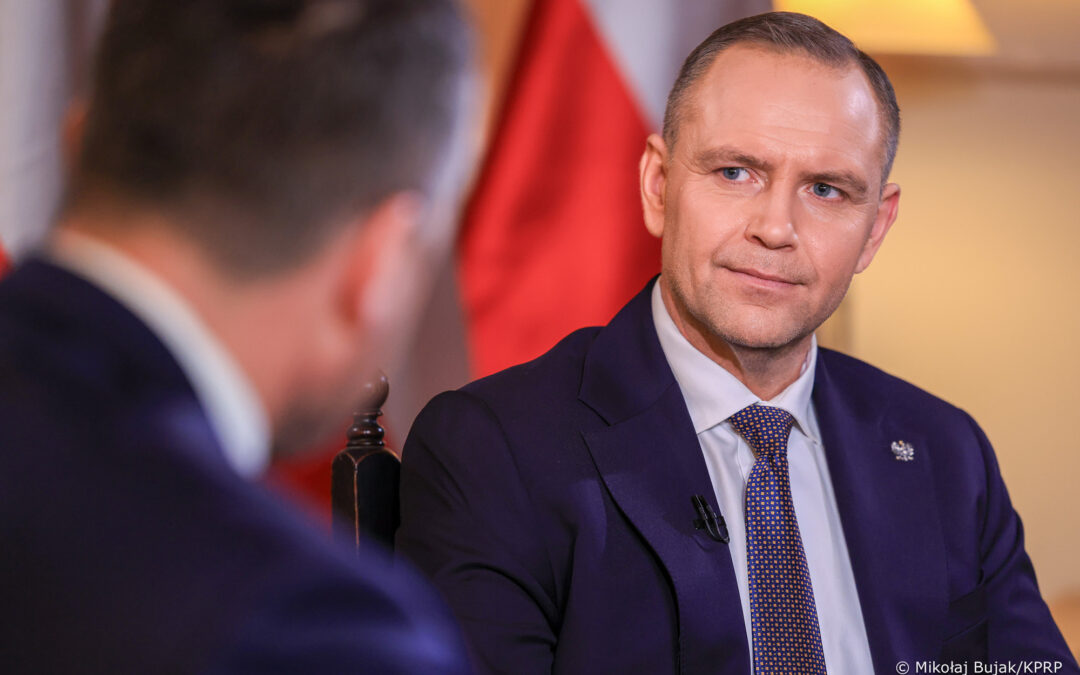
Main image credit: Mikołaj Bujak / KPRP

Alicja Ptak is deputy editor-in-chief of Notes from Poland and a multimedia journalist. She has written for Clean Energy Wire and The Times, and she hosts her own podcast, The Warsaw Wire, on Poland’s economy and energy sector. She previously worked for Reuters.