Keep our news free from paywalls by making a donation to support our work!

Notes from Poland is run by a small editorial team and is published by an independent, non-profit foundation that is funded through donations from our readers. We cannot do what we do without your support.
Poland and the United States have signed an agreement on defence research, development, testing and evaluation, concluding 17 years of negotiations and opening the way for deeper technological cooperation.
The agreement establishes a framework for joint defence projects, as well as the exchange of technical data and expertise, giving Poland – which is already a major importer of US arms – a formal role in the development of American defence technologies for the first time.
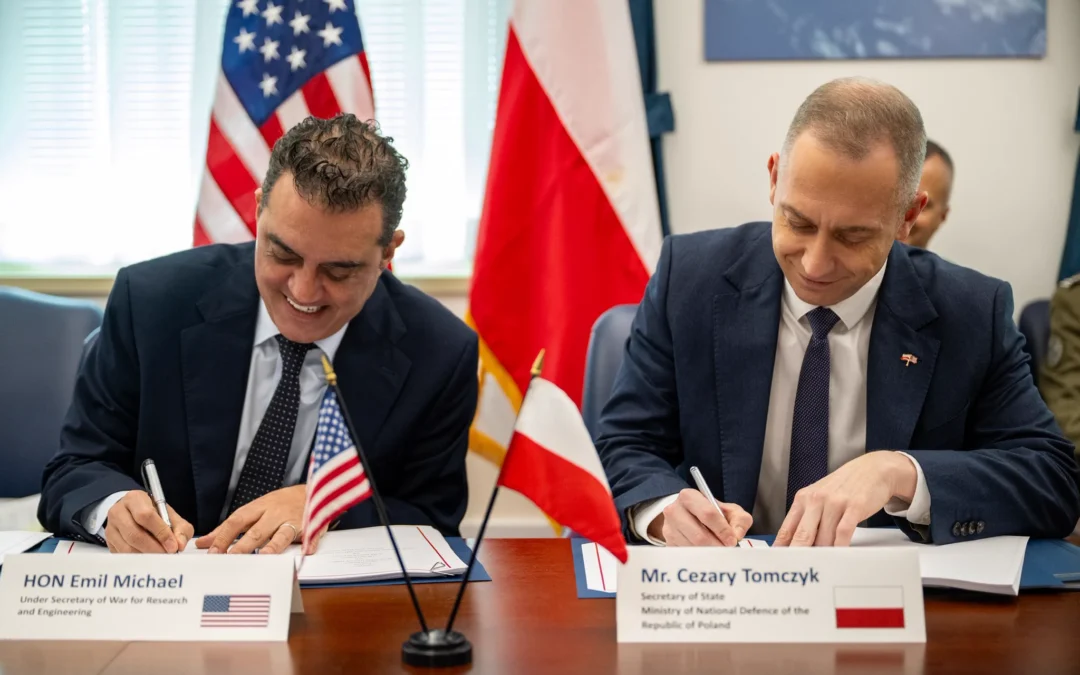
Under Secretary Emil Michael (@USWREMichael) and Mr. Cezary Tomczyk, Poland’s Secretary of State at the Ministry of National Defence, signed the Agreement Between the Government of the United States of America and the Government of the Republic of Poland for Defense Research,… pic.twitter.com/7EAgK3nD2i
— Department of War CTO (@DoWCTO) November 23, 2026
The agreement was signed at the Pentagon by Poland’s deputy defence minister Cezary Tomczyk and US under secretary of war for research and engineering Emil Michael.
According to the Department of War, the deal will help “turn research and development into validated military capabilities to jointly support US and Polish warfighters”.
Tomczyk said the agreement would allow Polish universities, research institutes and companies to participate in joint research and development work on defence technology with US partners and would enable such technologies to be tailored more closely to the requirements of the Polish armed forces.
During a briefing in Washington, Tomczyk admitted that the agreement had been negotiated for what he described as a “probably record-breaking” 17 years, but he noted a “significant acceleration in relations” between the US and Poland over the last six months.
General Marcin Górka, who oversees innovation in the Polish armed forces and accompanied Tomczyk to the United States, likewise welcomed the agreement, which he said would “open the doors to American military laboratories for our scientists and engineers”.
Górka also said the agreement would enable Poland and the United States to jointly develop anti-drone systems and advanced drones, with testing taking place in both countries.
Poland is a major importer of US military hardware. Between 2021 and 2025, it was the biggest overall importer of arms in NATO, with around 44% of that equipment coming from the US, including F-35 fighter jets, Abrams tanks, Patriot air defence systems and HIMARS rocket launchers.
But Poland has recently sought to move from being a client of the US defence industry to more of a partner. Earlier this month, Polish defence minister Władysław Kosiniak-Kamysz and Secretary of War Pete Hegseth signed a declaration on expanding bilateral defence-industrial cooperation
Poland and the US have signed a statement of intent on strengthening defence industry cooperation.
Polish defence minister @KosiniakKamysz said his country would be "the US ambassador in the EU", including seeking EU funds for jointly produced equipment https://t.co/SKHrxTEKIW
— Notes from Poland 🇵🇱 (@notesfrompoland) November 11, 2026
Last month, Poland was chosen as the location for a planned Patriot missile maintenance and servicing facility, the first of its kind outside the United States. In May, an agreement was signed to establish a centre in Poland for servicing the engines of Abrams tanks.
This year, Polish state defence group PGZ was chosen as the first European producer of American Barracuda-500M cruise missiles, while US defence giant Northrop Grumman and Polish arms manufacturer Niewiadów-PGM announced plans to jointly produce artillery shells in Poland.
Poland is also seeking to host a new permanent US military base, with Tomczyk reiterating during his Washington visit that a decision is expected from the Trump administration in early December.
NATO has approved the deployment of an Airborne Warning and Control System to Poland in response to three Russian missiles striking Polish territory last week.
Hours after the decision was announced, Poland’s airspace was again violated by a Russian drone https://t.co/gudQJsPlQ5
— Notes from Poland 🇵🇱 (@notesfrompoland) November 24, 2026
The new agreement on defence technology was signed amid heightened tensions with Russia. On Friday, three Russian Kh-101 cruise missiles struck separate locations in southeastern Poland, near the Ukrainian border.
Tomczyk said the Polish delegation had briefed Pentagon officials on the missile strikes, which he described as a “provocation” by Russia. The Polish minister was also asked about US President Donald Trump last week calling Russia’s Vladimir Putin his “friend”.
“One thing is certain: Vladimir Putin is not our friend; he is a threat to us,” replied Tomczyk. “This is the most important message that should come from Poland and resonate with the people of the United States.”
Subsequently, on Monday night, a Russian drone entered Polish airspace from Ukraine for a few minutes before turning back.
Notes from Poland is run by a small editorial team and published by an independent, non-profit foundation that is funded through donations from our readers. We cannot do what we do without your support.
Main image credit: Department of War CTO / X

Alicja Ptak is deputy editor-in-chief of Notes from Poland and a multimedia journalist. She has written for Clean Energy Wire and The Times, and she hosts her own podcast, The Warsaw Wire, on Poland’s economy and energy sector. She previously worked for Reuters.