Keep our news free from ads and paywalls by making a donation to support our work!

Notes from Poland is run by a small editorial team and is published by an independent, non-profit foundation that is funded through donations from our readers. We cannot do what we do without your support.
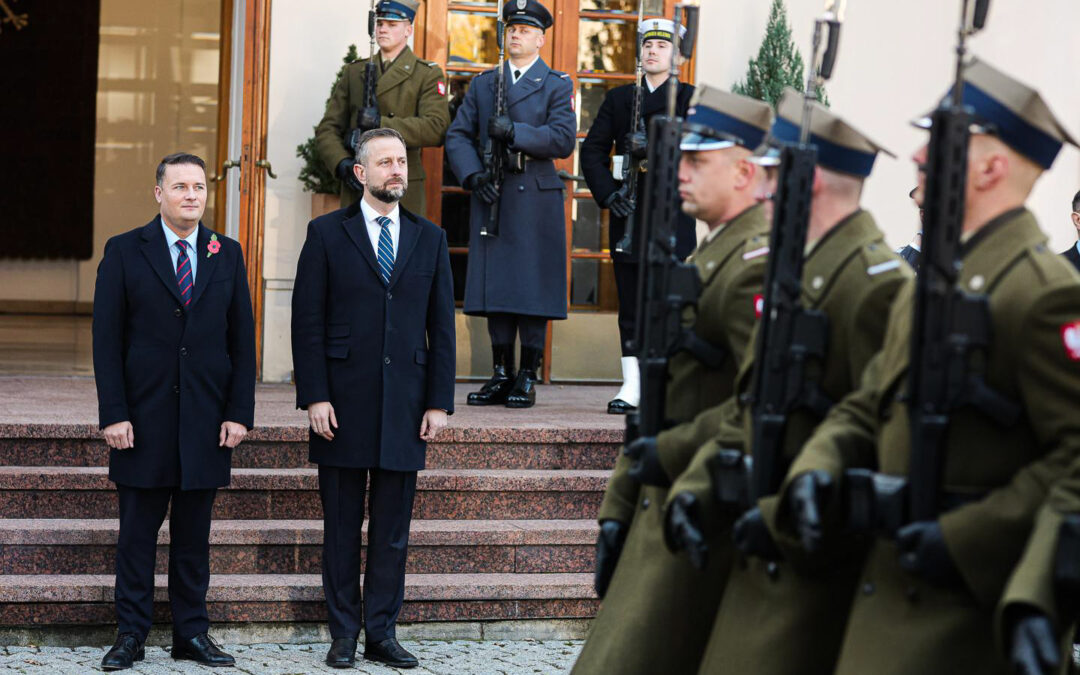
Poland and the United Kingdom have signed the Warsaw Defence Plan, an agreement to enhance their cooperation on security. The aim, says the British Ministry of Defence, is to “deter Russian threats”.
The plan, which follows on from the two countries signing a strategic defence partnership earlier this year, will include joint development and production of defence technologies and military exercises in the Baltic Sea.
The UK and Poland share a deep and historical defence partnership.
Today, Defence Secretary @WesStreeting signed the Warsaw Defence Plan to bring our two nations’ Armed Forces and industries closer together and help ensure collective security in Europe. 🇬🇧🤝🇵🇱 pic.twitter.com/IP98D1Qs1L
— Ministry of Defence 🇬🇧 (@DefenceHQ) October 27, 2026
“Poland is one of the UK’s closest allies – from flying together in the Battle of Britain, to breaking the Enigma code, they have been a vital partner for our defence for nearly a century,” said British defence secretary Wes Streeting on a visit to Warsaw.
“The new Warsaw Defence Plan honours this cooperation and sets out how we will continue to work together today, building a stronger Europe in a stronger NATO,” he added.
His Polish counterpart, Władysław Kosiniak-Kamysz, declared that “the Polish-British alliance has never been as strong as it is now”. Both he and Streeting also emphasised the importance of working together to support Ukraine.
Among the aims listed for the plan are collaboration in the development and manufacture of next-generation air-defence missiles, as well as drones and counter-drone technologies.
Earlier this year, Poland and the UK, along with Germany, France and Italy, agreed to jointly develop and procure air-defence systems, including missiles and drones.
The Warsaw Defence Plan also pledges to “increase defensive maritime activity in the Baltic Sea through exercises and regional coordination, helping British and Polish forces protect vital lines of communication in the sea”.
The two countries will also seek to build upon existing cooperation between their defence industries, including Poland’s purchase of CAMM-ER surface-to-air missiles and 100 launchers from MBDA and last year’s strategic partnership on ammunition production between Poland’s PGZ and Britain’s BAE Systems.
Poland and the UK have signed a major new defence and security treaty.
The agreement includes plans to jointly develop a new air-defence missile, hold large-scale military exercises, and cooperate on countering Russian hybrid attacks https://t.co/cXeYT2u1lw
— Notes from Poland 🇵🇱 (@notesfrompoland) May 27, 2026
This week’s agreement builds upon the Northolt Treaty signed by Poland and the UK in May this year, under which the two countries agreed to cooperate more closely on security.
Last year, Poland signed a similar agreement upgrading relations with France. That followed a strategic partnership agreement with Sweden the previous year.
In April this year, Poland signed new comprehensive strategic partnership agreements with South Korea and Japan. This year, it has also deepened security ties with Canada and Norway.
In November, Poland will host the first military exercises organised by the so-called Coalition of the Willing. Thousands of personnel from the UK, Poland, France and Germany will test operational readiness for a multinational force to secure a potential future Ukraine peace deal.
Notes from Poland is run by a small editorial team and published by an independent, non-profit foundation that is funded through donations from our readers. We cannot do what we do without your support.
Main image credit: MON (under CC BY-SA 4.0)

Daniel Tilles is editor-in-chief of Notes from Poland. He has written on Polish affairs for a wide range of publications, including Foreign Policy, POLITICO Europe, EUobserver and Dziennik Gazeta Prawna.