Keep our news free from ads and paywalls by making a donation to support our work!
Notes from Poland is run by a small editorial team and is published by an independent, non-profit foundation that is funded through donations from our readers. We cannot do what we do without your support.
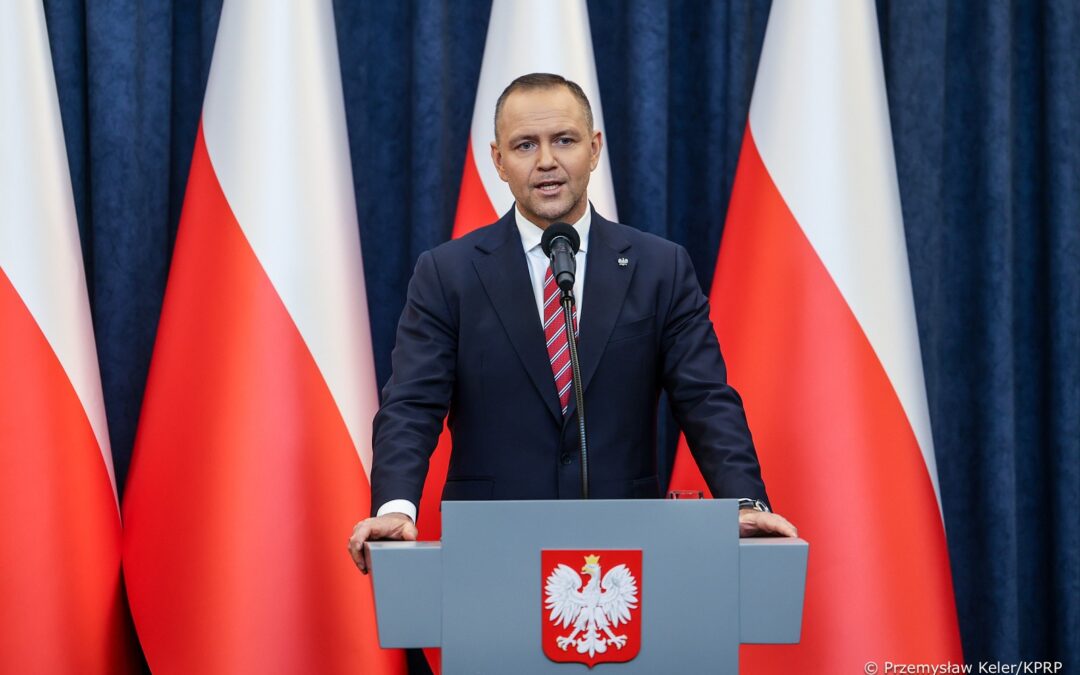
President Karol Nawrocki has vetoed a government bill creating new powers to block harmful online content. Nawrocki, who is aligned with the right-wing opposition, argued that the measures were too far-reaching and could be abused to introduce “censorship”.
Government figures have strongly criticised the president’s decision, arguing that it will leave young people in particular more exposed to dangerous content. It also means that Poland still has not fully implemented the European Union’s Digital Services Act (DSA).
❌ Nie dla cenzury Internetu! pic.twitter.com/WusnK7LImD
— Kancelaria Prezydenta RP (@prezydentpl) November 13, 2026
Previously, in January this year, Nawrocki had vetoed an earlier bill intended to implement the DSA, describing the measures as “Owellian”.
That prompted the government to split the legislation in two. In September, Nawrocki agreed to sign one of those bills, which appointed the president of the Office of Electronic Communications (UKE) as Poland’s digital services coordinator, responsible for overseeing enforcement of the DSA.
A second bill was then needed to introduce the actual powers to block harmful online content. It was approved by the government’s majority in parliament in October, with the right-wing and far-right opposition either voting against it or abstaining.
Among the new powers included in the legislation were authorisation for the heads of UKE and the National Broadcasting Council (KRRiT) to order the blocking of online content containing violence or threats based on race, nationality, ethnicity, religion or political affiliation.
It also allowed the immediate blocking, at the request of a prosecutor or the police, of content involving the acceptance of a contract to commit murder or inciting or assisting in suicide or self-harm.
“Perpetrators of serious crimes should not be allowed to use the internet to spread violence and threats,” said digital affairs minister Krzysztof Gawkowski. “The state must have effective tools to quickly respond to such threats. The safety of internet users must transcend political divisions.”
The government also argued that last month’s series of stabbings in schools and this month’s deadly terrorist attack in Kraków – which have raised concern about the online radicalisation of young people – have emphasised the importance of tough controls over digital content.
There are "strong traces of right-wing extremism" in the activity of the man who carried out the mass shooting in Kraków, says Poland's justice minister.
His search history included websites relating to Anders Breivik, the Norwegian far-right terrorist https://t.co/UhVbkWSaCq
— Notes from Poland 🇵🇱 (@notesfrompoland) November 10, 2026
However, on Friday, the final day by which the president had to make a decision on the bill, Nawrocki announced that he was vetoing it. He argued that “the government has clearly mixed up European obligations with its own political interests”.
The measures in the bill threaten to create a “censorship official” and “essentially give the government arbitrary control and the ability to decide what we can and cannot say, write or publish, said the president.
Decisions on whether content is permitted or not should be “the exclusive competence of the justice system and independent judges”, he argued. Nawrocki also said that the powers in the vetoed bill were “disproportionate”, allowing an entire domain to be blocked due to a single example of illegal content.
“The security of citizens cannot be a pretext for weakening their freedoms,” said Nawrocki. “We must not create a false choice: either the security or the freedom of its citizens. A responsible state must ensure and balance both.”
Dlaczego Prezydent RP Karol Nawrocki zawetował ustawę o DSA? ⬇️ pic.twitter.com/1BUJVFEftl
— Kancelaria Prezydenta RP (@prezydentpl) November 13, 2026
Deputy digital affairs minister Dariusz Standerski, however, said that the president was “not defending free speech” but instead “once again siding with global [digital] platforms and allowing them to decide what users see”.
“The vetoed provisions concerned illegal content, not opinions or views expressed online,” added the ministry, which also noted that all decisions on blocking content were subject to appeals and judicial review.
Prime Minister Donald Tusk, meanwhile, accused Nawrocki of “waging war on the government at the expense of Polish children and Polish security”, which would both be threatened by the absence of the vetoed measures.
Ochrona dzieci przed internetowymi przestępcami. Trudno wyobrazić sobie ważniejszą sprawę, która powinna łączyć ponad politycznymi podziałami. A jednak zawetował.
— Donald Tusk (@donaldtusk) November 13, 2026
Aleksandra Wójtowicz, an analyst on new technologies at the Polish Institute of International Affairs (PISM), told the Fakt newspaper that the measures do “not in any way relate to alleged censorship”. They are intended to force digital platforms to remove illegal content, she explained.
Wójtowicz added that the measures would actually have protected free speech by giving Polish users whose accounts were unjustly deleted by social media platforms the right to appeal against those decisions outside of the platform itself.
However, Nawrocki’s veto was praised by Przemysław Czarnek, deputy leader of the national-conservative Law and Justice (PiS), Poland’s largest opposition party. Czarnek told TV Trwam that the proposed measures had been intended to “fight the opposition” rather than actual hate speech.
Notes from Poland is run by a small editorial team and published by an independent, non-profit foundation that is funded through donations from our readers. We cannot do what we do without your support.
Main image credit: Przemysław Keler/KPRP

Daniel Tilles is editor-in-chief of Notes from Poland. He has written on Polish affairs for a wide range of publications, including Foreign Policy, POLITICO Europe, EUobserver and Dziennik Gazeta Prawna.