Keep our news free from ads and paywalls by making a donation to support our work!

Notes from Poland is run by a small editorial team and is published by an independent, non-profit foundation that is funded through donations from our readers. We cannot do what we do without your support.
After Russia announced that it had dismantled a Polish spy network and arrested two alleged agents, Poland has dismissed the claims as “disinformation” and a “provocation”.
On Wednesday, while Poland was celebrating its national Independence Day, Russia’s Federal Security Service (FSB) announced that it had “disrupted the activities of an intelligence network of the Polish special services operating in Kaliningrad”, a Russian exclave that borders Poland.
It claimed to have detained two “agents”- one working for Poland’s Military Intelligence Service (SWW), the other for the Internal Security Agency (ABW) – who had been “collecting and transmitting information about military personnel and facilities” and “the socio-economic situation in the Kaliningrad region”.
The FSB added that seven Polish citizens and three Russians who had had contact with Polish intelligence agencies had been “officially warned”, and that the Polish citizens had been banned from entering Russia.
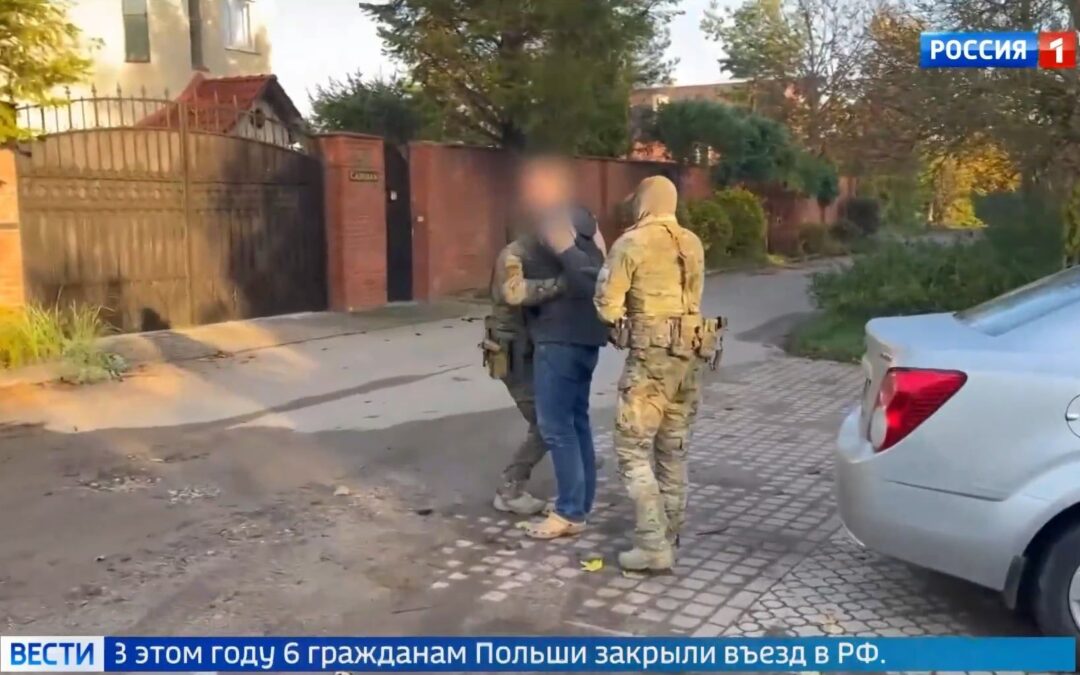
The agency also published a film containing images of alleged suspects being detained and various documents and telephone messages in Polish.
Kremlin spokesman Dmitry Peskov said the arrests would not further worsen relations with Poland given ties between the two countries “essentially do not exist right now,” reported the RIA news agency.
In a statement on Wednesday morning, Jacek Dobrzyński, the spokesman for Poland’s security services, said that he regarded the Russian announcement “as yet another provocation and act of disinformation”, especially as it had been released on Polish Independence Day.
He added that he would not comment further and “appealed to everyone not to amplify hostile narratives or play into Russian propaganda”.
Speaking to news website Wirtualna Polska, Maciej Wewiór, the spokesman for Poland’s foreign ministry, said that Poland was working to verify the information announced by the FSB.
However, he urged “extreme caution” when dealing with such claims from Russia. “Let’s not fall for Russian propaganda and become pawns in this game,” he said.
Jako rzecznik ministra koordynatora służb specjalnych nie komentuję materiałów zamieszczanych w sieci przez rosyjskie służby.
🛑 W dniu Narodowego Święta Niepodległości traktuję je szczególnie jako kolejną prowokację i dezinformację.
🛑 Apeluję o niepowielanie wrogiej narracji i…— Jacek Dobrzyński (@JacekDobrzynski) November 11, 2026
Polish fact-checking and investigative journalism service OKO.press also raised doubts about the material shared by Russia. It notes that the alleged Polish-language phone messages released by the FSB have unnatural wording and appear to have been translated from Russian.
It also points out that the footage showing the alleged detentions appears to have been recorded much earlier, judging by the green folliage on trees.
This assessment was echoed by Stanisław Żaryn, who served as spokesman for the security services from 2016 to 2022. He said that “fabricated propaganda materials” were clearly “prepared in advance” and “fit the Russian security services’ ongoing campaign against Poland”.
“It should be assumed that, in its operation against Poland, Moscow will resort to fabricated evidence, and today’s FSB statement will be used to legitimise earlier accusations against Poland of preparing an attack on Kaliningrad,” he added.
#InfoAlert. Kolejna rosyjska prowokacja. FSB twierdzi, że rozbiła polską siatkę szpiegowską pracującą w Obwodzie Królewieckim. Analiza komunikacji rosyjskiej wskazuje, że mamy do czynienia z zaplanowaną sekwencją działań informacyjnych. Wpisuje się ona w stałe oddziaływanie… pic.twitter.com/s6bTV9pIK8
— Stanisław Żaryn (@StZaryn) November 11, 2026
The FSB’s announcement came a week after Poland announced that it had detained and charged six people – five Poles and one Russian – suspected of running an operation to illegally supply Russia with military components, which were smuggled over the border into Kaliningrad.
Poland also sent additional security personnel to its regions along the Russian border this month following intelligence reports suggesting a planned act of sabotage or other provocation there.
Prime Minister Donald Tusk later claimed that “individuals with flashlights” had been spotted at the border but “we very quickly mobilised the appropriate forces and managed to prevent a provocation”.
Poland recently launched a special operation along the Russian border after receiving information that acts of sabotage may take place there in the coming days.
For more, see our report from yesterday:https://t.co/RVaXb6SQJI
— Notes from Poland 🇵🇱 (@notesfrompoland) November 3, 2026
Poland has seen a sharp rise in cases of espionage and sabotage carried out on behalf of Moscow in recent years.
The ABW launched 48 investigations related to espionage last year, more than twice as many as in 2024. In those two years taken together, there were more espionage investigations than over the previous three decades combined.
Earlier this year, the International Centre for Counter-Terrorism published a report identifying Poland as the “primary focus” of Russia’s campaign of sabotage in Europe.
In response, Poland has successively closed down all of Russia’s consulates on its territory, prompting Russia to do the same with Polish consulates in a tit-for-tat move.
Notes from Poland is run by a small editorial team and published by an independent, non-profit foundation that is funded through donations from our readers. We cannot do what we do without your support.
Main image credit: Россия 1 screenshot

Alicja Ptak is deputy editor-in-chief of Notes from Poland and a multimedia journalist. She has written for Clean Energy Wire and The Times, and she hosts her own podcast, The Warsaw Wire, on Poland’s economy and energy sector. She previously worked for Reuters.