Keep our news free from ads and paywalls by making a donation to support our work!

Notes from Poland is run by a small editorial team and is published by an independent, non-profit foundation that is funded through donations from our readers. We cannot do what we do without your support.
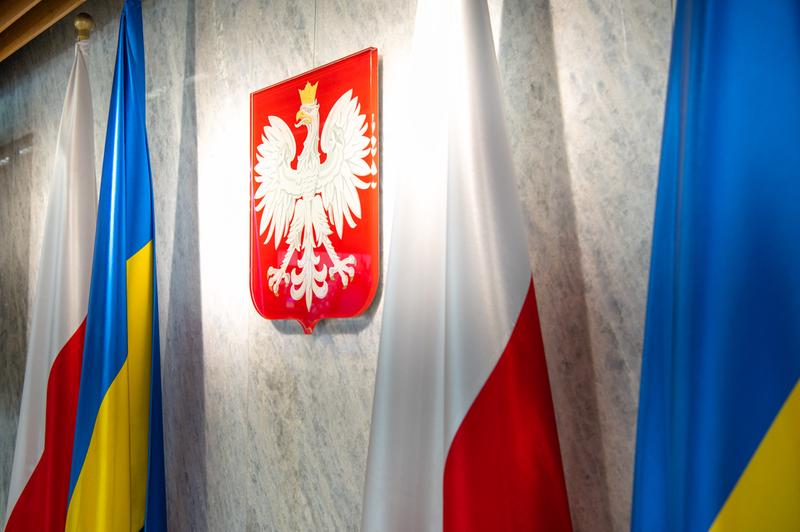
Poland has granted permission for Ukraine to conduct a search for the remains of Ukrainian civilians killed by Polish resistance fighters during World War Two.
The decision marks the latest step towards reconciliation between the two countries over their difficult shared history. Following a diplomatic breakthrough last year, Kyiv has also granted Poland permission to search for and exhume the remains of Poles massacred by Ukrainian nationalists.
On Tuesday, Ukrainian deputy culture minister Ivan Verbytskyi announced that the Polish authorities had granted a permit for a Ukrainian group to conduct exploratory work in the village of Łasków in southeastern Poland, around 10km from the border with Ukraine.
The search aims to uncover the remains of Ukrainian civilians killed by the Peasant Battalions (Bataliony Chłopskie), a major underground resistance movement that emerged in Poland during the German occupation of World War Two.
Łasków, which had a predominantly ethnic Ukrainian population, was attacked by a Peasant Battalion unit on 10 March 1944, with some estimates suggesting around 300 civilians were killed. Among those who died was a local Orthodox priest, Lev Korobchuk.
On the same day, members of the Home Army (Armia Krajowa), Poland’s largest armed resistance movement, also attacked the nearby village of Sahryń. According to estimates, they killed hundreds more Ukrainians. Ukraine has also submitted an application to carry out exploratory work there.
Dariusz Kopciowski, the conservator of monuments in the Lublin province where Łasków is located, confirmed to the Polish Press Agency (PAP) that a permit for exploration work in Łasków had been granted.
The issue had recently begun to cause tension, with Ukrainian media reporting last week that Ukraine has been waiting over a year for permission to carry out searches in Łasków. By contrast, Kyiv has granted permission for Poland to conduct such searches on its territory.
Those Polish efforts are focused in particular on finding and exhuming the remains of victims of the so-called Volhynia massacres, in which Ukrainian nationalists killed around 100,000 Poles, mostly women and children, as part of an ethnic cleansing operation.
Poland regards those massacres as a genocide. However, Ukraine strongly rejects that label and also points to the fact that Polish partisan units killed Ukrainian civilians during the war. Poland, in turn, argues that many such incidents were acts of reprisal for the massacres carried out by Ukrainians.
Long-simmering tensions between Poland and Ukraine over WWII massacres have finally boiled over, prompting a diplomatic crisis.@danieltilles1 looks at how we got here and what it may mean for the two countries and Europe more broadly https://t.co/a8tiYJJHRr
— Notes from Poland 🇵🇱 (@notesfrompoland) June 22, 2026
In 2017, Ukraine introduced a moratorium on search and exhumation work on its territory in response to the dismantling of a monument in Poland dedicated to the Ukrainian Insurgent Army (UPA).
The UPA led the Volhynia massacres but is still celebrated by many in Ukraine for its role in fighting for independence from Moscow-backed Soviet rule.
Last year, following negotiations with Poland, Ukraine lifted that moratorium and again began issuing permits for searches and exhumations of Polish victims on its territory, a number of which have already taken place.
Last Sunday, Verbytskyi attended a funeral ceremony for 55 Polish massacre victims, around half of them children, whose remains were recently found and exhumed in a former Polish village located in what is now Ukraine.
The remains of 55 Poles massacred by Ukrainian nationalists in WWII have been reburied at a ceremony in Ukraine attended by political and religious figures from both countries.
The victims, around half of them children, were exhumed this summer https://t.co/4q3giZhBAL
— Notes from Poland 🇵🇱 (@notesfrompoland) August 31, 2026
However, as well as those moves towards reconciliation, there have also been regular clashes between Warsaw and Kyiv over World War Two history, in particular following President Volodymyr Zelensky’s decision in May this year to name a military unit after the UPA.
That triggered strong protests from Poland, whose president, Karol Nawrocki, stripped Zelensky of Poland’s highest honour, the Order of the White Eagle.
Poland has also expressed concern over a new national pantheon being established by Ukraine. It has warned that, if figures associated with the massacre of Poles are included, that could have consequences for Ukraine’s ambitions to join the European Union.
President Zelensky has signed a law establishing a national pantheon to commemorate Ukrainian heroes, prompting Poland to again warn that Ukraine "will have a huge problem" integrating into the EU if it honours figures associated with massacres of Poles https://t.co/fN7Zgbovvu
— Notes from Poland 🇵🇱 (@notesfrompoland) August 24, 2026
Notes from Poland is run by a small editorial team and published by an independent, non-profit foundation that is funded through donations from our readers. We cannot do what we do without your support.
Main image credit: Kancelaria Sejmu / Aleksander Zieliński (

Daniel Tilles is editor-in-chief of Notes from Poland. He has written on Polish affairs for a wide range of publications, including Foreign Policy, POLITICO Europe, EUobserver and Dziennik Gazeta Prawna.