Keep our news free from ads and paywalls by making a donation to support our work!

Notes from Poland is run by a small editorial team and is published by an independent, non-profit foundation that is funded through donations from our readers. We cannot do what we do without your support.
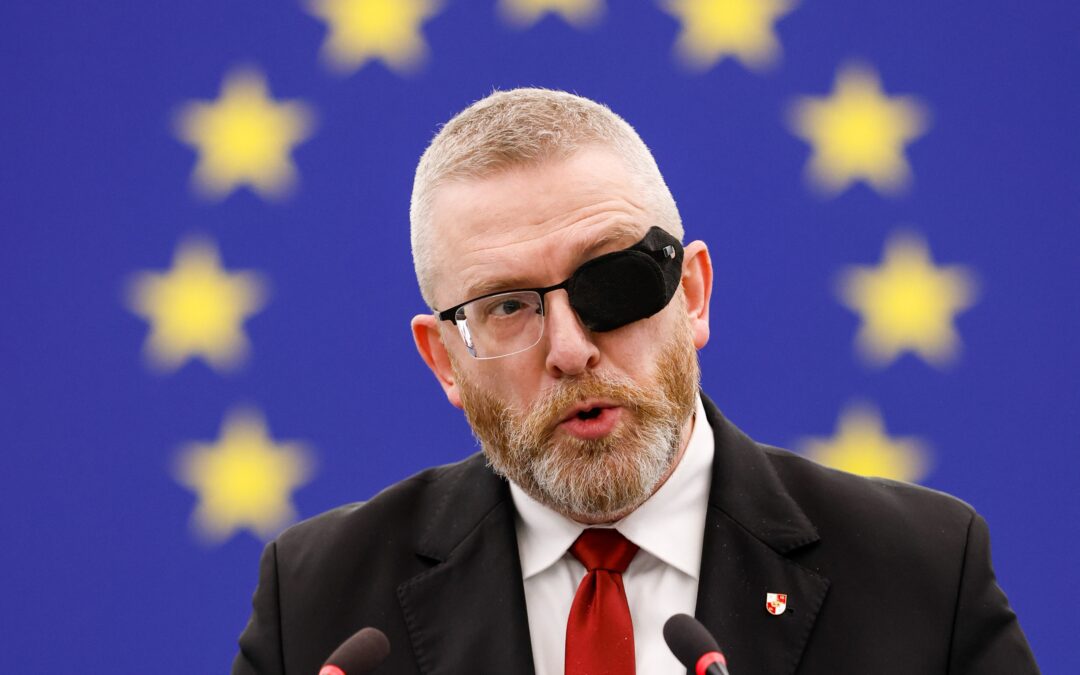
The European Parliament has voted to once again strip Polish far-right leader Grzegorz Braun of immunity so that he can face further criminal charges in his homeland, including for Holocaust denial.
Braun, who is already separately on trial for attacking a Jewish religious ceremony, will now face prosecution for his claim that the gas chambers at Auschwitz are “fake” as well as for various antisemitic, anti-Ukrainian and anti-LGBT incidents during last year’s presidential election campaign.
Decyzją Parlamentu Europejskiego Grzegorz Braun kolejny raz stracił immunitet. Przychylono się do dwóch wniosków polskiej prokuratury. pic.twitter.com/Okce0DhbPo
— tvp.info 🇵🇱 (@tvp_info) March 26, 2026
Braun – who finished a surprise fourth in the election, taking 6.3% of the vote, and whose party has since surged in the polls – has a long history of spreading antisemitic conspiracy theories.
Last July, he said during a radio interview that “Auschwitz with its gas chambers is unfortunately a fake”. A few days later, he reiterated that he finds the “hypothesis of the existence” of the gas chambers to be “a tenuous one, not based on verified facts”, that “has become less and less convincing over the years”.
His remarks were widely condemned in Poland. Braun was also accused of denying Nazi crimes, an offence in Poland that can be punished with a prison sentence of up to three years.
In September, Poland’s justice minister and prosecutor general, Waldemar Żurek, asked the European Parliament to lift Braun’s immunity, so that he could be presented with such a charge. Today, a majority of MEPs voted to approve that request.
Far-right leader Grzegorz Braun says the gas chambers at Auschwitz are “fake” and it is a “fact” that Jews have committed ritual murder.
Prosecutors have launched an investigation into whether he violated Poland's law against denying Nazi crimes https://t.co/7UUKzH5ndG
— Notes from Poland 🇵🇱 (@notesfrompoland) July 10, 2025
Meanwhile, in a separate vote, MEPs also approved another request, submitted by Poland in July last year, to strip Braun of immunity to face four other charges.
One, which is for criminal defamation, stems from Braun’s claim, during a televised presidential debate in April last year, that the yellow paper daffodils distributed each year in Warsaw to mark the anniversary of the 1943 Jewish Ghetto Uprising against German Nazi rule are “symbols of shame”.
During the same debate, Braun also warned about the “Judaisation” of Poland, saying that “Jews have far too much say in Polish affairs”. That prompted protests by some of his opponents, one of whom filed a notification to prosecutors.
Two other charges relate to thefts of flags. In one incident, Braun and his supporters removed a Ukrainian flag hanging outside city hall in the town of Biała Podlaska during a campaign event. In another, he removed a European Union flag from the government’s industry ministry in Katowice.
Braun regularly rails against what he calls the “Ukrainisation” of Poland, warning of the supposed dangers of having so many Ukrainian refugees and migrants in the country. He is also a vocal critic of the EU. His positions on both issues often echo Russian narratives.
The final charge, of destruction of property, relates to an incident in June 2025, when Braun vandalised an exhibition about the LGBT+ community in the Polish parliament. He regularly condemns what he calls the “perversions” of LGBT+ people, and has called for homosexuality to be criminalised.
If Braun is convicted, criminal defamation carries a prison sentence of up to one year, theft up to eight years, and destruction of property up to five years.
The trial of Polish far-right leader Grzegorz Braun for his attacks on a Hanukkah celebration in parliament and a Holocaust lecture has begun.
He declared in court that he was facing trial because he had "dared to defend myself against Jewish supremacy" https://t.co/NRZLw7yzyo
— Notes from Poland 🇵🇱 (@notesfrompoland) December 8, 2025
The European Parliament’s decisions mark the third and fourth time approved requests from Poland to lift Braun’s immunity. The first took place last May, as a result of which he is now on trial for four alleged crimes, including attacking a Jewish Hannukah ceremony in the Polish parlaiment in December 2023.
In November, the European parliament stripped his immunity again, this time to face charges of inciting religious hatred against Jews and assaulting a doctor involved in carrying out a late-term abortion.
Braun’s legal troubles have not harmed his popularity – on the contrary, they are part of his appeal to some supporters. His KKP party, which a year ago was not even included in most polling, is now averaging support of 8-9%, making it Poland’s fourth most popular party.
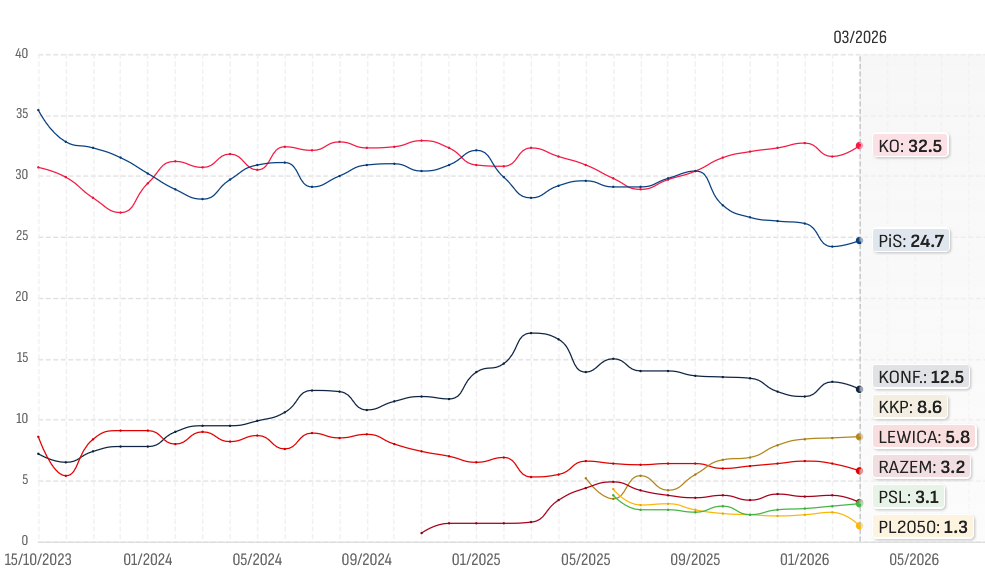
Thirty-day polling averages for Poland’s main political groups (via: ewybory.eu)
Notes from Poland is run by a small editorial team and published by an independent, non-profit foundation that is funded through donations from our readers. We cannot do what we do without your support.
Main image credit: Philippe BUISSIN/European Union

Daniel Tilles is editor-in-chief of Notes from Poland. He has written on Polish affairs for a wide range of publications, including Foreign Policy, POLITICO Europe, EUobserver and Dziennik Gazeta Prawna.