Keep our news free from ads and paywalls by making a donation to support our work!

Notes from Poland is run by a small editorial team and is published by an independent, non-profit foundation that is funded through donations from our readers. We cannot do what we do without your support.
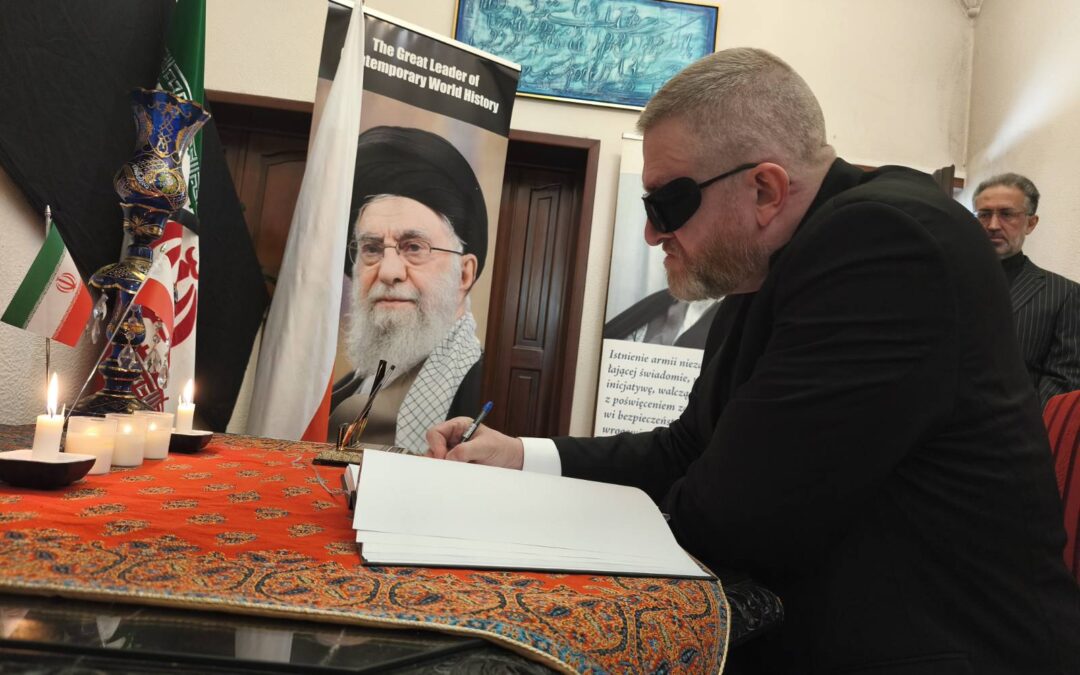
Polish far-right leader Grzegorz Braun has visited the Iranian embassy in Warsaw to sign a book of condolence for Ali Khamenei, Iran’s supreme leader, who was killed last week during the US and Israel’s ongoing attacks on Iran.
“God bless the Iranian nation,” wrote Braun, who finished fourth in last year’s Polish presidential election and whose party, Confederation of the Polish Crown (KKP), has recently surged in the polls, to support of around 8%.
Khamenei and other senior Iranian figures were killed on 28 February by an Israeli airstrike.
Braun – who is known for his conspiratorial antisemitism, including staunch criticism of Israel – told Iranians that he condemned the “shameful, cowardly and insidious murder of your leader”, which was a “manifestation of civilisational and personal savagery on the part of those who committed such an act”.
“The independence of states, sovereignty and the security of free nations should be dear to all, including us Poles,” declared Braun, who is currently on trial in Poland for attacking a Jewish religious celebration in parliament.
“Despite our significant differences, our countries are united by many universal principles,” he added. “And in this spirit, I raise the slogan: Tehran and Warsaw – a common cause!”
Wizyta @GrzegorzBraun_ w ambasadzie Iranu i wpis do księgi kondolencyjnej: Teheran-Warszawa – wspólna sprawa! 🇮🇷 🇵🇱 #PolskaZaPokojem #ToNieNaszaWojna #SolidarnizIranem #NieDlaWojny #Iran #Polska #GrzegorzBraun #KonfederacjaKoronyPolskiej pic.twitter.com/Ka7jVH6fcm
— Konfederacja Korony Polskiej (@KoronyPolskiej) March 7, 2026
As well as his vocal antisemitism, Braun is anti-Ukrainian, anti-American and anti-EU. In 2019, he declared that “the American empire is a political and military tool of Jewish blackmail against Poland”.
Though not openly pro-Russian, Braun has taken positions that align with Moscow’s, such as blaming the US and NATO for the war in Ukraine and claiming that last year’s violation of Polish airspace by Russian drones was in fact staged by Ukraine and Poland.
Some of Braun’s associates have also been linked to Russia, including a prospective election candidate who is currently on trial for alleged espionage on behalf of Moscow.
When the US and Israel began attacking Iran – which is a close ally of Russia – last week, Braun expressed support for Tehran. He also suggested that Israel’s actions could be a precursor to it seeking to exert control over Poland and its region, something he has long claimed Jews are trying to do.
“The doctrine of the absolute primacy of the claims and pretensions of ‘Greater Israel’, if ultimately it triumphs in the Middle East, will be enforced against us in Central Europe all the more easily and ruthlessly,” wrote Braun last week, shortly after the attacks on Iran began.
A member of parliament from Braun’s party, Włodzimierz Skalik, also condemned the actions of “the chauvinist genocidal and Zionist regime of Benjamin Netanyahu” against Iran.
Moje stanowisko wobec napaści na Iran nie zmienia się👇 Doktryna absolutnego prymatu roszczeń i uroszczeń „Wielkiego Izraela”, jeśli ostatecznie zatryumfuje na Bliskim Wschodzie, będzie tym łatwiej i tym bardziej bezwzględnie egzekwowana również wobec nas w Europie Środkowej. https://t.co/05w7qhBaZt
— Grzegorz Braun (@GrzegorzBraun_) February 28, 2026
KKP’s position on Iran is not shared by other parties represented in Poland’s parliament, including the far-right Confederation (Konferedacja) group that Braun used to belong to before being expelled last year.
“No one will mourn the death of Ayatollah Ali Khamenei, who was an ally of Vladimir Putin,” Confederation spokesman Wojciech Machulski told Polsat News. However, “In the Israeli-Iranian conflict, neither side is worth supporting”, he added.
Meanwhile, Poland’s right-wing president, Karol Nawrocki, who is a close ally of Trump, this week said that his “thoughts and prayers” are with the US military personnel who have been killed in Iranian attacks.
Nawrocki also expressed satisfaction that “the menacing Iranian regime – which armed Russia in its aggression against Ukraine and threatened other states in the Middle East – is being dismantled before our eyes”.
Stany Zjednoczone – największy sojusznik Rzeczypospolitej Polskiej – straciły dziś trzech swoich synów w ataku odwetowym przeprowadzonym przez Iran. Kilku innych odniosło obrażenia. Myślami i modlitwą jesteśmy z nimi oraz ich rodzinami.
Na naszych oczach upada groźny reżim…— Karol Nawrocki (@NawrockiKn) March 1, 2026
Today, however, centrist Prime Minister Donald Tusk, who is an opponent of Nawrocki and has in the past criticised Trump, expressed concern that the situation in the conflict in the Middle East may benefit Russia.
“The war in the Middle East continues and chaos is spreading. Oil prices are going up. Washington may lift sanctions on Russian oil. Who is the real winner here?” asked Tusk on social media.
On Friday, the US issued a 30-day waiver easing sanctions to allow India to buy Russian oil stranded at sea. Shortly afterwards, US treasury secretary Scott Bessent told Fox Business that Washington “may unsanction other Russian oil” in order “to bring relief to the market during this conflict”.
The war in the Middle East continues and chaos is spreading. Oil prices are going up. Washington may lift sanctions on Russian oil. Who is the real winner here?
— Donald Tusk (@donaldtusk) March 7, 2026
Notes from Poland is run by a small editorial team and published by an independent, non-profit foundation that is funded through donations from our readers. We cannot do what we do without your support.
Main image credit: KKP/X

Daniel Tilles is editor-in-chief of Notes from Poland. He has written on Polish affairs for a wide range of publications, including Foreign Policy, POLITICO Europe, EUobserver and Dziennik Gazeta Prawna.