Keep our news free from ads and paywalls by making a donation to support our work!

Notes from Poland is run by a small editorial team and is published by an independent, non-profit foundation that is funded through donations from our readers. We cannot do what we do without your support.
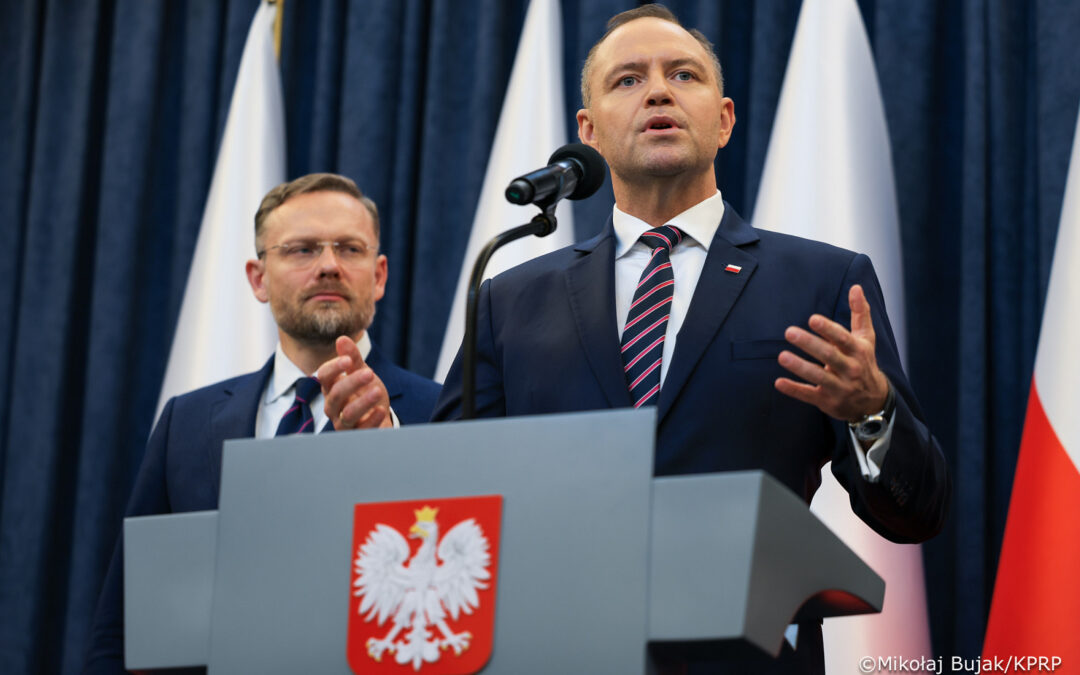
Opposition-aligned President Karol Nawrocki has vetoed a government bill intended to reform a judicial body at the heart of Poland’s rule-of-law crisis. He argues that the measures would create even greater “legal chaos”.
The government, however, says that Nawrocki is blocking its efforts to end the chaotic situation in Poland’s legal system which it inherited from the former administration. It now plans to resort to a “plan B” that sidesteps the president’s veto.
Ustawy zawetowane przez Prezydenta RP Karola Nawrockiego. pic.twitter.com/9kZt8DFIPA
— Kancelaria Prezydenta RP (@prezydentpl) February 19, 2026
The proposed law was intended to change the method of choosing members of the National Council of the Judiciary (KRS), the body responsible for nominating judges to their positions.
Until 2017, most members of the KRS were chosen by judges themselves. However, in that year, the former national-conservative Law and Justice (PiS) government changed the system so that most members were chosen by politicians.
The move was widely condemned by expert bodies as undermining judicial independence. Polish and European court rulings have found the KRS to no longer be a legitimate body due to it now being under political influence.
The current, more liberal government, which replaced PiS in 2023, has pledged to restore the legitimacy of the KRS by again having most members elected by judges. However, a previous attempt to do so was blocked in 2024 by then-President Andrzej Duda, a PiS ally.
Last November, justice minister Waldemar Żurek launched another effort to reform the KRS, which he said was an attempt at “compromise” as it took into account some of Duda’s concerns but still restored the right of judges to elect most KRS members in direct and secret elections.
The legislation was approved by parliament in January. However, Duda’s successor, Nawrocki, who is also aligned with PiS, has now decided to veto it.
Among the concerns expressed by Nawrocki’s office are that the law would have ended the role of parliament, which is “a representative of the sovereign, of all Poles”, in choosing members of the KRS.
The president’s chancellery also said that the proposed law “raises serious constitutional and systemic concerns”, including by specifying that KRS candidates have at least ten years of judicial experience and five years in their current position. This “arbitrarily excludes a significant group of judges from running”.
The justice ministry has presented a bill that would overhaul one of the institutions at the heart of Poland's rule-of-law crisis.
It wants to ensure that the body responsible for nominating judges is made independent of political control https://t.co/9Cilwx6e46
— Notes from Poland 🇵🇱 (@notesfrompoland) November 6, 2025
Meanwhile, Nawrocki argued that one element of the legislation would have resulted in doubts over the legal status of around 3,000 judges previously appointed by the KRS and all the rulings issued by them, therefore creating “immense legal chaos”.
However, the government’s spokesman, Adam Szłapka, responded to Nawrocki’s veto by saying that signing the bill would have been a way “to end the chaos in the courts” caused by PiS’s reforms, which rendered many institutions and appointments illegitimate.
Żurek, meanwhile, told news website Onet that Nawrocki had “refused to engage in the discussion during preparation of the bill, as we proposed”. He also said that requiring candidates for the KRS to have a certain level of experience and seniority was a standard and constitutional measure for such institutions.
Waldemar Żurek reaguje po wecie Karola Nawrockiego w sprawie ustawy o KRS. Więcej ➡️ https://t.co/hR2av32aIX pic.twitter.com/uKxF9V0z1q
— Onet (@onetpl) February 19, 2026
Having long anticipated Nawrocki’s veto, the ruling coalition does, however, have a “plan B”, which it set in motion last week, when the speaker of parliament began the process of selecting new members of the KRS for when its current term expires in May.
Given that the PiS-era law giving parliament the right to choose KRS members remains in place, the ruling coalition plans to use its parliamentary majority to choose candidates democratically nominated by judges themselves.
“There will be grassroots elections by judges of the best candidates and a request to the parliamentary majority to respect this choice,” Żurek today confirmed to Onet. “It will take more time, but we will do it. If the president then questions the election of the new KRS, he will open himself up to constitutional liability.”
The speaker of parliament has launched the process of selecting new members of a key judicial body, despite the fact that it will take place under rules introduced by the former government that the current authorities regard as illegitimate https://t.co/6zw6ORLyMv
— Notes from Poland 🇵🇱 (@notesfrompoland) February 12, 2026
Since coming to office last August, Nawrocki has vetoed government bills at an unprecedented rate. Last week, he vetoed bills on regulating crypto-asset markets and recognising Silesian as a regional language.
Alongside today’s veto of the KRS bill, the president also vetoed another bill that the government said was intended to support farmers.
The president, however, claimed it was “a bad law hiding behind a pretty name” and would in fact have favoured large entities while drowning smaller family farmers in bureaucracy. That would have “threatened hundreds of thousands of Polish farming families and the country’s food security”, said Nawrocki.
As reports of Nawrocki’s two latest vetoes – the 26th and 27th of his term – emerged, Prime Minister Donald Tusk condemned the president for vetoing “blindly, just to cause harm” rather than to protect Poland’s interests.
Szykują się kolejne weta. Tak na ślepo, byle zaszkodzić. To nie jest prezydent polskich spraw.
— Donald Tusk (@donaldtusk) February 19, 2026
Notes from Poland is run by a small editorial team and published by an independent, non-profit foundation that is funded through donations from our readers. We cannot do what we do without your support.
Main image credit: Mikołaj Bujak/KPRP

Daniel Tilles is editor-in-chief of Notes from Poland. He has written on Polish affairs for a wide range of publications, including Foreign Policy, POLITICO Europe, EUobserver and Dziennik Gazeta Prawna.