Keep our news free from ads and paywalls by making a donation to support our work!

Notes from Poland is run by a small editorial team and is published by an independent, non-profit foundation that is funded through donations from our readers. We cannot do what we do without your support.
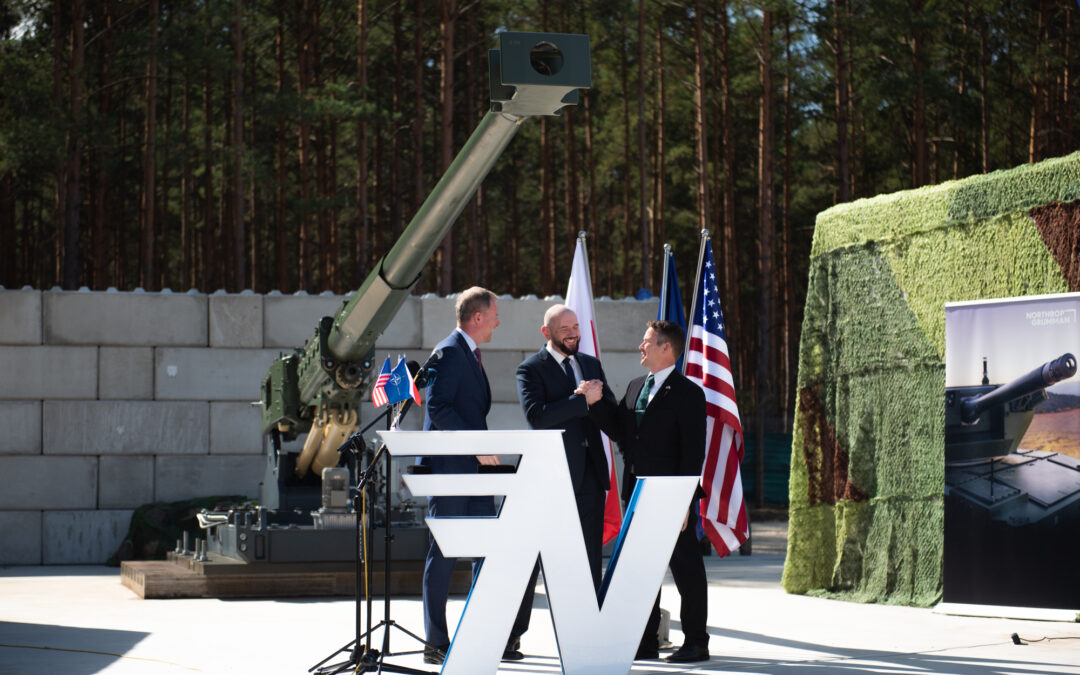
US defence giant Northrop Grumman and Polish arms manufacturer Niewiadów-PGM have announced plans to jointly produce over 180,000 155-mm artillery shells annually in Poland.
The endeavour aims to meet growing demand for ammunition in Europe, including potentially supplying Ukraine, while also catering to the US market.
Umowa ramowa z Northrop Grumman – kolejny etap budowy kompetencji produkcji amunicji 155 mm w Polsce.
Niewiadów Polska Grupa Militarna oraz spółka wchodząca w skład Grupy – Elaboracja Niewiadów, przy wsparciu ZSP Niewiadów Sp. z o.o., podpisały w dniu 10.02.2026 umowę ramową z… pic.twitter.com/zyGF4U6CmS
— Niewiadów Polska Grupa Militarna (@grupaniewiadow) February 11, 2026
On Tuesday, Niewiadów announced the adoption of a framework agreement with Northrop Grumman, which follows a memorandum of understanding signed last year.
“Northrop Grumman brings its experience in the design and production of artillery ammunition and advanced manufacturing technologies, while companies belonging to the Niewiadów group contribute expertise in handloading, assembly, and final product integration,” said the Polish firm.
In comments to Reuters on Wednesday, Northrop Grumman’s managing director for Poland, Quinn Canole, said that “Poland was a natural location” to help internationalise Northrop Grumman’s technology.
He revealed that production of so-called “qualification rounds”, which are meant for testing purposes, would start “definitely inside this year”, with the aim of then ramping up output to reach a target of more than 180,000 155-mm artillery shells a year.
Mirosław Klepaczewski, head of Elaboracja Niewiadów, a subsidiary group, said on Tuesday that the new agreement demonstrates the partners’ ability to “effectively respond to the growing demand for artillery ammunition in Europe”.
However, Canole confirmed to Reuters that production would cater to the US market as well as Europe. She also did not rule out Ukraine as a potential client. Such shells are widely used by Ukraine in its defence against Russian aggression, but have been in short supply.
Polish state defence group @PGZ_pl has formed a strategic partnership with Britain's @BAESystemsplc to produce 155mm artillery shells.
The deal will see BAE Systems transfer "technology and know-how" for Poland to produce the ammunition domestically https://t.co/nT77RCGZog
— Notes from Poland 🇵🇱 (@notesfrompoland) September 12, 2025
In March last year, the head of then-President Andrzej Duda’s National Security Bureau caused concern when he warned that Poland only had enough ammunition to defend itself “for a week or two” if it were attacked by Russia. However, his claims were rejected as untrue by the government.
Nevertheless, Poland has been since been seeking to increase its domestic ammunition production capacity. In 2024, a special law was passed granting defence firms up to 3 billion zloty (€712 million) to invest in such production.
Last year, state defence group Polska Grupa Zbrojeniowa (PGZ) similarly launched a partnership with Britain’s BAE Systems to produce 155-mm artillery shells.
Prime Minister Tusk said at the time that the deal was part of government plans to increase the production of large-calibre shells to 130,000 annually within two years.
Poland has increased the production of small-calibre ammunition fivefold – to one million bullets a day – at state-owned defence firm Mesko following the opening of a new production facility https://t.co/kcGh7EDT54
— Notes from Poland 🇵🇱 (@notesfrompoland) June 16, 2025
Since Russia’s full-scale invasion of Ukraine, Poland has significantly increased its wider defence spending, including making large-scale purchases from the United States and South Korea of tanks, self-propelled howitzers and aircraft, among other hardware.
Poland is currently NATO’s largest relative defence spender, with its defence budget set to reach 4.8% of GDP this year. Spending began to rise under the former Law and Justice (PiS) government but has continued to expand under the current ruling coalition led by Prime Minister Donald Tusk.
Notes from Poland is run by a small editorial team and published by an independent, non-profit foundation that is funded through donations from our readers. We cannot do what we do without your support.
Main image credit: Niewiadów Polska Grupa Militarna/X

Olivier Sorgho is senior editor at Notes from Poland, covering politics, business and society. He previously worked for Reuters.