Keep our news free from ads and paywalls by making a donation to support our work!

Notes from Poland is run by a small editorial team and is published by an independent, non-profit foundation that is funded through donations from our readers. We cannot do what we do without your support.
A Russian married couple accused of being spies have gone on trial in Poland. The pair, who had refugee status, are alleged to have passed information to Moscow about Russian opposition figures in Poland. The husband is additionally accused of sending a package containing explosives.
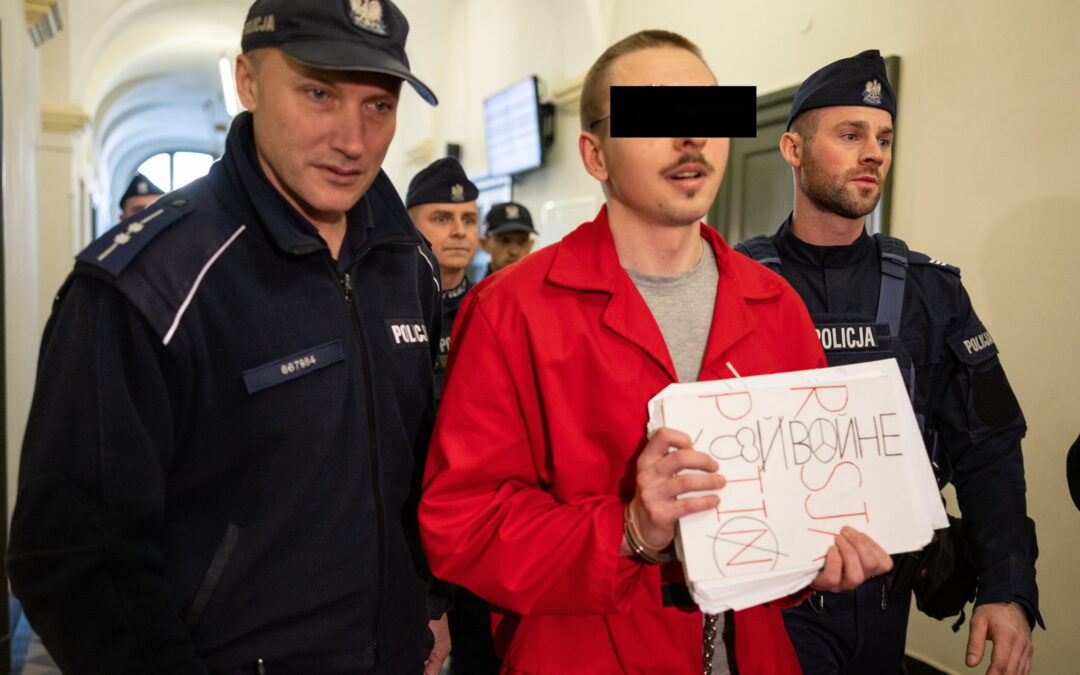
The couple, who can be named only as Igor R. and Irina R. under Polish privacy law, were pictured arriving at court in the city of Sosnowiec on Tuesday. However, the trial has been closed to the public at the request of prosecutors to protect information relating to national security.
Proces rosyjskiego małżeństwa w Sosnowcu toczy się za zamkniętymi drzwiami. Oskarżeni o szpiegostwo i zamach, stają przed sądem. #polityka #aktoskarzenia #rosja #sad #sosnowiec #szpieg #fsb https://t.co/N37ITASCay
— Fakt (@Fakt_pl) January 20, 2026
As he was escorted to the hearing by police officers, Igor R. (pictured above) was seen holding a sign containing the words (in Polish) “Russia” and “Putin” and (in Russian) “fuck war”.
The capitalised “N” in Putin was turned on its side to look like a “Z” (the symbol of Russia’s war in Ukraine) with a line crossing it out, while the letter “O” had been turned into a peace symbol.
The couple had previously been students at the University of Silesia and both had refugee status in Poland, reports broadcaster TVN. Igor had been an active member of Russian opposition groups while still in Russia.
Do niedawna byli studentami Uniwersytetu Śląskiego ze statusem uchodźców. Dziś młode rosyjskie małżeństwo Igor i Irina R. stają przed polskim sądem pod zarzutem szpiegostwa.
Pisze @SzotPawel 👇 https://t.co/abFNzEG7rq
— TVN24+ (@tvn24plus) January 20, 2026
But, according to prosecutors, between February and August 2022, Igor R. cooperated with Russia’s Federal Security Service (FSB), including by collecting intelligence on Russian opposition figures. Irina R. then sought to pass the information on to the FSB on an electronic storage device.
Igor R. is additionally accused of working as part of a group – also containing another Russian and two Ukrainian citizens – to send a parcel containing a nitroglycerin-based explosive and military-grade electronic detonators.
The group sought to have the package transported by a courier company, and it was discovered in a warehouse in Poland belonging to the delivery firm.
The couple, who were detained in July 2024 and indicted in October 2025, are both charged with espionage. However, because their alleged offences occurred before the relevant law was toughened to increase penalties to up to life in prison, they would face up to 15 years if convicted.
Igor R. is additionally charged with causing a large-scale threat to the lives or health of other people or to property, which is punishable by up to eight years in prison.
Igor R.’s defence lawyer, Marta Smołka, told the Polish Press Agency (PAP) that they were opposed to the trial being held behind closed doors given that “there’s so much [information] circulating in the public sphere” already. She argues that open proceedings offer a great guarantee of fairness and transparency.
Poland has charged five people – four Ukrainians and one Russian – with carrying out sabotage on behalf of Russia by putting explosives in packages then sending them by courier across Europe.
Two of the items exploded at airports in the UK and Germany https://t.co/Fh3qZW8fQp
— Notes from Poland 🇵🇱 (@notesfrompoland) January 16, 2026
Poland has in recent years detained, charged and in some cases convicted dozens of agents accused of carrying out espionage, sabotage and other so-called “hybrid actions” on behalf of Russia.
Last week, Polish prosecutors indicted five people – four Ukrainian citizens and one Russian – accused of carrying out a plot on behalf of Russia to plant explosives in packages that were then dispatched by courier services across Europe.
Notes from Poland is run by a small editorial team and published by an independent, non-profit foundation that is funded through donations from our readers. We cannot do what we do without your support.
Main image credit: Grzegorz Celejewski / Agencja Wyborcza.pl

Daniel Tilles is editor-in-chief of Notes from Poland. He has written on Polish affairs for a wide range of publications, including Foreign Policy, POLITICO Europe, EUobserver and Dziennik Gazeta Prawna.