Keep our news free from ads and paywalls by making a donation to support our work!

Notes from Poland is run by a small editorial team and is published by an independent, non-profit foundation that is funded through donations from our readers. We cannot do what we do without your support.
Opposition-aligned President Karol Nawrocki has signed the state budget for 2026 into law despite expressing strong reservations about the government’s management of the economy.
He called it a “budget of chaos”, but also acknowledged that, if he had taken the unprecedented decision not to sign the budget, it would have caused even greater uncertainty.
At the same time as signing the bill, Nawrocki also referred it to the Constitutional Tribunal (TK) for assessment. However, any decision the TK makes will be ignored by the government, which regards the tribunal as illegitimate.
Ten budżet jest dowodem głębokiego kryzysu wiarygodności, skuteczności i sprawczości obecnego rządu. To budżet, który pokazuje bezradną kapitulację wobec wyzwań, przed jakimi stoi Polska. To budżet niespełnionych obietnic z kampanii wyborczej, zawiedzionych oczekiwań Polaków. pic.twitter.com/nF8HIpBK1D
— Kancelaria Prezydenta RP (@prezydentpl) January 19, 2026
Unlike other bills, the budget act cannot be vetoed by the president. When it was sent to Nawrocki by parliament last Tuesday, the president had one week to decide between three options.
He could have simply signed the bill into law – always an unlikely choice for an opposition-aligned president who has regularly clashed with the government.
The second option was to sign it into law while also sending it to the TK for assessment, as was done by Nawrocki’s predecessor, Andrzej Duda, also an opposition ally, in each of the last two years.
Finally, he could have refused to sign the budget and at the same time sent it to the TK. No president has ever taken that option, and doing so would have created weeks, and possibly months, of fiscal and legal uncertainty.
Last week, Nawrocki said that he still did “not know what I will do” and remained “open to every possibility”. However, on Tuesday evening, the president announced that he had opted for option number two.
It means that the TK has up to two months to assess the budget and issue a ruling on its constitutionality. In the meantime, the budget goes into force as normal.
Given that the TK is stacked with opposition-aligned judges, it is likely to find fault with the budget. But it will almost certainly be ignored (as it was last year) by the government, which does not recognise the TK because it contains judges unlawfully appointed by the former Law and Justice (PiS) government.
The constitutional court has found that parts of the state budget cutting funding for judicial bodies, including the court itself, are unconstitutional.
The ruling is likely to be ignored by the government, which does not recognise the court's legitimacy https://t.co/vEkBmlhvIh
— Notes from Poland 🇵🇱 (@notesfrompoland) May 7, 2025
In a recorded speech, the president declared that the budget is “evidence of a deep crisis of credibility in the current government” and “demonstrates a helpless capitulation to the challenges facing Poland”.
In particular, Nawrocki criticised its impact on the level of debt, noting that it is the second year in a row in which the deficit is equivalent to almost a third of total spending.
“This means that every third zloty spent comes from debt. It is financed on credit…sinking the country into debt for decades.”
Poland has faced questions over its public finances in recent years. In 2024, the European Union placed Poland under its excessive deficit procedure, requiring it to take steps to bring the deficit, which stood at 6.5% of GDP that year, to below the EU target of 3%.
Poland's debt has been growing at the second-fastest rate in the EU this year, and is set to continue rising.
What is behind this trend – and should we be worried – asks Alicja Ptak in the latest of her series of articles and podcasts on Poland’s economy https://t.co/1pvnb2ZxoY
— Notes from Poland 🇵🇱 (@notesfrompoland) November 30, 2025
The deficit in fact rose to an estimated 6.8% of GDP in 2025 but is now forecast to decline to 6.3% in 2026 and 6.1% in 2027, according to the European Commission.
In the second quarter of last year, Poland’s public debt rose at the second-fastest annual rate in the EU. In the autumn, two of the big three credit ratings agencies – Fitch and Moody’s – shifted their outlook for Poland to negative, citing concern over “deteriorating public finances” and growing “political polarisation”.
However, despite his concerns over the budget, Nawrocki said that refusing to sign it into law “would not solve any of the problems we face” but would “pose a risk to the stability and predictability of state affairs”.
Credit ratings agency Fitch has revised Poland’s outlook to negative, citing “deteriorating public finances” and “political polarisation”.
The finance minister blamed the opposition-aligned president. But the opposition says the government is responsible https://t.co/tQ6fh3hWZS
— Notes from Poland 🇵🇱 (@notesfrompoland) September 6, 2025
Finance minister Andrzej Domański has, by contrast, called the government’s spending plans “a budget for an ambitious and secure Poland”, with a focus on “investments in innovation, digitisation and the competitiveness of our economy”.
In response to Nawrocki’s decision, Domański issued a brief statement: “The president has signed the budget. A budget of investments and record-high defence spending. The rest, including referring the bill to the Constitutional Tribunal, is political theatre with no real consequences. We continue working.”
Poland’s defence spending, which was already at the highest relative level in NATO, will now rise further to just over 200 billion zloty (€47.4 billion), the equivalent of 4.8% of GDP, this year. The budget also devotes 249 billion zloty, 6.8% of GDP, to healthcare.
Poland will next year increase defence spending to 4.8% of GDP, the highest relative level in NATO, according to a new draft budget published by the government.
The plans also include increased healthcare spending but a lower budget deficit https://t.co/2OZfigLo6Z
— Notes from Poland 🇵🇱 (@notesfrompoland) August 29, 2025
Notes from Poland is run by a small editorial team and published by an independent, non-profit foundation that is funded through donations from our readers. We cannot do what we do without your support.
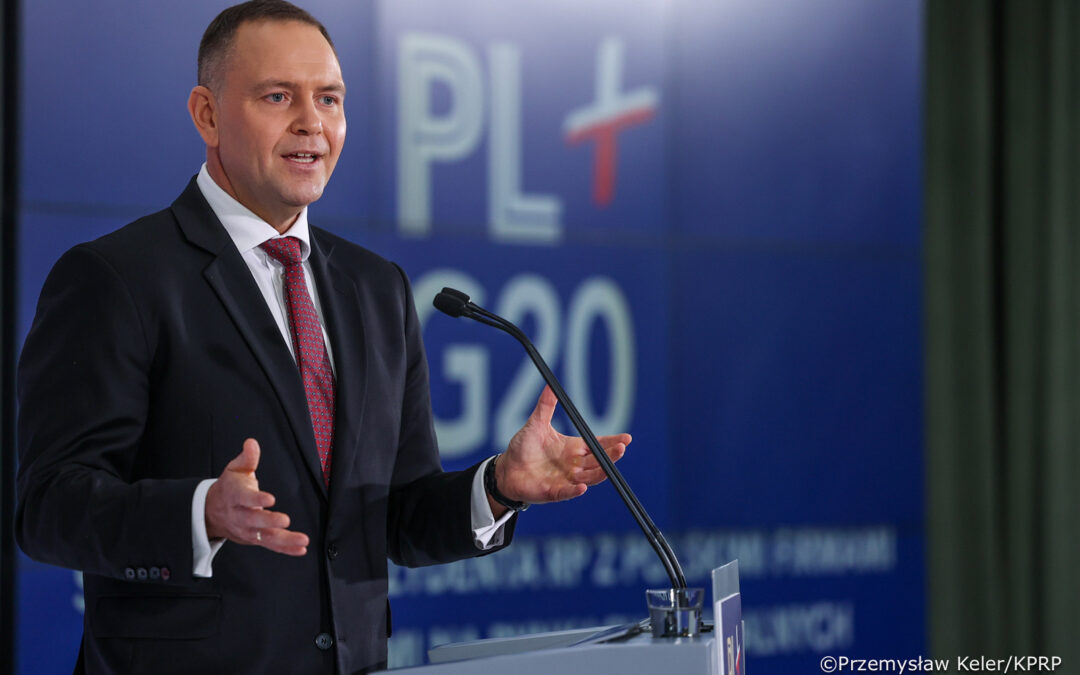
Main image credit: Przemysław Keler/KPRP

Daniel Tilles is editor-in-chief of Notes from Poland. He has written on Polish affairs for a wide range of publications, including Foreign Policy, POLITICO Europe, EUobserver and Dziennik Gazeta Prawna.