Keep our news free from ads and paywalls by making a donation to support our work!

Notes from Poland is run by a small editorial team and is published by an independent, non-profit foundation that is funded through donations from our readers. We cannot do what we do without your support.
In a further deepening of Poland’s rule-of-law crisis, a group of Supreme Court judges has issued a resolution rejecting the right of the European Union to regulate Poland’s justice system.
They also denied the right of other public authorities to disregard the rulings of judges – such as themselves – appointed after the former Law and Justice (PiS) government’s contested judicial reforms.
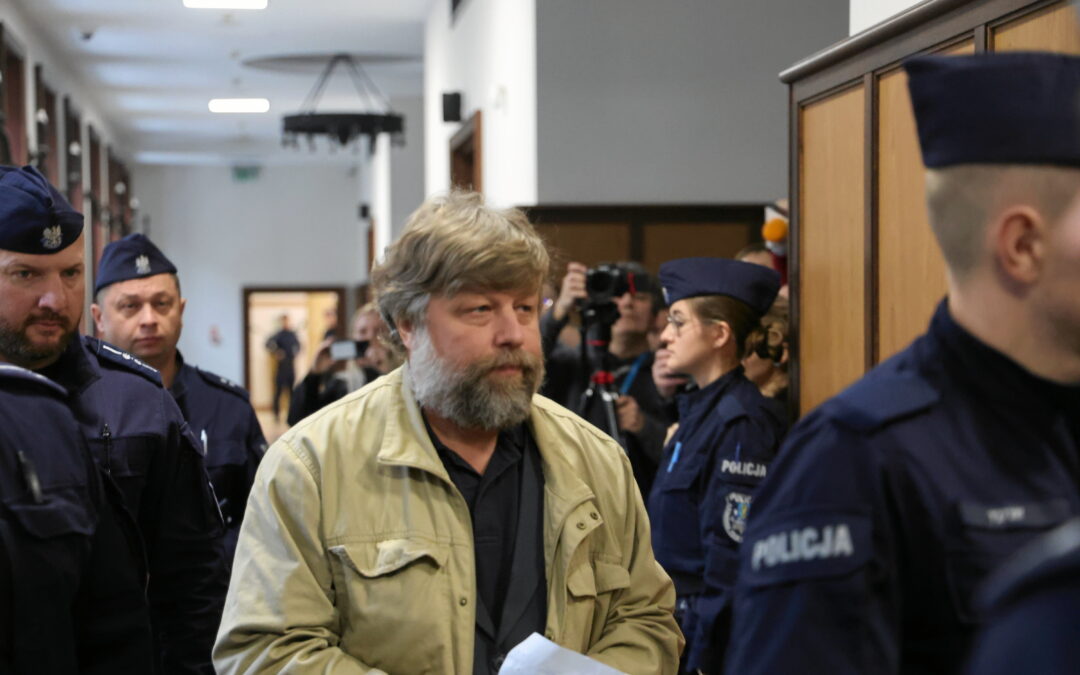
Today’s joint session of the Supreme Court’s extraordinary review and public affairs chamber and its labour and social security chamber was held in a tense atmosphere. As it got underway, police had to remove protesters from the public gallery who were shouting “you are not a court, you are not judges”.
📢Skandaliczne zakłócanie obrad Sądu Najwyższego! Zwolennicy Żurka i Tuska wkroczyli do akcji⁉️#Relacja wPolsce24 pic.twitter.com/zy63wjdRfx
— wPolsce24 🇵🇱 #TuJestPolska (@wPolscepl) December 3, 2025
That is because the judges were nominated to the Supreme Court by the National Council for the Judiciary (KRS) after it was overhauled by the former PiS government in a manner that gave politicians control over choosing members of the KRS.
Various Polish and European court rulings – including by the Supreme Court itself – have found that those changes rendered the KRS – and therefore the judges appointed by it – illegitimate because it is under political influence. Such judges are often referred to by opponents as “neo-judges”.
In September, a group of seven “old judges” – appointed before PiS’s overhaul of the KRS – in the Supreme Court’s labour chamber issued a resolution declaring that rulings made by the extraordinary review and public affairs should be treated as “non-existent” due to it being filled entirely with “neo-judges”.
In issuing their decision, they referred to a ruling from earlier that month by the Court of Justice of the European Union (CJEU) that confirmed the illegitimacy of the extraordinary review chamber and said that its judgements should be regarded as “null and void”.
“Courts must meet all requirements established at the EU level,” wrote the presiding judge, Dawid Miąsik.
That resolution, if adhered to by other courts, would have major ramifications, given that the extraordinary review chamber is responsible for, among other things, validating the results of elections.
One chamber of the Supreme Court has found that rulings issued by another of its chambers should be treated as “non-existent” due to the presence of illegitimate judges
The latter chamber is responsible, among other things, for validating election results https://t.co/XGrAiYrQix
— Notes from Poland 🇵🇱 (@notesfrompoland) September 25, 2025
Today, the extraordinary review chamber and labour chamber met to issue a response to legal questions arising from the previous resolution. Four “old judges” from the labour chamber refused to attend due to the presence of “neo-judges”, which they said rendered today’s session illegitimate.
The 23 judges present adopted a resolution declaring that “no court or other public authority is authorised to declare a Supreme Court judgement null and void and disregard its effect, even by invoking European Union law”.
“Poland has not transferred to the bodies of the European Union or any other international organisation the authority to establish norms regulating the organisation and functioning of the national justice system or to determine the scope in which they may be applied,” it continued.
“These competences belong exclusively to the constitutional bodies of Poland,” concluded the resolution.
PILNE! Sąd Najwyższy obalił zasadę prawną. Wzmacnia tzw. neosędziów i uderza w europejskie trybunałyhttps://t.co/1euHXjeuNc
— Rzeczpospolita Prawo (@RPPrawo) December 3, 2025
Supreme Court resolutions are supposed to guide judges in lower courts in making decisions. However, there are now two conflicting resolutions, reflecting the duality of the legal system in Poland, which is split between judges and institutions that are often completely at odds with one another.
Today’s resolution was immediately condemned by one of the labour chamber judges who had refused to attend the proceedings, Piotr Prusinowski.
“If anyone wants to [see] what the Supreme Court should not look like, they should watch the broadcast of [today’s] proceedings,” he told news website Onet.
“People whose status as judges is flawed, preventing them from constituting a court, and whom no one in Europe, nor even collectively in Polish courts and universities, recognises as a court, have just ‘decided’ that they are the Supreme Court, and no one can claim they are not,” he added.
Fifteen months since the change of government, Poland's rule-of-law crisis continues – indeed, many Poles think the situation has got worse.@J_Jaraczewski explains the roots of the crisis, what its impact has been, and how it might be resolved https://t.co/7KOCURV3dU
— Notes from Poland 🇵🇱 (@notesfrompoland) March 17, 2025
When it came to power in 2023, the current government pledged to restore the rule of law and efficacy of the courts by reversing many of PiS’s judicial reforms. That has included proposing measures to deal with the roughly 2,500 judges at various levels nominated by the KRS after it was overhauled.
However, it has made little progress in that regard, in some cases due to opposition from former PiS-aligned President Andrzej Duda but in many others because the ruling coalition has not agreed on measures to put to parliament.
An opinion poll published in September found that the proportion of Poles who say they distrust their country’s courts has now risen to 57%, the highest level ever recorded and up from 41% when PiS left office in 2023.
Notes from Poland is run by a small editorial team and published by an independent, non-profit foundation that is funded through donations from our readers. We cannot do what we do without your support.
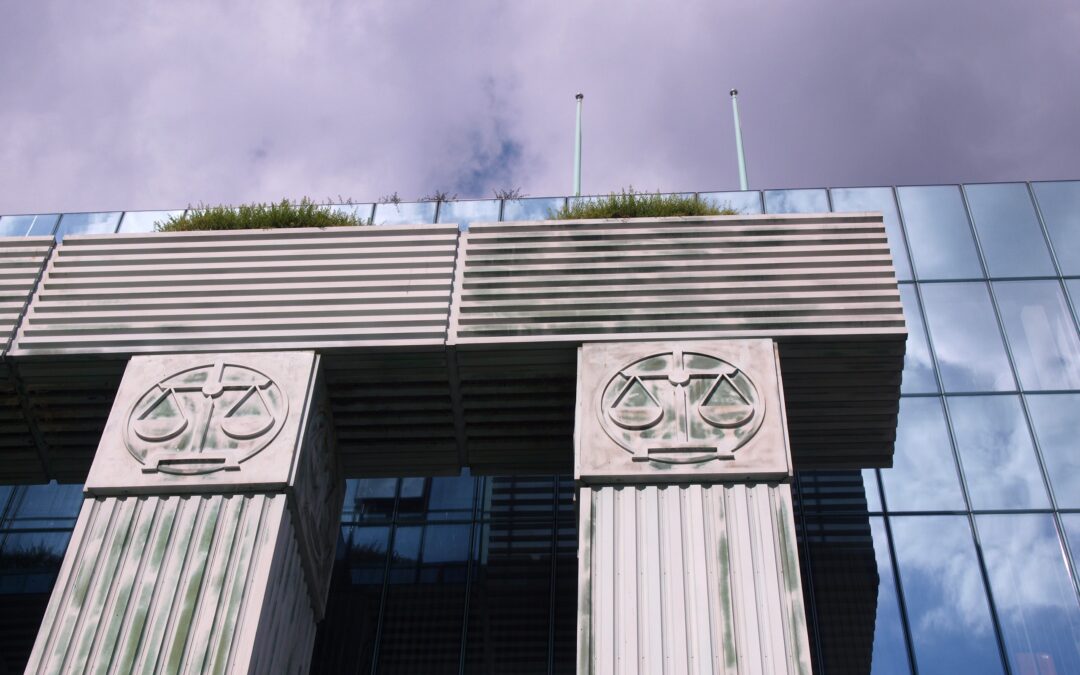
Main image credit: tomislav medak/Flickr (under CC BY 2.0)

Daniel Tilles is editor-in-chief of Notes from Poland. He has written on Polish affairs for a wide range of publications, including Foreign Policy, POLITICO Europe, EUobserver and Dziennik Gazeta Prawna.