Keep our news free from ads and paywalls by making a donation to support our work!

Notes from Poland is run by a small editorial team and is published by an independent, non-profit foundation that is funded through donations from our readers. We cannot do what we do without your support.
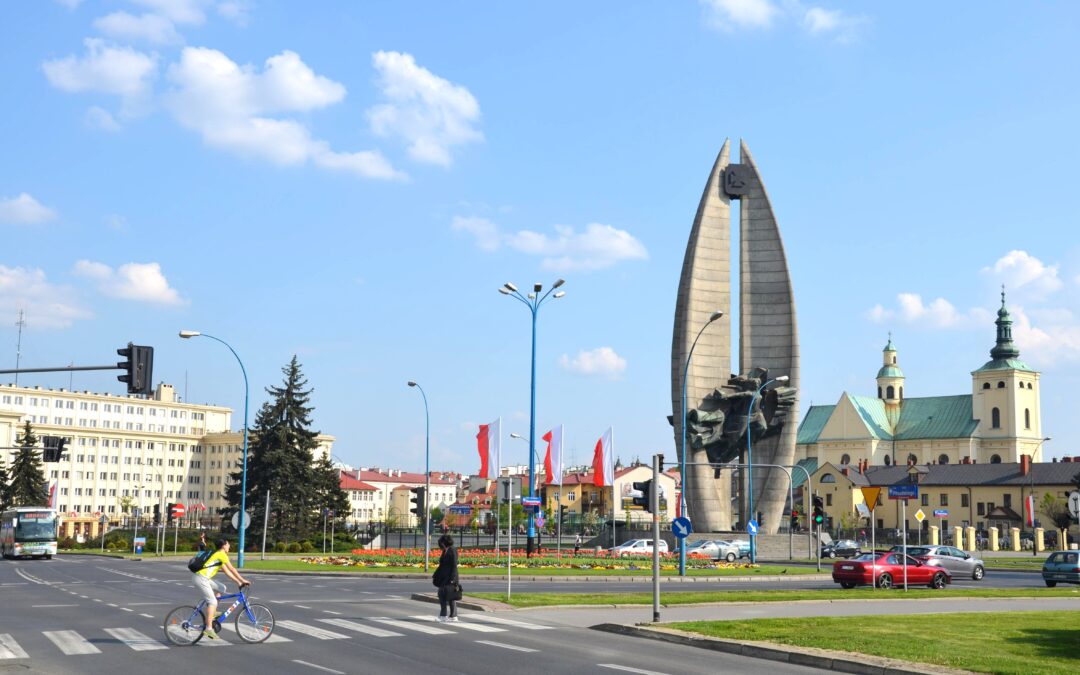
A huge communist-era monument in the city of Rzeszów has been saved from potential demolition after being added to Poland’s list of protected monuments.
The 38-metre-tall Monument to the Revolutionary Struggle, built in the early 1970s at the behest of local communist officials, dominates the skyline in central Rzeszów and has become the city’s most famous landmark – but also its most controversial.
The current owners of the land upon which it sits had hoped to demolish the monument, regarding it as an unwanted symbol of communist domination.
But the culture ministry has this week confirmed a decision by local conservation authorities to legally protect the monument – a move welcomed by Rzeszów’s mayor, who says that residents want to keep the monument.
Dziękuję Pani Minister za decyzję, na którą liczyły tysiące rzeszowian. To ważna wiadomość. Pomnik Czynu Rewolucyjnego jest jednym z najbardziej rozpoznawalnych symboli Rzeszowa i elementem jego tożsamości. Dziękuję Fundacji Rzeszowskiej, rzeszowskim dziennikarzom i artystom pic.twitter.com/ee1SQllvhH
— Konrad Fijołek (@FijoKonrad) October 1, 2025
The land that the monument sits on was in 2006 transferred to the Bernardines – a Catholic religious order that has a monastery alongside it – by the city council on the basis that the land had been previously confiscated from the monks during the communist era.
In 2017, the state Institute of National Remembrance (IPN) recommended that the monument be demolished under a “decommunisation” law recently passed by the then-ruling conservative Law and Justice (PiS) government. Local PiS politicians supported the plans.
However, they were opposed by the city’s then-mayor, Tadeusz Ferenc, a left-wing politician and former member of the communist party, who sought to have the monument added to the official register of protected monuments, which would prevent its demolition. That prompted years of political and legal wrangling.
In 2024, the Bernardines transferred ownership of the monument to an association representing families of underground soldiers who fought against the imposition of communism in Poland. That group, the Association of Families of Cursed Soldiers of Podkarpacie (SRŻNP), hoped to demolish it.
However, later that year, the provincial office for the protection of monuments decided to add the monument to the protected list, arguing that it is “an integral element of the urban structure of Rzeszów’s city centre”. The SRŻNP appealed that decision.
But now the culture ministry has rejected that appeal and the monument has been added to the protected list.
The development was welcomed by the city’s current left-wing mayor, Konrad Fijołek, who like Ferenc has fought against the demolition of the monument. Fijołek is aligned with Poland’s current national ruling coalition, which ranges from left to centre-right.
“I thank the [culture] minister for the decision that thousands of Rzeszów residents were counting on,” he wrote on social media. “The Monument to the Revolutionary Struggle is one of the most recognisable symbols of Rzeszów and an element of its identity.”
Opinion polls taken among residents of the city suggest that most favour keeping the monument, which is sometimes referred to by a vulgar nickname based on its purported resemblance to part of the female anatomy.
A survey carried out by the University of Rzeszów’s Institute of Sociology in 2015 found that only 11% of residents favoured demolishing it. A 2023 poll by the university’s Political Science Research Group for the Gazeta Wyborcza daily found that 19% wanted it demolished.
In 2020, local residents in the town of Dąbrowa Górnicza won a similar battle to save a communist-era monument from demolition under the PiS government’s decommunisation law. However, dozens of Soviet era monuments have been removed under the law.
A Polish city has won a long-running battle to stop a communist-era monument from being removed
In the 1990s, they saved the statute by renaming it in honour of Jimi Hendrix. Now a court has ruled that it cannot be dismantled under a "decommunisation" law https://t.co/M5TlYDUQCU
— Notes from Poland 🇵🇱 (@notesfrompoland) September 15, 2020
Notes from Poland is run by a small editorial team and published by an independent, non-profit foundation that is funded through donations from our readers. We cannot do what we do without your support.
Main image: Silar/Wikimedia Commons (under CC BY-SA 3.0)

Daniel Tilles is editor-in-chief of Notes from Poland. He has written on Polish affairs for a wide range of publications, including Foreign Policy, POLITICO Europe, EUobserver and Dziennik Gazeta Prawna.