Keep our news free from ads and paywalls by making a donation to support our work!

Notes from Poland is run by a small editorial team and is published by an independent, non-profit foundation that is funded through donations from our readers. We cannot do what we do without your support.
More than 30 MPs from the national-conservative Law and Justice (PiS), Poland’s main opposition party, have effectively resigned after refusing to sign a loyalty pledge, party leader Jarosław Kaczyński has announced.
The dispute centres around a more moderate faction in the party aligned with former prime minister and deputy PiS leader Mateusz Morawiecki, who is one of those now set to be expelled from the party. They have for months been unhappy with PiS’s move in a hard-right direction.
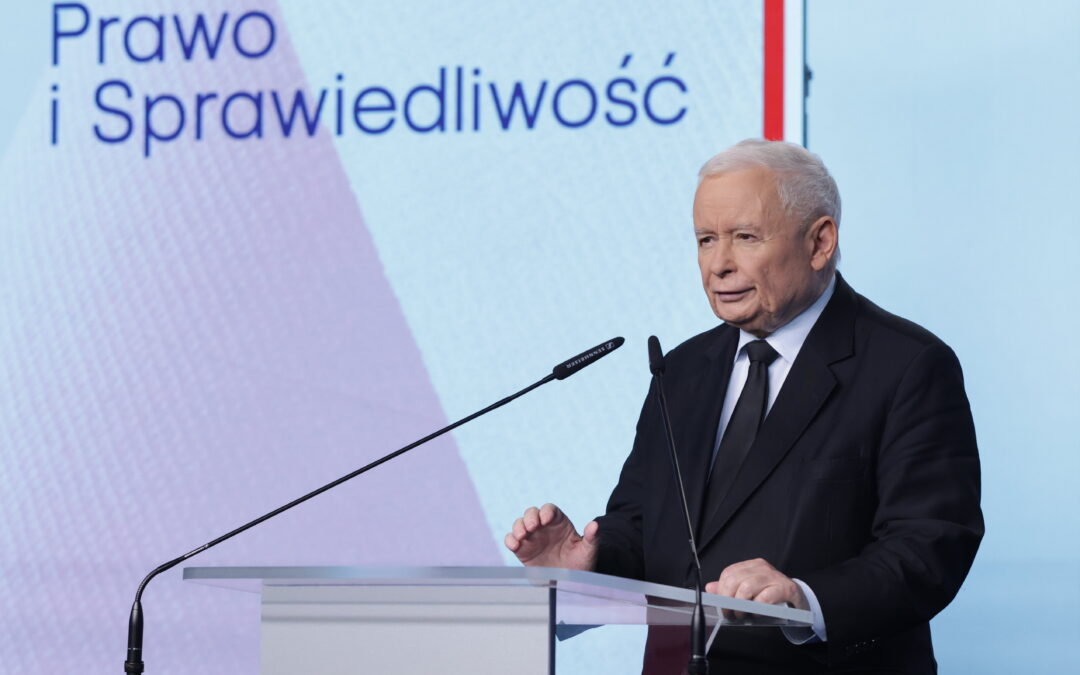
💬 Prezes PiS Jarosław Kaczyński @OficjalnyJK.
👉 Udostępnij pic.twitter.com/bycjE0Yq0f— Prawo i Sprawiedliwość (@pisorgpl) July 24, 2026
“Around 30-something…of our group’s MPs have resigned,” revealed Kaczyński at a press conference on Friday. He added that their departures would be formalised at a meeting of the party’s political committee scheduled for Tuesday next week.
Kaczyński’s announcement came after a deadline expired at midnight on Thursday for its MPs to sign a pledge of loyalty to the party that included a commitment not to be members of any external political associations.
That measure was aimed in particular at an association called Development Plus (Rozwój Plus) founded by Morawiecki in April. The former prime minister had always insisted that his organisation was intended as complementary to PiS, rather than a rival to it.
However, many figures in the party saw it as an attempt by Morawiecki to create a separate centre of power, and potentially to use the association as a launchpad for creating his own party ahead of the autumn 2027 parliamentary elections.
The right-wing opposition PiS party has threatened disciplinary action, including exclusion from electoral lists, against dozens of its MPs who have joined a new internal group led by former PM @MorawieckiM and intended to appeal to more moderate voters https://t.co/y62Cm361U2
— Notes from Poland 🇵🇱 (@notesfrompoland) April 17, 2026
After PiS issued a resolution on Wednesday last week requiring that its parliamentarians pledge to withdraw from any such associations, most of its 186 MPs quickly complied. However, a group of between 30 and 40 who are part of Development Plus refused to do so.
“Everyone knew what they were supposed to sign, and knew the consequences of not signing,” said Kaczyński on Friday. “And so they made the decision they did.”
“In this situation, we cannot view the [Development Plus] association as anything other than a component of a plan…to split our party,” he added. However, although its supporters will now leave PiS, “we want to part ways without any animosity”, said Kaczyński.
After Kaczyński’s announcement, senior figures from Development Plus made clear that no one from their association had resigned from PiS. They had simply not signed the declaration of loyalty demanded by the party.
Later, Morawiecki himself held a press conference in parliament surrounded by his supporters. He claimed that an unnamed “small group of schemers” within PiS had been seeking to turn Kaczyński against him and push him out of the party.
“We fought for the unity of Law and Justice until the very end,” declared Morawiecki, who said that his group included 40 MPs, one senator and three MEPs. However, three of the MPs are not members of PiS, and therefore were not expected to sign the loyalty declaration.
Szanowni Państwo!
🟦Do ostatniej chwili walczyłem o jedność Prawa i Sprawiedliwości. Nie o stanowiska. Nie o osobiste ambicje. Nie o wpływy.
🟦Walczyłem o jedność obozu, który przez osiem lat zmieniał Polskę – budował jej bezpieczeństwo, rozwijał gospodarkę i przywracał godność… pic.twitter.com/PP7sOkzMHp
— Mateusz Morawiecki (@MorawieckiM) July 24, 2026
If the expulsion of Morawiecki’s supporters is confirmed, it will mark a major shake-up of Poland’s political landscape. PiS has for the last two decades been the dominant force on the Polish right, including periods leading governments in 2005-2007 and 2015-2023.
However, since losing power at elections in 2023, when the party won 35% of the vote, PiS has seen its average support in polls fall to around 23-24%, the lowest level in 14 years.
Meanwhile, it has been challenged by the rise of the far right, where two parties, Confederation (Konfederacja) and Confederation of the Polish Crown (KKP), now together poll a similar combined level of support to PiS.
In response, Kaczyński in March named a hardline figure, Przemyszław Czarnek, as PiS’s candidate for prime minister in next year’s elections. Czarnek was seen as someone who could appeal to far-right voters, while also potentially working with the far right if a coalition was needed after the elections.
Support for PiS has fallen to its lowest in 14 years, as the party grapples with internal division, the rise of far-right challengers, living in President Nawrocki's shadow, and the unpopularity in Poland of PiS ally Donald Trump, writes @danieltilles1 https://t.co/QRScBpEQQG
— Notes from Poland 🇵🇱 (@notesfrompoland) March 2, 2026
However, there has been no rise in support for PiS since Czarnek was named, prompting growing concern from more moderate figures within the party, led by Morawiecki.
They argue that PiS has wrongly disowned many of the successes of its time in office before 2023, and they fear that its rightward shift damages its chances of winning over more centrist voters.
Morawiecki, who was an international banker before joining PiS to become finance minister and then prime minister, wants the party to focus on more technocratic issues, such as economic development, rather than Euroscepticism and culture wars.
That has led to frequent public sparring between his supporters and others in the party. In April, PiS threatened disciplinary action against members of Development Plus. Kaczyński and Morawiecki then reached an agreement that allowed the association to continue. But that uneasy truce has now fallen apart.
Notes from Poland is run by a small editorial team and published by an independent, non-profit foundation that is funded through donations from our readers. We cannot do what we do without your support.
Main image credit: Dawid Zuchowicz / Agencja Wyborcza.pl

Daniel Tilles is editor-in-chief of Notes from Poland. He has written on Polish affairs for a wide range of publications, including Foreign Policy, POLITICO Europe, EUobserver and Dziennik Gazeta Prawna.