Keep our news free from ads and paywalls by making a donation to support our work!

Notes from Poland is run by a small editorial team and is published by an independent, non-profit foundation that is funded through donations from our readers. We cannot do what we do without your support.
By Aleks Szczerbiak
The parliamentary survival of Poland’s agrarian party is on a knife edge as it has lost much of its core rural-agricultural electorate and its distinctive identity is overshadowed in the governing coalition. The party’s ability to clear the electoral representation threshold could determine whether pro-government groupings secure a majority at the next election.
A class-based rural-agricultural party
In December 2023, a coalition headed up by liberal-centrist Civic Coalition (KO, until last autumn Civic Platform: PO) leader Donald Tusk took office following eight years’ rule by the right-wing Law and Justice (PiS) party, currently the main opposition grouping.
The ruling coalition also includes: the agrarian Polish People’s Party (PSL), liberal-centrist Poland 2050 (Polska 2050) party and breakaway Centre (Centrum) caucus, and the New Left (Nowa Lewica).
The ruling coalition is likely to survive until next year's election, but its prospects are hampered by a weak domestic record, writes @AleksSzczerbiak
The government has therefore made security key to its reelection narrative, but that also carries risks https://t.co/w2UeNaTwAO
— Notes from Poland 🇵🇱 (@notesfrompoland) June 1, 2026
PSL was formed in 1990 as the organisational successor to the former communist satellite United Peasant Party (ZSL), although it attempted to legitimate itself by claiming to have roots in the pre-communist agrarian movement which dates back to the 19th century.
Peasant parties were prominent in inter-war Polish politics, and the movement provided the main political opposition to the communist takeover in the late 1940s.
In the 1990s, it was estimated that 25% of Poles were employed in the farming sector, mostly in peasant smallholdings that survived as an independent economic sphere throughout the communist period. This provided PSL with a substantial segment of the electorate that it could appeal to on the basis of a clear socioeconomic interest and collective identity.
Consequently, it was a junior coalition partner in the governments led by the communist successor Democratic Left Alliance (SLD) between 1993 and 1997 (with its leader Waldemar Pawlak prime minister from 1993 to 1995) and 2001 to 2003.
A near-death experience
The party returned to office in 2007, when it became PO’s junior governing partner, a coalition that lasted two terms until 2015, when it was ousted by PiS.
Over the years, PiS severely eroded PSL’s core rural-agricultural electoral base, and the agrarians had a near-death experience in the 2015 parliamentary election, when they only just crossed the 5% representation threshold for individual parties.
PSL leaders have often talked about rebranding the grouping as a broader centrist formation in the way that some west European agrarian parties evolved from class-based organisations into more “catch-all” groupings.
In the 2019 election, for example, it headed up a broader centre-right “Polish Coalition” (KP) bloc including right-wing anti-establishment rock star Paweł Kukiz (although the bloc’s candidates actually ran on the party’s electoral lists to avoid the higher 8% threshold for formal electoral coalitions). In the event, KP secured a solid 8.6% of the votes.
Crucial to the Tusk government’s majority
PSL contested the most recent autumn 2023 parliamentary election as part of the Third Way (Trzecia Droga), an eclectic electoral coalition with Poland 2050, a party founded by former TV personality-turned-politician Szymon Hołownia to capitalise on his strong third-placed showing in the 2020 presidential election.
In the event, Third Way effectively recaptured Hołownia’s claim to represent a fresh, untainted alternative to the dominant KO-PiS duopoly and finished third with a larger-than-expected 14.4% share of the votes.
PSL, and Third Way more broadly, were thus crucial elements of the current governing parties’ election-winning coalition, acting as an effective channel or “gateway” for picking up uncertain voters who were disillusioned with PiS but reluctant to back KO directly and return Tusk to office.
The Third Way project stayed together for the spring 2024 local elections, when its support held steady (14% in the regional assembly polls), and summer European Parliament (EP) election, when it slumped to only 7%.
But, following Hołownia’s unsuccessful 2025 presential bid – he finished fifth with just under 5% of the votes – PSL decided to end the alliance and contest future elections under its own banner.
PSL and Poland 2050, the two parties that make up the Third Way alliance, have confirmed that they are splitting and will stand separately at the next elections.
They will, however, remain part of @donaldtusk's ruling coalition https://t.co/NduEJY25eE
— Notes from Poland 🇵🇱 (@notesfrompoland) June 18, 2025
But on a knife edge
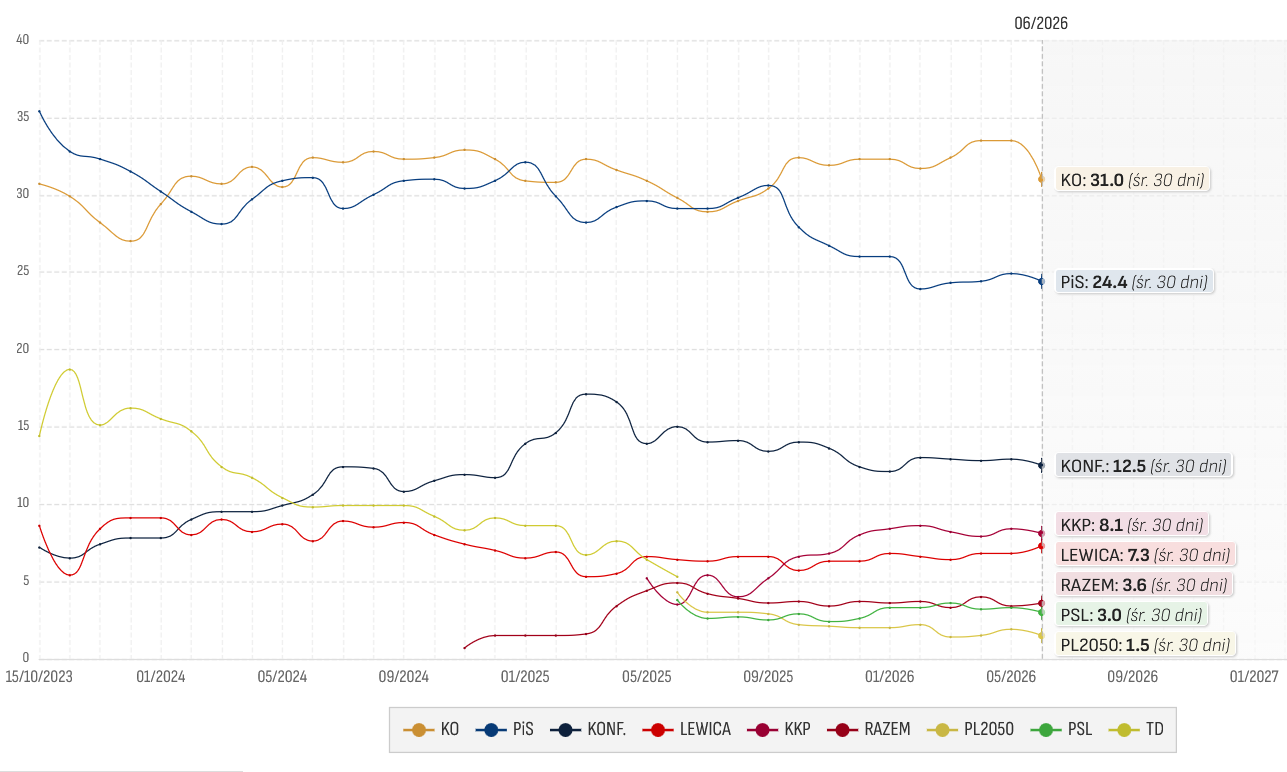
However, since then the party’s opinion poll ratings have been consistently below the 5% threshold in the low-to-mid single digits. One of the key reasons why PSL, and the Third Way project more generally, lost support after its strong 2023 performance was that, by aligning so closely with a KO-dominated government, it came to be seen as a loyal, uncritical appendage of the main governing party.
It thereby failed to carve out a distinctive identity as a genuine alternative to the dominant KO-PiS duopoly.
All of this really matters for the governing coalition because, although KO is currently well ahead in the opinion polls as the most competitive individual grouping, if an election were held today the current ruling parties would likely fall short of an overall parliamentary majority.
This is because overall the right-wing opposition has greater combined strength and, crucially, some of KO’s smaller coalition partners that it needs to deliver the extra parliamentary seats required for a majority cannot be sure of crossing the 5% threshold.
And PSL’s situation is the most knife-edge, but crucial as to whether the coalition can boost its seat total and prevent the “wasted” votes that would otherwise help the right-wing opposition erase its parliamentary majority.
A single pro-government mega-list?
Since Third Way’s dissolution, there has been constant speculation about how PSL will attempt to cross the threshold next time. At this stage, in spite of poor opinion poll ratings, party leaders claim that the matter is settled and appear determined to contest the next election independently.
However, notwithstanding the party’s rural visibility and highly developed local networks in the countryside, a solo run appears extremely risky and there is a good chance that it will be forced to at least consider some alternative strategic and tactical solutions.
Thirty-day polling averages for Poland’s main political groups (source: eWybory.eu)
At first glance, an obvious one would be leveraging KO’s strength and running as part of a single, joint mega-list comprising all the parties affiliated with the Tusk government.
However, for the moment at least, PSL leaders have rejected such a formula, arguing this could risk alienating a large segment of its core, more socially conservative, rural and small-town electoral base, who would find it difficult to vote for an electoral list that included politicians advocating left-liberal policies on moral-cultural issues such as abortion.
Opponents of the single joint list idea often point to the experience of the “European Coalition” (Koalicja Europejska), when virtually all of the opposition to the then-PiS government came together to form a broad alliance dominated by socially liberal and culturally left-wing parties specifically to contest the May 2019 EP elections.
In the event, PiS secured 45%, its highest-ever vote share in a national election, ahead of the Coalition with only 38%, which was less than the combined support of the parties comprising the bloc when it was formed.
At the same time, the New Left is also more inclined to run an independent party list given that polls suggest that it is likely to cross the 5% threshold. Indeed, some analysts who previously supported the idea of a joint list are now significantly more sceptical, citing the fall in left-wing voter enthusiasm for such a project.
Loyalty versus distinctiveness
PSL may be more open to a potential coalition with just KO, as this could allow them to present themselves as the moderate conservative wing of a so-called “democratic coalition”.
In fact, polls and past experience suggest that, even with such a limited electoral coalition, PSL’s distinct profile as a moderate socially conservative grouping with deep roots in the countryside and focused on agriculture, rural development and traditional values would risk being subsumed by KO’s more dominant urban liberal branding.
The centre-right PSL, a junior partner in Poland’s ruling coalition, has asked its members what they would think about forming an alternative government with the national-conservative PiS and far-right Confederation, two opposition parties https://t.co/DQRT94AbaZ
— Notes from Poland 🇵🇱 (@notesfrompoland) June 9, 2025
As well as risking a loss of identity, there are also concerns that Tusk’s much larger party would dominate the merged electoral list with fewer PSL candidates securing winnable positions.
Indeed, even KO leaders argue that it is too early to discuss the idea of a joint list, as this could reinforce the perception that the governing parties are on the defensive.
The government’s immediate priority, they argue, should be implementing its programme so that its constituent elements can contest the election with a more solid record of policy achievements.
As part of this, PSL’s strategy has been to leverage its ministerial posts to position itself as a centre-right grouping that can build consensus and lower the temperature of political debate, thus representing moderate voters who care about the responsible governance of the state.
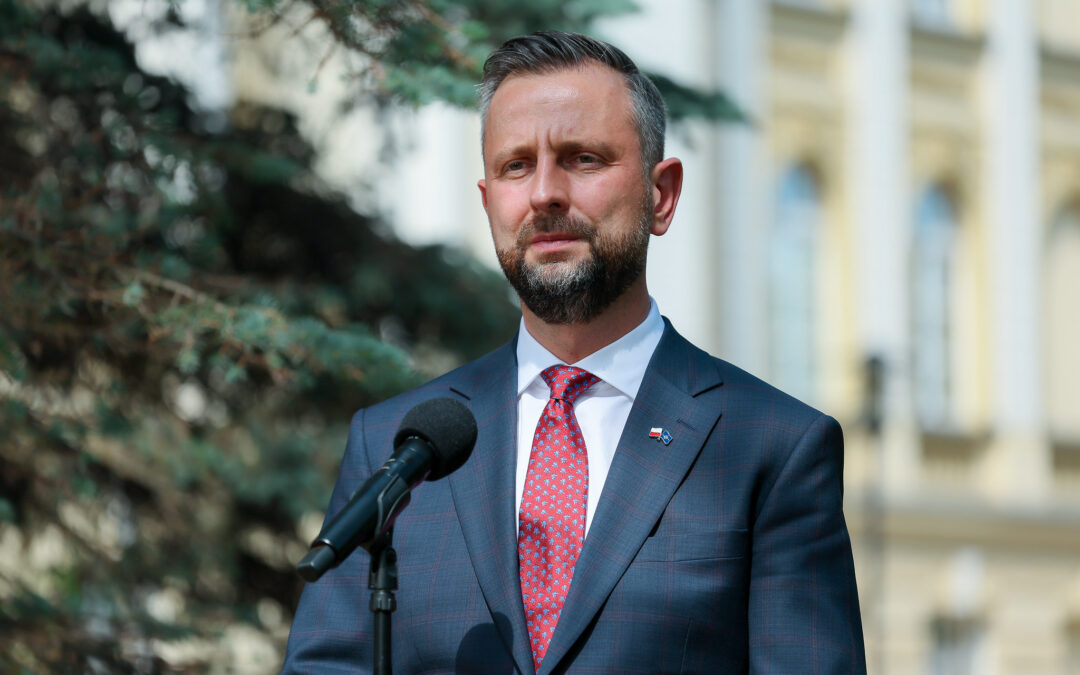
One of the party’s strongest assets here is its emollient leader: deputy prime minister and defence minister Władysław Kosiniak-Kamysz. Some also have high hopes for PSL-linked rising star Magdalena Sobkowiak-Czarnecka, who has enjoyed a very high media profile as the public face of Poland’s €44 billion share of the EU’s Security Action for Europe (SAFE) defence loan programme.
— Magdalena Sobkowiak (@magdasobkowiak) June 26, 2026
However, there is an obvious tension here between remaining loyal to the government and seeking enough autonomy for a credible electoral pitch that is distinctive enough to differentiate PSL from the main ruling grouping.
Arguably, up until now the agrarians have attached too much weight to the former. Sobkowiak-Czarnecka’s public profile is, for example, very detached from any party affiliation.
A looser centrist alliance?
Another option is for PSL to find partners to run as part of a looser centrist alliance, as it did with the Polish Coalition bloc in 2019. One possibility that sparked a flurry of speculation earlier this year was the idea of a link-up with former PiS prime minister, and head of the party’s more centrist modernising-technocratic wing, Mateusz Morawiecki.
Morawiecki is clearly trying to find a place for himself at the centre of the political scene, and is at odds with Law and Justice’s traditionalist-conservative faction that appears to have gained the upper hand within the party.
However, having strengthened his position in recent weeks, the chances of Morawiecki leaving the party have been reduced. At the same time, PSL leaders would find it difficult to justify forming an alliance with, and thereby legitimating, someone whom the Tusk government has accused of being heavily implicated in scandals linked to the previous PiS administration.
The probability of a major split is higher than ever in the history of Poland's right-wing PiS party, writes @AleksSzczerbiak.
Plummeting polling numbers have intensified a dispute between traditionalist-conservative and modernising-technocratic factions https://t.co/c9ntNBOAyG
— Notes from Poland 🇵🇱 (@notesfrompoland) May 11, 2026
Indeed, PSL has plenty of other potential strategic partners, including those rooted more in civil society than political circles.
For example, there have been media reports that the high-profile chief executive of the InPost parcel delivery company, Rafał Brzoska, is planning to create a new pro-business centrist political force open to cooperation with the party.
PSL has been courting entrepreneurs, particularly small and medium-sized businesses, for some time now, albeit with limited success.
What is the party’s long-term strategy?
Beyond the specific challenge that the party faces from PiS for its traditional electoral base, longer-term demographic trends show that Poles are moving away from rural areas and the proportion working in agriculture is declining steadily as modern farms operate increasingly as agrobusinesses rather than traditional peasant smallholdings.
Nonetheless, in spite of its changing electorate and apparently more open political style, plans to modernise PSL have not progressed much beyond rather vague aspirations.
Critics argue that it remains in essence a deeply pragmatic, office-seeking, interest-based rural-agricultural “class” grouping strongly rooted in powerful local patronage networks and provincial transactional politics.
So while the party is well-placed to engage in short-term electoral strategic partnerships and tactical alliances, it still needs to answer the more fundamental, long-term question of: what kind of strategy or vision does a modern-day peasant, or “people’s”, party need in an era when its rural-agricultural roots are no longer sufficient to generate a solid and reliable core electorate?
Notes from Poland is run by a small editorial team and published by an independent, non-profit foundation that is funded through donations from our readers. We cannot do what we do without your support.
Main image credit: KPRM/Flickr (under CC BY-NC-ND 4.0)