
Keep our news free from ads and paywalls by making a donation to support our work!

Notes from Poland is run by a small editorial team and is published by an independent, non-profit foundation that is funded through donations from our readers. We cannot do what we do without your support.
By Alicja Ptak
The article is part of a new series by Alicja Ptak, senior editor at Notes from Poland, exploring the forces shaping Poland’s economy, businesses and energy transition. Each instalment will be accompanied by an in-depth conversation with a leading expert on The Warsaw Wire podcast.
You can listen to the full podcast conversation on Spotify, Apple Podcasts and YouTube.
Take a look at recent headlines in Poland, and it is easy to feel concerned about the labour market:
- “Unemployment in Poland: biggest rise in five years”
- “Disastrous labour market figures. Corporations are quietly getting rid of Poles”
- “A wave of redundancies is just around the corner. These two sectors are in the firing line”
- “Collective redundancies are becoming the norm”
- “Szczecin too expensive for the Swedes. They’re closing a factory and people are losing their jobs”
- “AI is taking jobs “
- “Polish factory to lay off up to 200 workers”
Such reports are not fake news; they describe real events. In April 2026, for example, the number of registered unemployed people did indeed rise by the largest amount in five years.
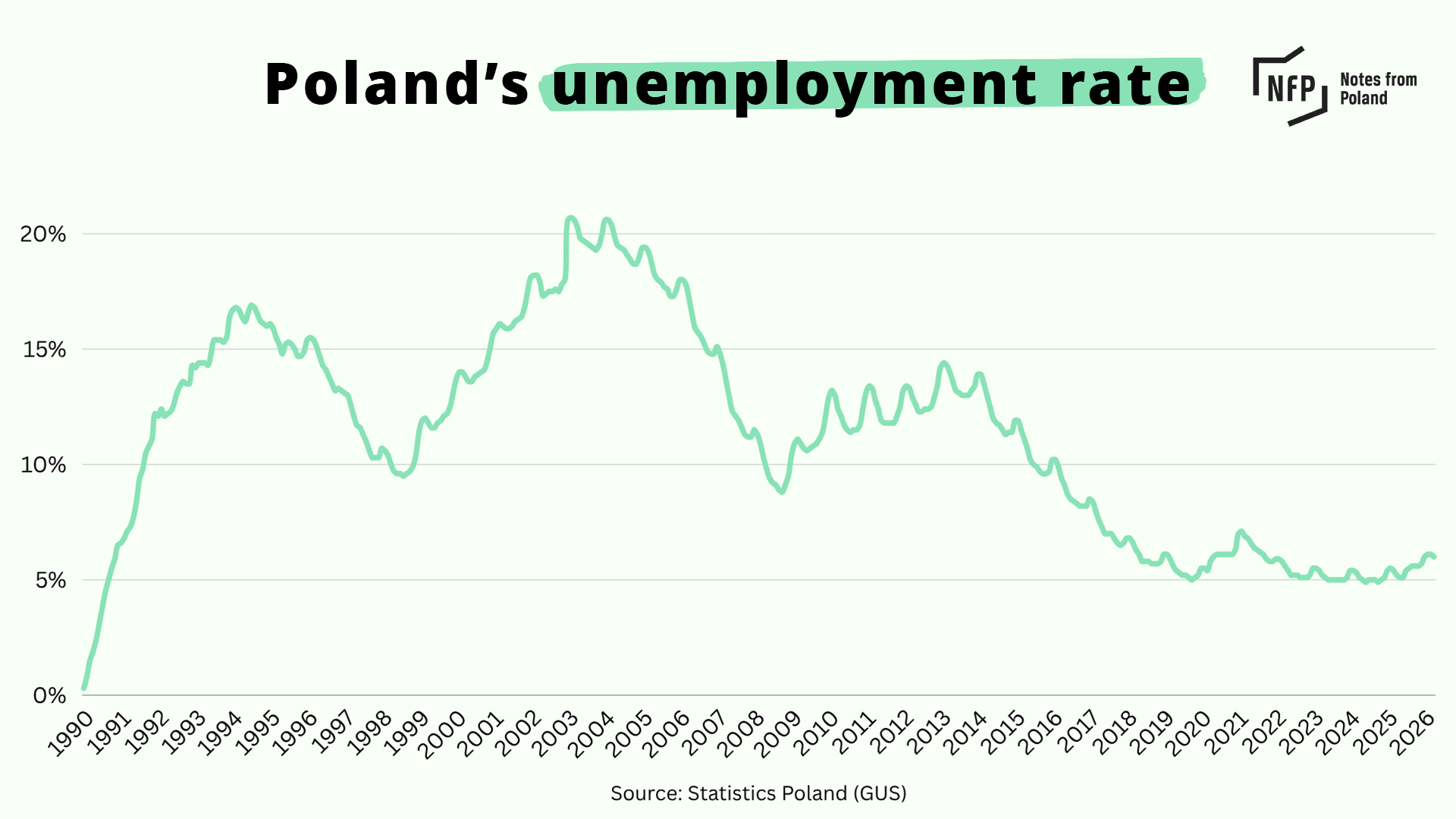
In 2025 and 2026, there was a record number of collective redundancies announced by large firms. Between April 2025 and April 2026, the unemployment rate increased from 5.2% to 6%.
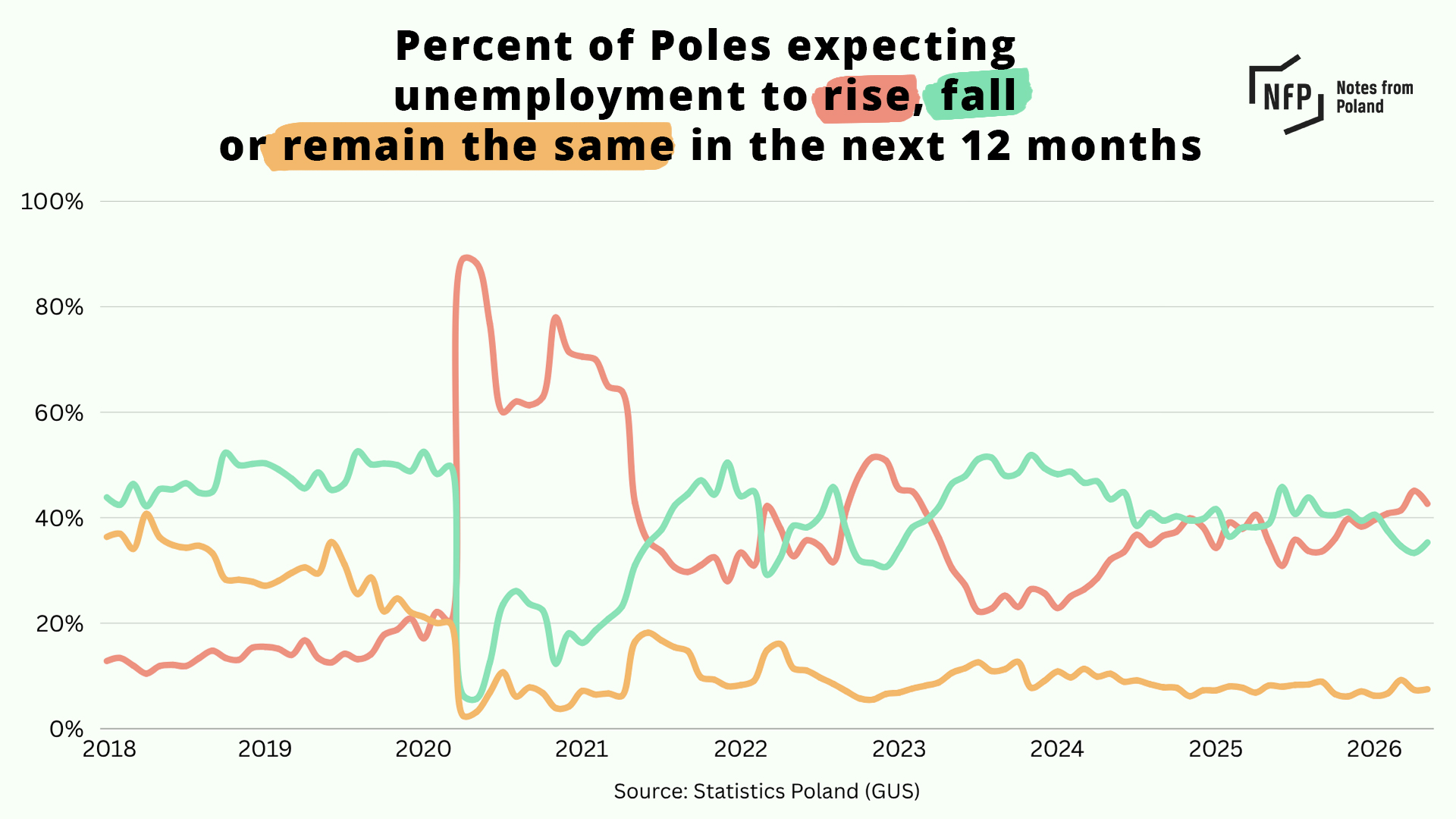
Poles themselves have also become more pessimistic. According to regular surveys conducted by Statistics Poland (GUS), a state agency, 45% of respondents expect unemployment to rise over the next 12 months, and a growing number believe that labour market conditions are deteriorating.
Yet economists remain stubbornly optimistic. Seemingly at odds with both media narratives and public sentiment, they point to a different set of indicators: rising employment, steadily growing wages, and the slowest pace of job losses in years.
Some also note that, despite a recent uptick in unemployment – which they say is largely influenced by Poland changing rules on who can register as unemployed (more on that below) – the jobless rate remains close to a historic national low of 4.9% registered last in October 2024, while it is also among the lowest in the European Union.
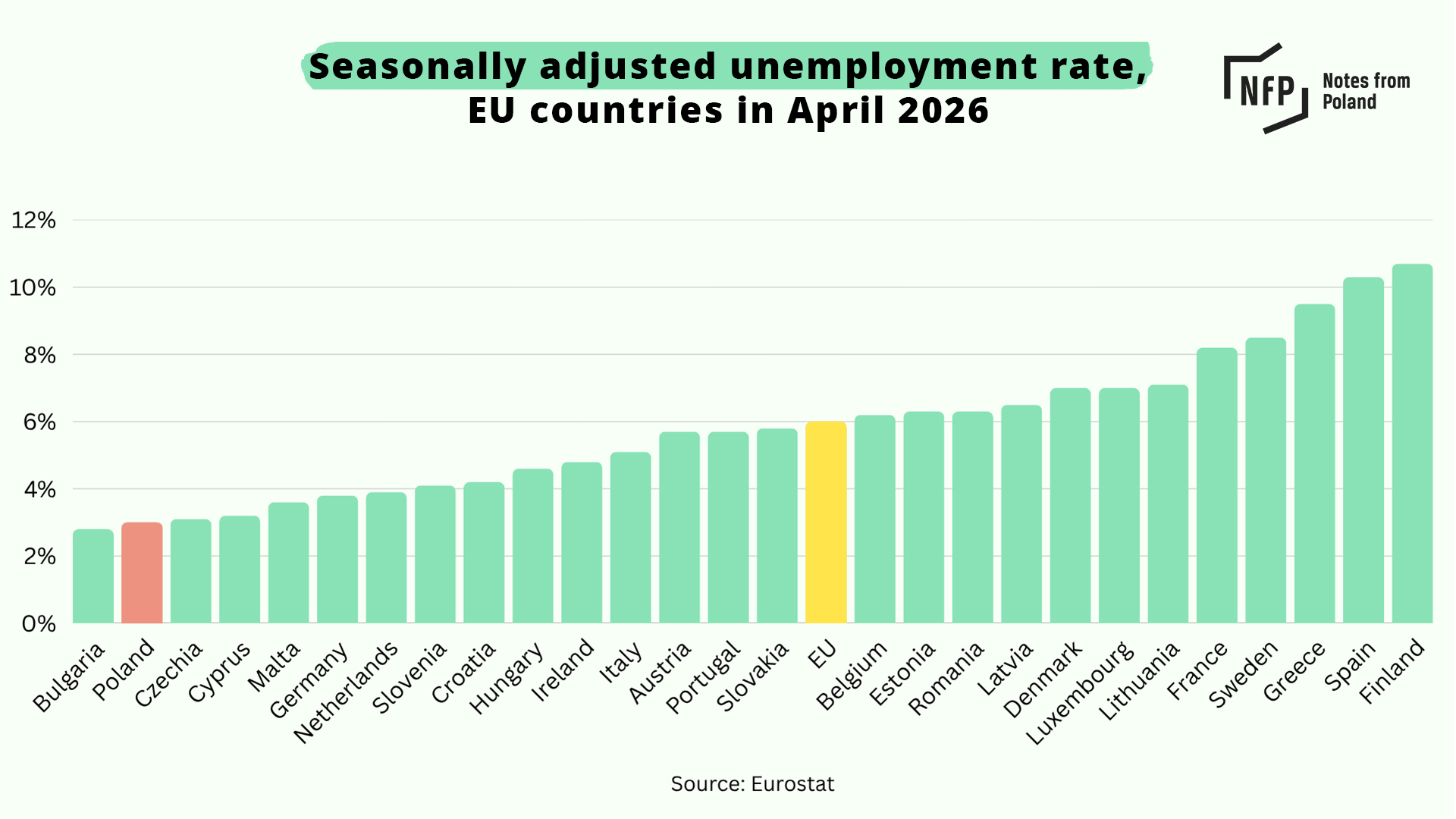
According to the EU Labour Force Survey published by Eurostat, an EU agency (which calculates unemployment using a different methodology from Poland’s), unemployment stood at 3.0% in Poland in April, exactly half the EU average and the second-lowest figure in the bloc.
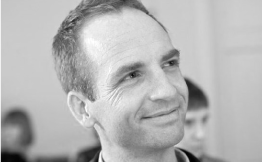
Kazimierz Sedlak, founder of Sedlak & Sedlak, Poland’s oldest HR consultancy, sees little cause for alarm. “The labour market is in good shape,” he told Notes from Poland.
So where does the discrepancy come from between expert assessments, media headlines and public sentiment? There are several explanations.
First: a change in methodology
The indicator most commonly cited by the media is the registered unemployment rate, which measures the number of people registered as unemployed with employment offices as a share of the economically active population.
In June 2025, however, changes to the law expanded eligibility for registration. Farmers owning at least two hectares of land and their family members gained the right to register as unemployed. People were also allowed to sign on at employment offices where they actually live rather than their official place of residence (which in Poland is often not the same place).
At the same time, the rules governing unemployed people changed. Under the new regulations, jobseekers can refuse a job offer from an employment office without risking removal from the register.
As a result, more people became eligible to register and fewer people left the unemployment rolls, pushing up the registered unemployment rate even if underlying labour market conditions remained unchanged.
Poland's youth unemployment rate has risen by more than 27% over the last year, which is the biggest increase in the EU https://t.co/tjK9AL1yL8
— Notes from Poland 🇵🇱 (@notesfrompoland) July 21, 2025
Economists have long argued that the registered unemployment rate is an imperfect measure of labour market health. Registration provides access to benefits such as health insurance, creating incentives for some people to register even when they are not actively seeking work.
Part of the unemployment figure consists of “people who are able to work but, for various reasons, find it not worth their while to do so”, said Sedlak.
“This is a group of people who register with employment offices solely to obtain social security cover and access to benefits, and nothing more. Such people have always existed, exist now, and always will.”
That is why economists often prefer the Labour Force Survey (LFS), also published by GUS, which is designed to provide a more accurate picture of labour market conditions.
Under the survey’s methodology, a person is classified as unemployed if they did not work during the reference week, actively sought employment during the previous four weeks, and were available to start work within two weeks.
According to the survey, unemployed people accounted for 3.3% of the labour force in the first quarter of 2026, 0.1 percentage points lower than a year earlier.
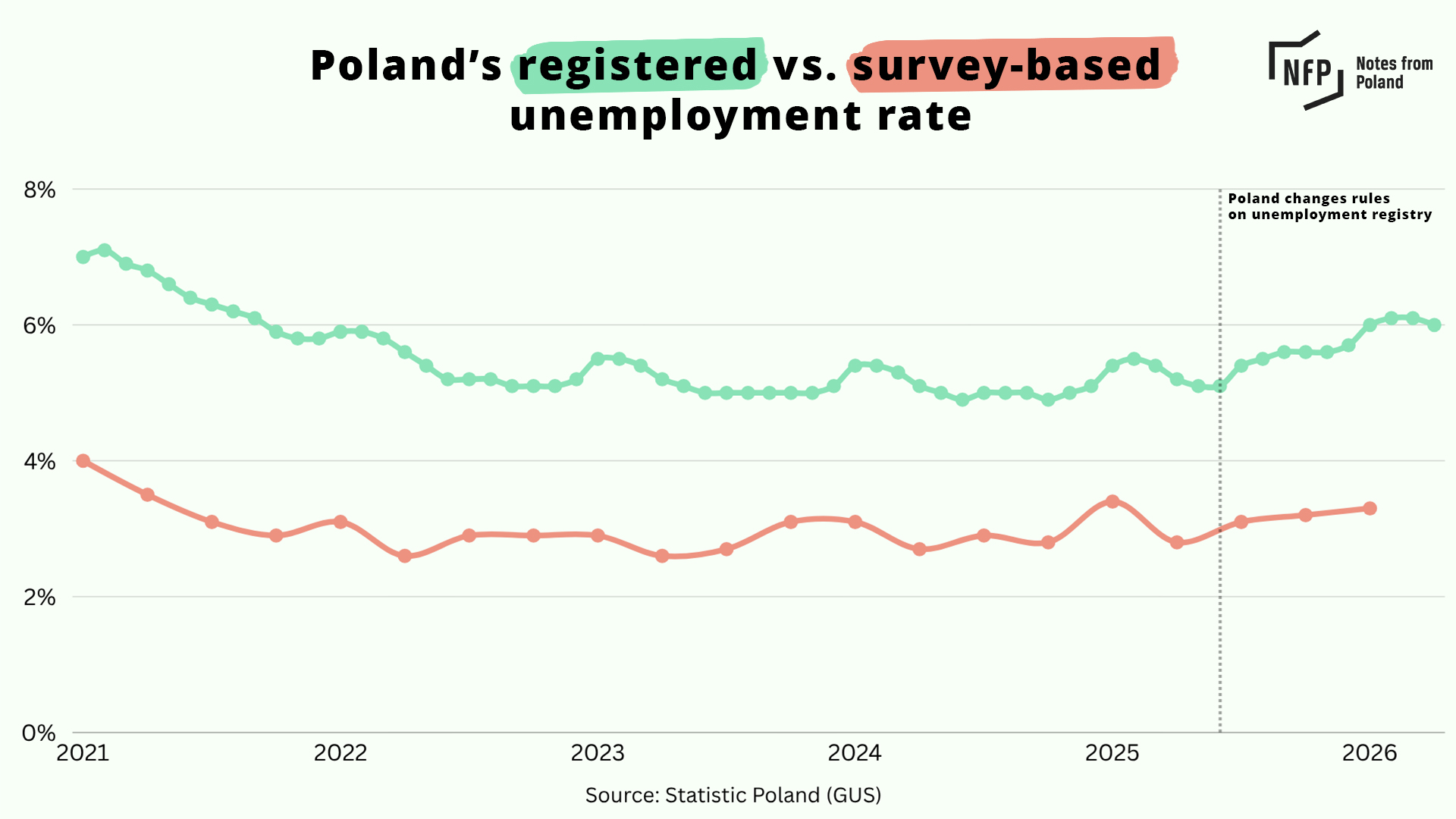
“Overall, this suggests that the increase in the registered unemployment rate was largely driven by changes in registration rules rather than by actual deterioration in labour market conditions,” Piotr Lewandowski, president of the Institute for Structural Research (IBS), told the Warsaw Wire podcast.
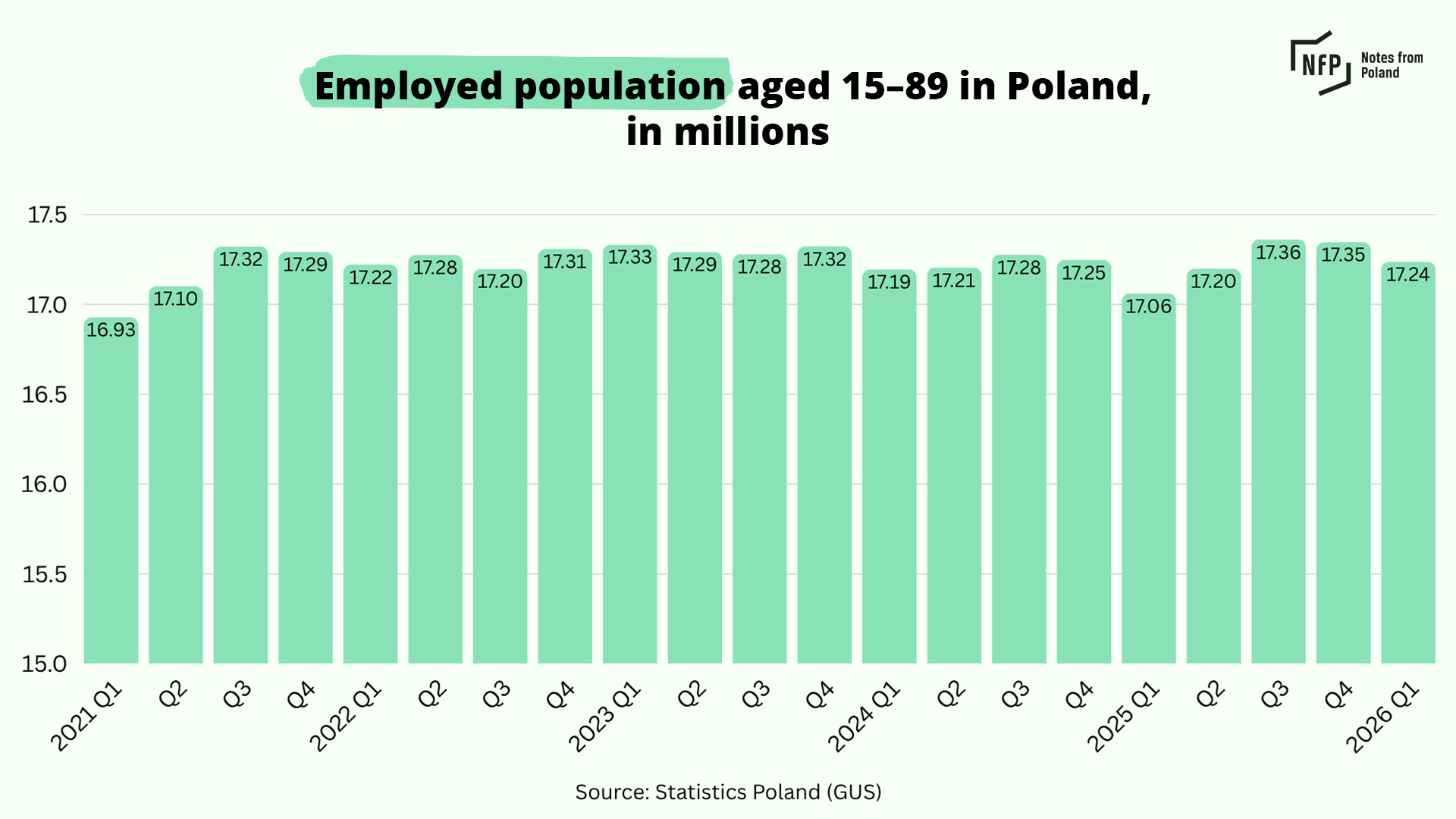
The same survey found that 17.24 million people aged 15-89 were in employment in the first quarter of 2026, close to the record high of 17.36 million reached just two quarters earlier.
Second: structural changes
None of this means that there are no problems in the labour market.
Lewandowski notes that there are signs of a slowdown, including weaker job creation and a longer average period spent searching for work.
According to GUS data from the first quarter of 2026, unemployed people spent an average of 8.5 months actively seeking work, one month longer than a year earlier. That may reinforce perceptions that finding a job has become more difficult.
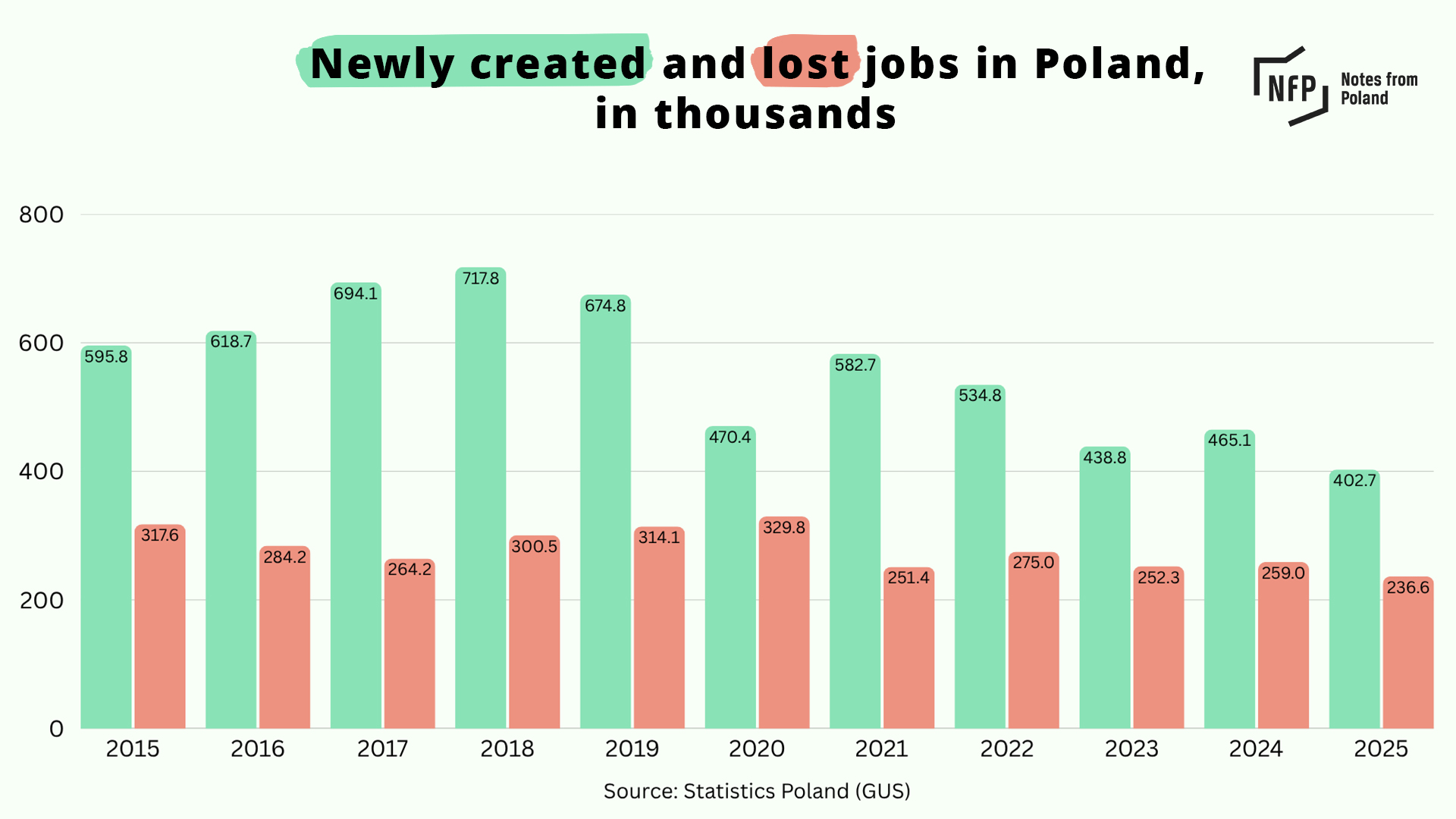
The number of newly created jobs also fell. In 2025, employers created 402,700 new positions, 13% fewer than in 2024 and almost 44% below the peak recorded in 2018. However, the pace of job losses was also the slowest in years.
“It’s not really bad, but it’s definitely less rosy than it was one, two or three years ago,” said Lewandowski. “So I’m not surprised that people are slightly more concerned, but I think we should have a more balanced narrative. It’s not a disaster.”
Among the sectors most exposed to weaker labour market conditions, he highlighted manufacturing, particularly the automotive industry, as well as sectors important to the Polish economy such as furniture production and construction materials.
Ignacy Morawski, deputy editor-in-chief of the business daily Puls Biznesu, however, argues that Poland is undergoing a period of “creative destruction” – a term coined by economist Joseph Schumpeter to describe the process by which innovation drives economic growth by replacing older industries and technologies.
In practice, this means that while some sectors are shrinking rapidly, others are expanding just as quickly.
Alongside the industries highlighted by Lewandowski as facing challenges, Morawski noted in a social media post this week that “other sectors are growing rapidly, including the manufacture of transport equipment, machinery, computers, measuring instruments and waste management”.
Dawno w polskiej gospodarce nie było takiej kreatywnej destrukcji. Oznacza to, że branże rosnące rosną szybko, a spadające szybko spadają.
Ogólnie, według GUS, produkcja w Polsce rośnie w tempie 4 proc. rok do roku. Ta średnia jednak ukrywa głębokie zmiany strukturalne.
Duże… pic.twitter.com/pbAZp964yU
— Ignacy Morawski (@iggnacy) June 22, 2026
Third: demographics
Ironically, many of these same sectors which are slowing employment were until recently warning of severe labour shortages and urging the government to facilitate greater immigration into Poland, a country facing both rapid population decline and an ageing society.
According to Lewandowski, slower job creation in these industries does not necessarily signal weakness. In many cases, it reflects companies investing in automation in response to labour shortages that are expected to worsen in the coming decades.
When asked about the impact of artificial intelligence on the Polish labour market, neither expert was willing to make firm predictions.
Sedlak quoted the economist John Kenneth Galbraith, who famously observed that “the only function of economic forecasting is to make astrology look respectable”.
Lewandowski similarly argued that it is too early to draw conclusions, partly because adoption of AI technologies in Poland remains relatively limited.
“There is evidence from the US that occupations more exposed to AI may be seeing weaker job creation, especially at entry level,” he said. “But whether these investments will actually pay off and whether they will lead to lasting organisational changes that reduce labour intensity across industries is still too early to tell.”
Only 5.9% Polish firms use AI tools, which is the second-lowest figure in the EU. In some member states, the number is over 25%.
"Changing this should be a priority" to avoid "losing market share to foreign competitors", writes @PIE_NET_PL in a new report https://t.co/HFcCcCmF2E
— Notes from Poland 🇵🇱 (@notesfrompoland) July 3, 2025
The shadow of the past
So why is there so much concern in Poland about rising unemployment? According to Lewandowski, part of the explanation lies in collective memory.
The period of high unemployment that followed Poland’s transition from the communist centrally planned economy to a market economy in the 1990s and early 2000s remains deeply embedded in public consciousness.
Just before Poland joined the EU in 2004, registered unemployment exceeded 20%, while youth unemployment surpassed 40%.
“This inheritance from the trauma of the high-unemployment era has essentially defined public debate about employment and the labour market in Poland,” said Lewandowski.
Poland has emerged as Europe’s undisputed growth champion over the past 35 years.
In the first part of a new series of articles and podcasts, @AlicjaPtak4 explores the reasons behind Poland's rapid economic development, and the dangers that may lie ahead https://t.co/bW3bnV7Ozn
— Notes from Poland 🇵🇱 (@notesfrompoland) July 7, 2025
He believes the discussion should evolve, with greater attention paid to indicators such as employment growth and wage growth, as is common in countries such as the United States.
Sedlak, meanwhile, argues that labour market confidence is also shaped by politics and geopolitics.
In his view, political uncertainty during the Law and Justice (PiS) government’s tenure between 2015 and 2023 discouraged investment, while the ongoing war in neighbouring Ukraine continues to weigh on sentiment.
“This reluctance to invest stems from a lack of confidence among business owners. It is worth the government bearing this in mind,” he said.
He hopes that investment will increase thanks to the release of EU post-pandemic funds and defence spending supported by the EU’s SAFE loan programme.
Poland has signed its first contracts using funds from the EU's SAFE mechanism, which is providing €44 billion in loans for defence spending.
The first deals include cybersecurity systems and drones, with more agreements to follow by tomorrow's deadline https://t.co/HPegKDG54L
— Notes from Poland 🇵🇱 (@notesfrompoland) May 29, 2026
What next?
Lewandowski believes the current government’s response to Poland’s labour market challenges lacks coherence.
Despite existing labour shortages and the prospect of more severe shortages as the population ages and shrinks, the government led by Prime Minister Donald Tusk, a coalition ranging from left to centre right, has adopted a tougher stance on migration, echoing rhetoric traditionally associated with the right and far right.
At the same time, it is running a pilot programme exploring a four-day or shorter working week.
“You can either say that 25% of occupations will face labour shortages, or you can reduce the working week, or you can reduce immigration,” said Lewandowski. “The only way to deal with labour shortages without attracting more workers is to increase productivity dramatically.”
Almost 2,000 employers in Poland have applied to take part in a government pilot programme to test shorter working hours for staff with the same rate of pay.
The labour ministry argues that cutting hours can benefit both employers and their staff https://t.co/PHBHTV8pqP
— Notes from Poland 🇵🇱 (@notesfrompoland) September 17, 2025
That may be achievable in manufacturing through automation, and perhaps in some service sectors if AI fulfils its promise, he said. But in many parts of the public sector, the options are more limited.
“It is much more difficult in healthcare or public transport. You cannot simply tell train drivers to run the trains faster.”
For that reason, Lewandowski believes Poland has yet to resolve a fundamental contradiction.
“I think this paradox remains completely unresolved,” he said. “And labour shortages will soon become a constraint on Poland’s economic growth.”
Notes from Poland is run by a small editorial team and published by an independent, non-profit foundation that is funded through donations from our readers. We cannot do what we do without your support.

Alicja Ptak is deputy editor-in-chief of Notes from Poland and a multimedia journalist. She has written for Clean Energy Wire and The Times, and she hosts her own podcast, The Warsaw Wire, on Poland’s economy and energy sector. She previously worked for Reuters.