Keep our news free from ads and paywalls by making a donation to support our work!

Notes from Poland is run by a small editorial team and is published by an independent, non-profit foundation that is funded through donations from our readers. We cannot do what we do without your support.
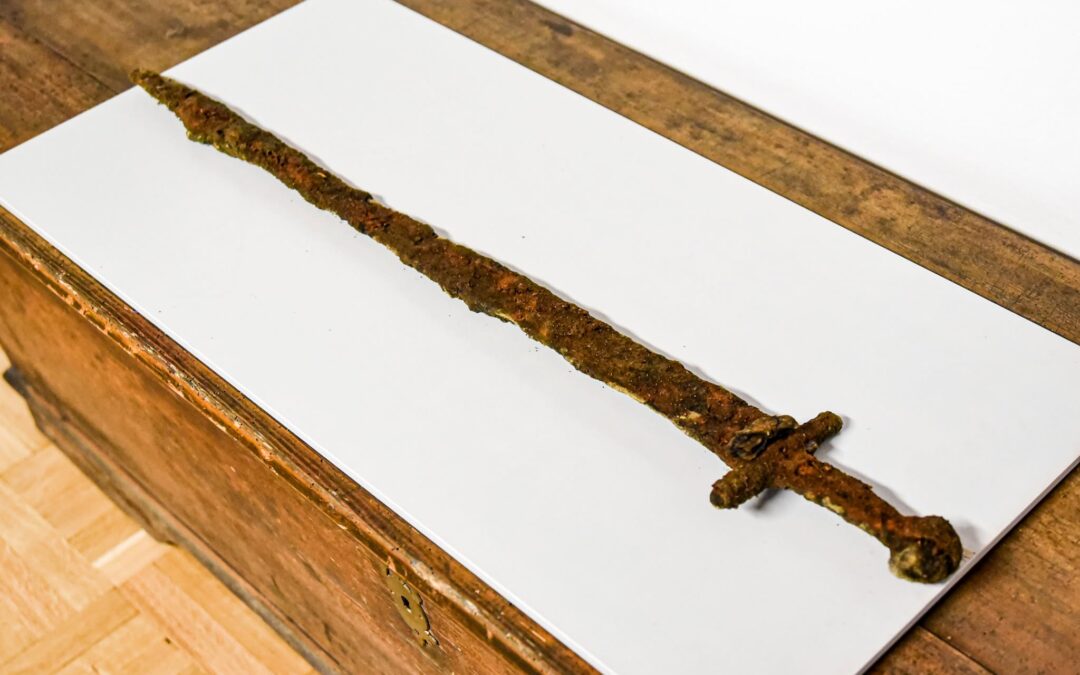
A well-preserved, 1,000-year-old sword has been found in a river in western Poland. Experts have dated the item to around the time when the House of Piast, Poland’s first ruling dynasty, was present in the same region.
The museum where the weapon will go on display has speculated that it may either have belonged to a warrior or have been thrown overboard into the Warta river in an act of worship.
The sword was pulled out of the riverbed near the town of Wronki by local man Mirosław Tucholski, who then handed it in to the Museum of the Wronki Region. There, it was inspected by an archaeologist, Ryszard Pietrzak, who confirmed that it was an original sword dating back to the 11th century.
The museum alerted the Provincial Office for the Protection of Monuments to the find. The mayor of Wronki said that the town would pay for examination and preservation of the medieval weapon, to take place at Nicolaus Copernicus Museum in Toruń.
The sword dates from the early period of the Polish state under the Piast dynasty, which ruled from Greater Poland, the region where it was found.
Mieszko I had converted to Christianity in 966 in an event often known as the Baptism of Poland. In 1025, Bolesław I the Brave was crowned the first king of Poland in nearby Gniezno. The Piasts continued to rule until 1370, when King Casimir III the Great died.
In the latest episode of our Brief History of Poland podcast series, we look at the medieval period of the Piast dynasty.@StanleySBill talks about the conflict with the Teutonic Knights, the reign of Kazimierz the Great, and the oldest known Polish song. https://t.co/Yi09onPnB7
— Notes from Poland 🇵🇱 (@notesfrompoland) May 29, 2020
In a social media post, the Museum of the Wronki Region promised that visitors will be able to see the sword for themselves within a few months.
“What is the weapon’s history? Did it belong to a warrior living in our region in early medieval times, or might it have been thrown from a boat sailing down the Warta as a result of an act of worship?” the museum mused. “We will never know…But what we do know is that our region still keeps many secrets from us.”
Thanks to Tucholski’s responsible actions, it added, the precious artefact was in the best place for future generations to be able to see it.
The discovery of the sword is not the first such find in Poland in recent years. Last summer, a fisherman pulled a medieval sword out of the Vistula river amid record low water levels.
A 2,000-year-old Roman sword was discovered in southern Poland in early 2025, while another medieval sword, possibly of Viking origin, was found in a river in 2024. Last year, a well-preserved wooden sculpture of a human face, dating back 1,000 years, was found at the bottom of a lake.
The drought conditions that have plagued Poland in recent years represent both an opportunity and a threat to archaeological heritage, according to National Geographic’s Polish edition.
While low water levels make finding ancient relics more common, the lack of moisture means that they can be damaged as water has preservative properties.
A well-preserved, 1,000-year-old wooden sculpture of a human face has been discovered at the bottom of a lake in Poland.
The archaeologists behind the find say that it "opens a fascinating discussion on the spiritual life of early medieval Slavs" https://t.co/9TbZBn7qVS
— Notes from Poland 🇵🇱 (@notesfrompoland) July 12, 2025
Notes from Poland is run by a small editorial team and published by an independent, non-profit foundation that is funded through donations from our readers. We cannot do what we do without your support.
Main image credit: Muzeum Ziemi Wronieckiej/Facebook

Ben Koschalka is a translator, lecturer, and senior editor at Notes from Poland. Originally from Britain, he has lived in Kraków since 2005.