Keep our news free from ads and paywalls by making a donation to support our work!

Notes from Poland is run by a small editorial team and is published by an independent, non-profit foundation that is funded through donations from our readers. We cannot do what we do without your support.
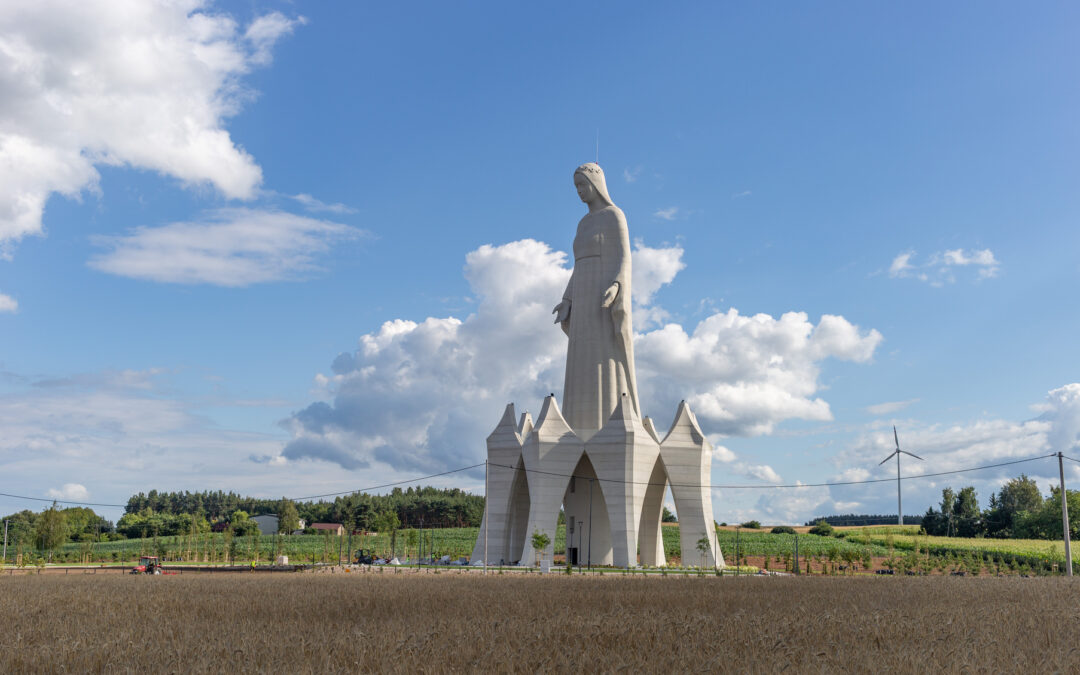
The tallest statue of the Virgin Mary in Europe has been officially opened in the small village of Konotopie in central Poland.
Towering over the rural landscape at 55.6 metres high, the monument, whose construction was funded by a wealthy local couple, is taller than the famous Christ the Redeemer statue in Rio de Janeiro, Brazil.
The new landmark, which is also the tallest religious statue of any kind in Europe, was unveiled on 15 August, when Catholics celebrate the assumption of Mary into heaven.
The consecration ceremony was led by Krzysztof Wętkowski, bishop of the diocese of Włocławek in which Konotopie, which has a population of only around 130 people, is located. The local community hopes that the statue will become a major site of pilgrimage.
Among those to attend the ceremony was former Polish president and Nobel Peace Prize winner Lech Wałęsa.
“We sinners ask Our Lady of Mercy to take care of the whole nation,” wrote the 82-year-old in a post on social media, sharing photos of himself at the statue.
Construction of the concrete statue took 18 months and reportedly cost around 100 million zloty (€23.2 million). Those costs were covered by the couple behind the project, Roman and Grażyna Karkosik.
After making his fortune investing in undervalued companies during Poland’s post-communist transition in the 1990s, Roman Karkosik had by the early 21st century become one of Poland’s richest people, though his fortune has since diminished somewhat, according to estimates.
The couple – who keep an extremely low profile, rarely giving interviews and never speaking publicly about the project to build the statue of Mary – live in a restored 18th-century palace around 2 kilometres away, from where they can see the new monument.
Konotopie’s statue of Mary has now overtaken one in Miribel, France, as Europe’s tallest. But it is still some distance behind the tallest in the world, the 98-metre Mother of All Asia–Tower of Peace in Batangas City, Philippines.
Until recently, Poland also had the tallest statue of Jesus in the world, the 33-metre-high Jesus Christ the King of the Universe monument, erected in the town of Świebodzin in 2010. However, in 2024, it was overtaken by a 61-metre-tall statue of Jesus in Indonesia.
The design for the statue of Mary in Konotopie was originally conceived in the form of a two-metre-high model by sculptor Adam Jakub Matejkowski, who told the Polish edition of Forbes magazine that the Karkosiks had specifically requested that the statue be larger than Świebodzin’s Christ.
Chief engineer Bartłomiej Niesłuchowski told broadcaster TVN that it took months to find a company willing and able to undertake such a project. Because no suppliers in Poland could produce the material needed for the unique mould into which the concrete would be poured, it had to be manufactured in Italy.
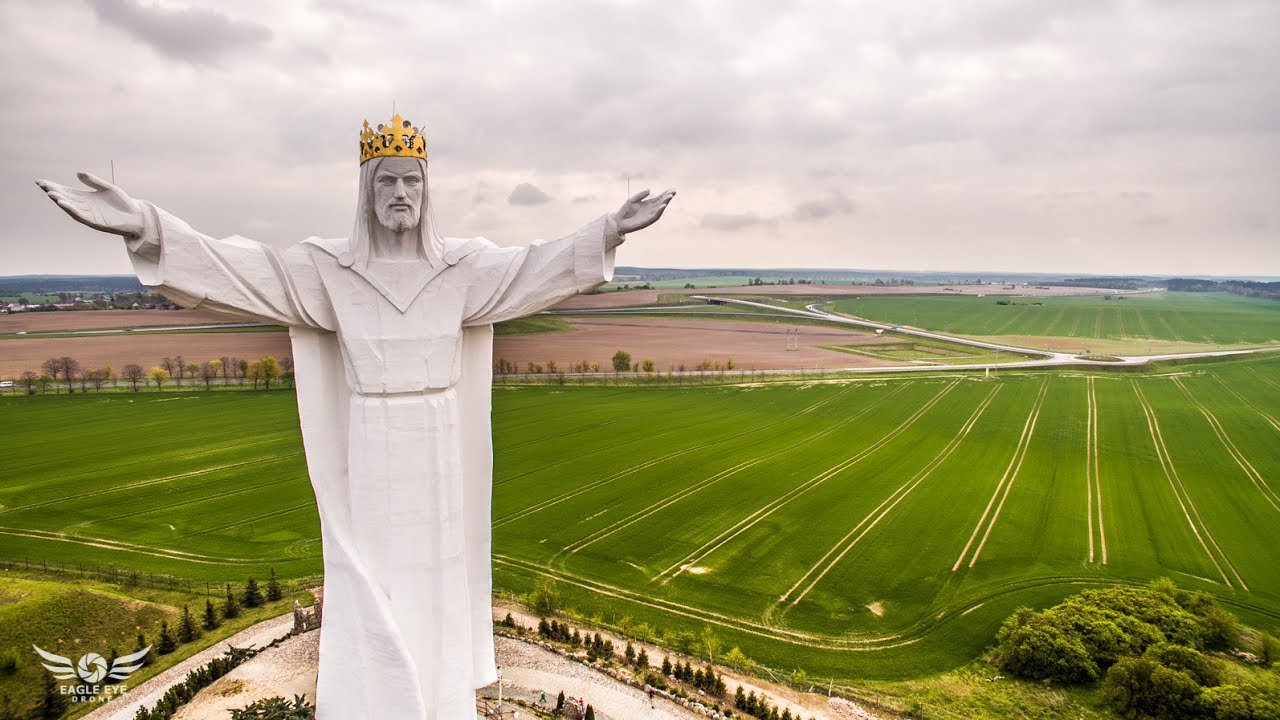
The 33-metre-tall statue Jesus Christ the King of the Universe in Świebodzin, Poland, opened in 2010 (image credit: Oskierro/Wikimedia Commons, under CC BY-SA 4.0)
The monument will be free for the public to access, including its observation deck, located 15 metres up on the pedestal upon which Mary stands. The site is expected to become a place of pilgrimage, with local authorities preparing for an influx of people.
“We’re already seeing growing interest in investment plots, including restaurants,” Renata Gołębiewska, mayor of the nearby town of Kikoł, told the Rzeczpospolita daily. “But it’s too early to assess the impact.”
Poland is one of Europe’s most religious countries. Just over 70% of the population identify as Catholic, according to the most recent national census, while around 30% attend Sunday mass.
However, religiosity has been falling rapidly in recent years, especially among young Poles. The Catholic church in Poland has also been hit by a series of scandals relating to historical child sex abuse as well as accusations that it interferes in politics.
The proportion of Catholics who attend Sunday mass in Poland has stabilised at around 30% after falling from a peak of 57%, new church data show.
The proportion of children taking Catholic catechism in schools has continued to fall but remains a majority https://t.co/5bu35hzJ7c
— Notes from Poland 🇵🇱 (@notesfrompoland) December 17, 2025
Notes from Poland is run by a small editorial team and published by an independent, non-profit foundation that is funded through donations from our readers. We cannot do what we do without your support.
Main image credit: Pko/Wikimedia Commons (under CC BY-SA 4.0)

Daniel Tilles is editor-in-chief of Notes from Poland. He has written on Polish affairs for a wide range of publications, including Foreign Policy, POLITICO Europe, EUobserver and Dziennik Gazeta Prawna.