Keep our news free from ads and paywalls by making a donation to support our work!

Notes from Poland is run by a small editorial team and is published by an independent, non-profit foundation that is funded through donations from our readers. We cannot do what we do without your support.
Prime Minister Donald Tusk has confirmed that he will seek to have Maciej Berek, a government minister who stepped down this week and whom Tusk calls his “right-hand man”, appointed as a judge on Poland’s constitutional court.
The move has generated considerable controversy given that Tusk’s ruling coalition has repeatedly pledged to “depoliticise” the Constitutional Tribunal (TK) after the previous national-conservative Law and Justice (PiS) government appointed its former politicians to the court.
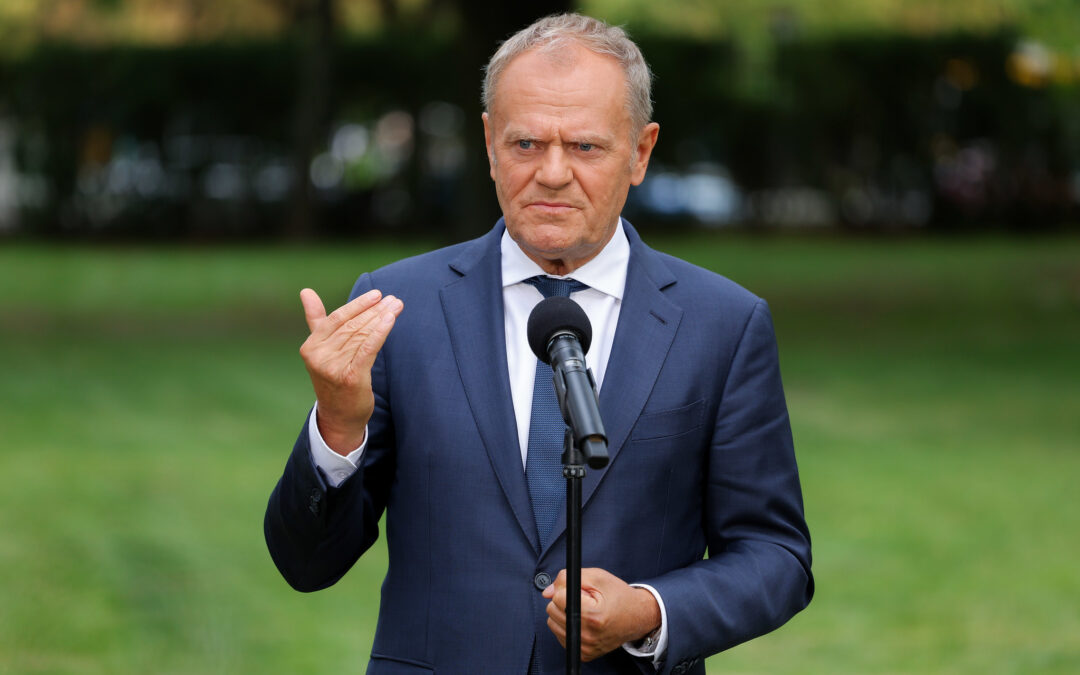
At a press conference on Thursday, however, Tusk defended the idea, describing Berek as an “apolitical and nonpartisan” figure who would help “fix the Constitutional Tribunal” after it was rendered illegitimate by PiS.
Premier @donaldtusk potwierdził, że @MaciejBerek – do tej pory minister ds. nadzoru nad wdrażaniem polityki rządu – będzie kandydatem na sędziego Trybunału Konstytucyjnego. – To jeden z najwybitniejszych polskich prawników – uzasadnił szef rządu.https://t.co/RsKLhLjHhC
— PolsatNews.pl (@PolsatNewsPL) August 13, 2026
Berek is a longstanding associate of Tusk. During Tusk’s first period as prime minister, from 2007 to 2014, Berek was head of the Government Legislation Centre (RCL) while also serving as secretary of the cabinet.
After Tusk returned to power in 2023, heading a coalition of parties ranging from left to centre right, Berek was appointed as a minister without portfolio and then, in 2025, was made minister in charge of overseeing the implementation of government policy.
He has, however, been an extremely low-key figure, rarely speaking in public. Berek is also not a member of parliament, and indeed not even a member of any political party.
On Tuesday this week, Tusk unexpectedly announced before a cabinet meeting that Berek, whom he called his “right-hand man”, was leaving the government in order to “move on to other tasks”.
The prime minister did not say what those tasks would be, but multiple media outlets reported that Berek would be presented as a candidate to become a judge on the Constitutional Tribunal.
Since Tusk’s government came to power in December 2023, it has ignored all TK rulings because three of the tribunal’s judges were appointed illegitimately under the former PiS government.
Fifteen months since the change of government, Poland's rule-of-law crisis continues – indeed, many Poles think the situation has got worse.@J_Jaraczewski explains the roots of the crisis, what its impact has been, and how it might be resolved https://t.co/7KOCURV3dU
— Notes from Poland 🇵🇱 (@notesfrompoland) March 17, 2025
The new ruling coalition also criticised the fact that some TK judges were former PiS politicians. Two of them, for example, were appointed in 2019 shortly after stepping down as PiS MPs.
Another, the current TK chief justice, Bogdan Święczkowski, previously served as a deputy justice minister in the PiS government (though he was never a member of the PiS party).
When Tusk’s coalition came to power, it promised to restore the legitimacy of the TK, including by “depoliticising” it. In 2024, it approved legislation that would have banned anyone who had served as a politician in the last four years from becoming a TK judge.
However, the measures were referred by the then-president, PiS ally Andrzej Duda, to the TK itself, which subsequently declared them unconstitutional, meaning they did not come into force.
Poland’s constitutional court has rejected two government bills seeking to overhaul the court itself, with the aim of reversing the politicisation that took place under the former administration.
It found that the measures "violate judicial independence" https://t.co/uBJr1bXFv4
— Notes from Poland 🇵🇱 (@notesfrompoland) July 30, 2025
At a press conference on Thursday, Tusk confirmed the rumours that he would seek to make Berek a TK judge. He called Berek “one of the most distinguished Polish legal practitioners, who has made his apolitical and nonpartisan nature a hallmark”.
Berek has a doctorate in law and, between his stints in government, worked as an assistant professor in the department of constitutional law at the University of Warsaw.
“For him, compliance with the law and the constitution has always been paramount,” declared Tusk. “I don’t know anyone better equipped, better prepared, to help rectify the situation we face with the flawed Constitutional Tribunal.”
💬 Premier @donaldtusk w #Warszawa: Nie mamy żadnych innych interesów w tej sprawie. Zależy nam na naprawieniu Trybunału Konstytucyjnego, żeby nie był na smyczy prezydenta i PiS-u, tylko wykonywał swoją robotę.
— Kancelaria Premiera (@PremierRP) August 13, 2026
The prime minister acknowledged that his government had tried to ban politicians from serving on the TK. But he said that Berek himself had recently told him that, “under the current political circumstances, we must do everything we can to remedy the situation” at the tribunal.
“Since methods that are unconstitutional are being used from the other side, I must also demonstrate my determination and that we won’t give in to such methods,” added Tusk.
Those remarks, in which Tusk also called Święczkowski’s leadership of the TK “embarrassing”, were a reference to the fact that the current PiS-aligned president, Karol Nawrocki, and Święczkowski have refused to accept four new TK judges chosen by parliament earlier this year.
“We have no interests in this matter other than to repair the Constitutional Tribunal so that it is not a tool and is not under the thumb of the president or PiS, but rather that it performs its work as objectively as possible,” said Tusk.
A newly sworn-in @TK_GOV_PL judge says he will not take his seat until four colleagues appointed by parliament are allowed to take theirs.
He said their appointments had been blocked "unlawfully", in the latest twist in a long-running disputehttps://t.co/X30rm1Gfzs
— Notes from Poland 🇵🇱 (@notesfrompoland) July 29, 2026
However, there remain major potential stumbling blocks on Berek’s path to the TK, not least doubts over whether Tusk’s coalition partners will support his nomination in the Sejm, the lower house of parliament, which is responsible for nominating new TK judges.
Anna Maria Żukowska, the head of The Left’s (Lewica) parliamentary caucus, declared on Tuesday that, if rumours of Berek’s nomination were true, “he won’t get votes from The Left because we promised our voters that politicians wouldn’t end up on the TK”.
Given that the government has a majority of just nine in the 460-seat Sejm, it would only require a small number of MPs from Tusk’s coalition to oppose Berek’s nomination for him to lose the vote.
On Thursday, Tusk said that he “understands” concerns from some coalition partners but that he would “try to convince those who have doubts”.
Jeżeli to się wydarzy (a raczej nie), to do niedawna czynny polityk nie dostanie głosów klubu @__Lewica, gdyż obiecaliśmy naszym wyborcom, że politycy nie trafią do TK.
Ale IMHO to bardzo krzywdząca dla @MaciejBerek plotka, on by się jako państwowiec w życiu na coś takiego nie… https://t.co/QWFFmdy4V3— Anna-Maria Żukowska 💁🏻♀️ (@AM_Zukowska) August 11, 2026
The next vacancy on the TK’s 15-judge bench is due to open on 18 September, when the nine-year term of Justyn Piskorski, one of the PiS-era judges regarded as illegitimate by the current government, ends. After that, a further vacancy will open in January.
However, even if Berek is approved by the Sejm, the law states that new TK judges must swear an oath “before the president”. Nawrocki has used this requirement to refuse to swear in four of the judges chosen by the Sejm this year. He has, however, sworn in three others.
It remains unclear what the president would do in the case of Berek. Earlier this week, his chief of staff, Zbigniew Bogucki, told Radio Zet that Nawrocki would “accept the oath if procedures are followed”. However, he added that he does “not know if [the Sejm] is able to carry out those procedures properly”.
Notes from Poland is run by a small editorial team and published by an independent, non-profit foundation that is funded through donations from our readers. We cannot do what we do without your support.
Main image credit: KPRM/Flickr (under CC BY-NC-ND 4.0)

Daniel Tilles is editor-in-chief of Notes from Poland. He has written on Polish affairs for a wide range of publications, including Foreign Policy, POLITICO Europe, EUobserver and Dziennik Gazeta Prawna.