
Keep our news free from ads and paywalls by making a donation to support our work!

Notes from Poland is run by a small editorial team and is published by an independent, non-profit foundation that is funded through donations from our readers. We cannot do what we do without your support.
Poland’s public debt has risen above 60% of GDP for the first time on record, thereby exceeding the limit enshrined in European Union law.
According to finance ministry data published on Wednesday, debt reached 61.6% of GDP in the first quarter of 2026 under EU accounting rules, up from 59.7% in the last quarter of 2025.
That means Poland now exceeds both of the fiscal thresholds that can trigger the EU’s excessive deficit procedure. The country was placed under the procedure in 2024 after its budget deficit surpassed the bloc’s 3% limit.
Warsaw is therefore required to take steps to bring public finances under greater control. However, last year, Poland’s deficit actually rose to 7.3% of GDP, which was the second-highest level in the EU and well above the 5.5% the Polish government had planned for 2025.
Polski dług publiczny przebił właśnie symboliczną barierę. https://t.co/UDMUVumXIl
— Business Insider Polska 🇵🇱 (@BIPolska) June 10, 2026
Poland’s constitution also limits public debt to 60% of GDP. However, that figure is calculated using a different methodology that excludes certain off-budget liabilities included under EU accounting rules, such as debt held by state-managed special funds.
As a result, under national methodology, Poland’s public debt stood at 50.6% of GDP at the end of the first quarter, still significantly below the constitutional ceiling.
Poland’s national fiscal rules include warning thresholds that trigger corrective measures as debt rises. Crossing the 55% threshold under the national methodology would require steps to reduce the debt ratio in the following year, including a freeze on public-sector wages and limits on the indexation of social benefits.
Reaching the constitutional limit of 60% would force the government to prepare a balanced budget for the following year.
Successive governments, however, have increasingly shifted spending outside the central budget, creating additional room before national debt thresholds are reached.
As a result, the gap between debt measured under EU and national methodologies has widened to 436.1 billion zloty (€102.5 billion), equivalent to nearly 11% of GDP. Before the COVID-19 pandemic, the difference was around 50 billion zloty.
Under the EU methodology, public debt increased by 109 billion zloty (€25.6 billion) during the first quarter to 2.44 trillion zloty. The cost of servicing public debt, measured as interest payments recorded in the state budget over the previous 12 months, amounted to 81.7 billion zloty, or around 2.1% of GDP.
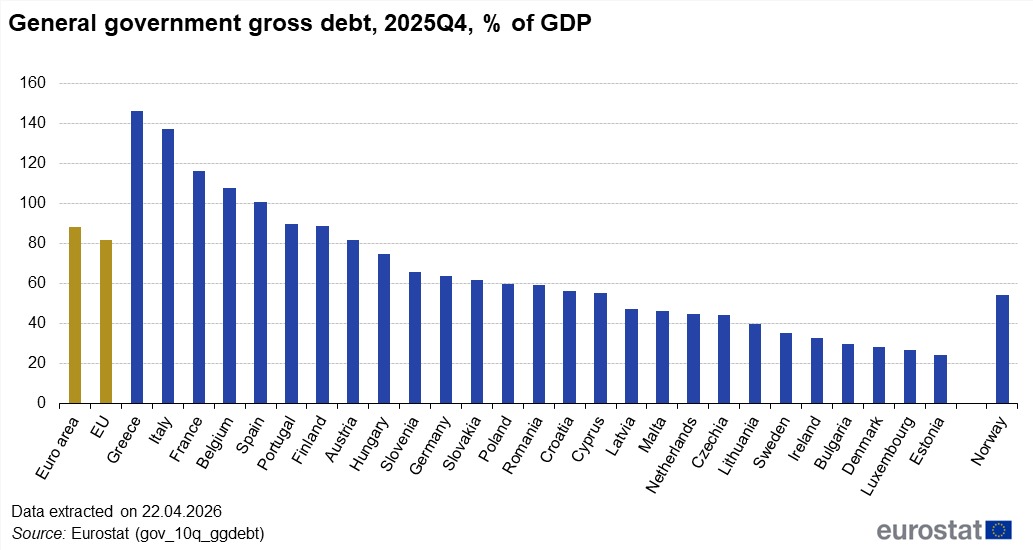
Despite the rise, Poland’s debt burden remains below the EU average, which in the last quarter of 2025 stood at 81.7%, and far beneath the levels in countries such as Greece (146.1% of GDP) and Italy (137.1%).
Poland’s finance ministry expects the rise will continue in the coming years, with debt reaching 75% of GDP in 2029.
Poland’s rising debt has been driven by one of the fastest-growing budget deficits in the EU, amid increased spending on social programmes and defence. The deficit stood at 3.4% of GDP in 2022, rising to 5.2% in 2023, 6.4% in 2024, and 7.3% in 2025.
That was a key factor behind decisions by two of the big three credit rating agencies, Fitch and Moody’s, to last year revise Poland’s outlook from stable to negative, signalling possible future credit-rating downgrades.
Plans to reduce the deficit have been complicated by political tensions between the government and opposition-aligned President Karol Nawrocki, who can veto laws and has opposed several fiscal measures, including tax increases. He did, however, consent to a new levy on banks.
In January, when Nawrocki signed the state budget for 2026, he criticised its impact on the level of debt, noting that it is the second year in a row in which the deficit is equivalent to almost a third of total spending.
Tensions between the government and president led Fitch to warn earlier this year that “a prolonged period of political gridlock will limit Poland’s capacity to implement policies…[needed] to address wider fiscal pressures leading to large fiscal deficits and rapidly rising debt”.
Poland's debt has been growing at the second-fastest rate in the EU this year, and is set to continue rising.
What is behind this trend – and should we be worried – asks Alicja Ptak in the latest of her series of articles and podcasts on Poland’s economy https://t.co/1pvnb2ZxoY
— Notes from Poland 🇵🇱 (@notesfrompoland) November 30, 2025
Notes from Poland is run by a small editorial team and published by an independent, non-profit foundation that is funded through donations from our readers. We cannot do what we do without your support.
Main image credit: SHOX ART/Pexels

Alicja Ptak is deputy editor-in-chief of Notes from Poland and a multimedia journalist. She has written for Clean Energy Wire and The Times, and she hosts her own podcast, The Warsaw Wire, on Poland’s economy and energy sector. She previously worked for Reuters.