Keep our news free from ads and paywalls by making a donation to support our work!

Notes from Poland is run by a small editorial team and is published by an independent, non-profit foundation that is funded through donations from our readers. We cannot do what we do without your support.
By Filip Mazurczak
Warsaw’s sewer system, one of the first in Europe, began operating 140 years ago. Built by British engineers, the sewers survived the destruction of World War Two, when they were used by underground resistance fighters to move around the city, and continue to serve Varsovians today.
By the end of World War II, Warsaw was a smouldering skeleton of a city, with 85% of its buildings ruined and most of its population killed or expelled by the Nazi-German occupiers.
One of the few parts of Warsaw’s infrastructure that remained relatively intact, however, was its extensive sewerage system, which had played a crucial role in both the 1943 Warsaw Ghetto Uprising and 1944 Warsaw Uprising, enabling partisans to move quickly through the bowels of the city.
The Polish capital owed this underground labyrinth to the noted British engineer William Lindley and his sons, who had been commissioned in the 1880s by an enlightened mayor to take action to counteract a catastrophic sanitary situation that was causing thousands of deaths every year.
When the network began operating 140 years ago, Warsaw became one of the first European cities with a modern sewage system, and many parts of it continue to be used to this day.
“The air is thick…filth is growing”
In the late 18th century, Poland was erased from the map of Europe in a series of partitions that divided it up between Russia, Prussia and Austria.
Whereas the Austrian rulers were relatively tolerant, and even appointed numerous Poles to high-ranking administrative posts, the Polish population experienced brutal forced Germanisation and Russification in the remaining partitions.
In Warsaw, in the Russian partition, rapid urbanisation and industrialisation led to an increase in the population from 163,000 to 383,000 between 1850 and 1882. But it also led to a growth in untreated waste.
The celebrated Polish novelist Bolesław Prus wrote in his weekly column for Kurier Warszawski: “The air is thick, the cobblestones are rising, filth is growing, and people are growing weaker…The human race is on its way to the cemetery.”
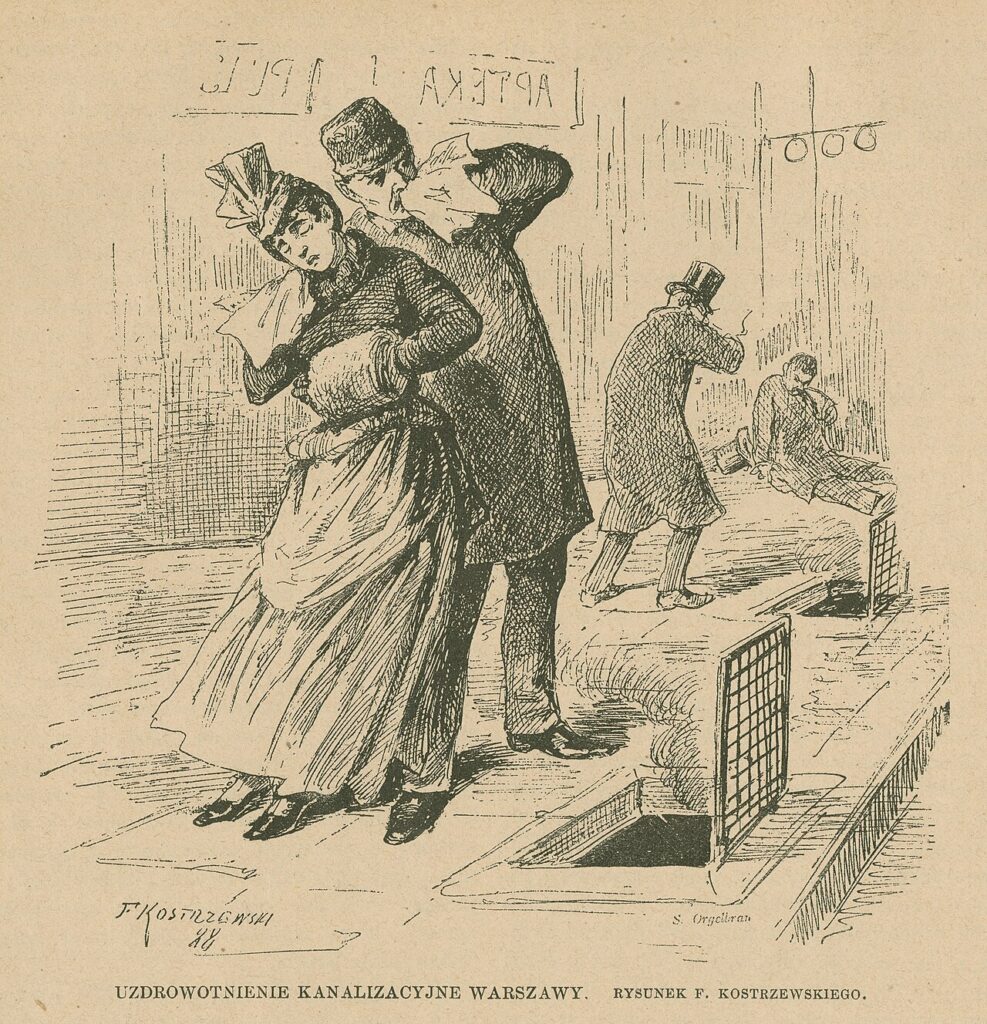
“Healing Warsaw’s sewers” by F. Kostrzewski, 1889 (Mazovian Digital Library, under public domain)
The pervasive unpleasant smell was, however, less of a danger for Varsovians than the deleterious health effects resulting from the fact that they drank unfiltered water from the Vistula River.
In the 19th century alone, the city experienced five cholera epidemics as well as major outbreaks of dysentery, typhoid fever and typhus, among others. Human waste left Warsaw homes for the Vistula, often infecting wells along the way.
Warsaw’s mayor from 1875 to 1892 was Sokrat Starynkevich, an enlightened and modernising Russian general. He regularly consulted his decisions on the construction of the sewage and water system in Warsaw with the Citizens’ Sanitary Committee, which alerted him to the appalling state of the city’s water.
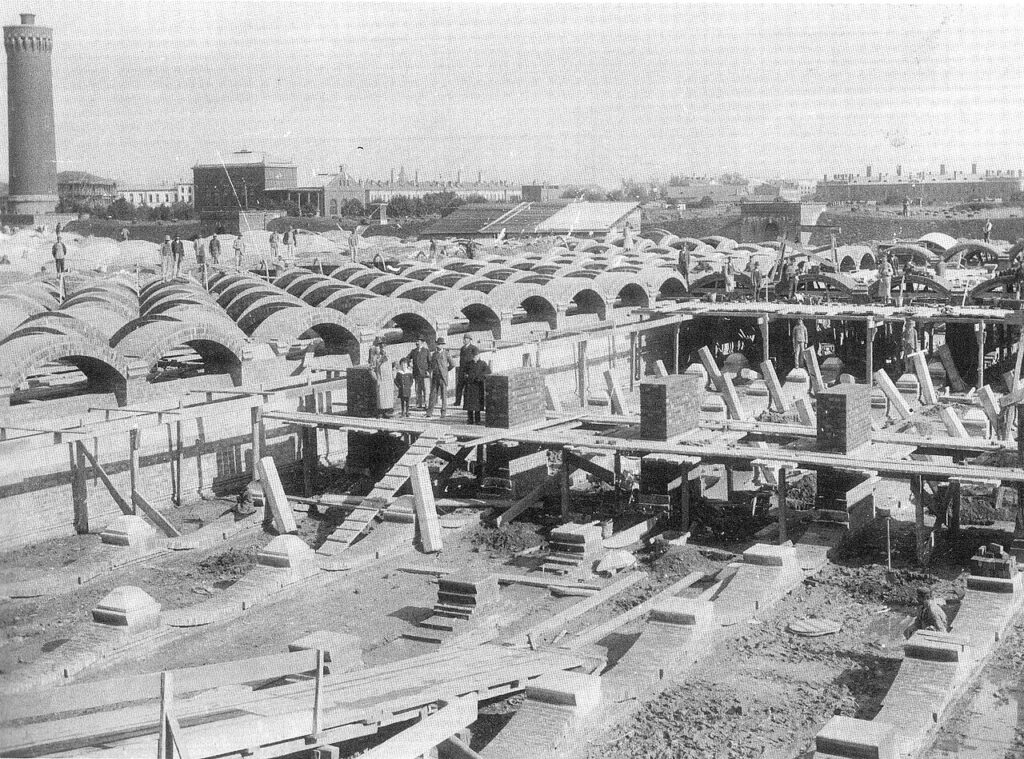
The construction of Warsaw’s slow sand filters, 1880s (Wikimedia Commons, under public domain)
The mayor was informed that, between 1874 and 1879, the death rate in Warsaw was 41.5 for every thousand inhabitants. Meanwhile, according to data provided by the academic and activist Adolf Suligowski, for each of the city’s inhabitants, 462 kilograms of human excrement were dumped into the Vistula annually.
Warsaw also had a significant Russian military presence, especially since crushing the 1863 Polish January Insurrection, so it was in the Russians’ interest for drinking water to be clean and safe.
An engineer whose vision changed Warsaw
In 1876, just a year after coming to power, Starynkevich appointed the English civil engineer William Lindley to design Warsaw’s sewer and water supply system, approving his blueprint four years later.
This London native had experience in Germany, building the Hamburg-Bergedorf railway and overseeing the reconstruction of Hamburg, which had been badly damaged in a major 1842 fire.
Lindley’s plan for the northern German city included the building of an 11-kilometre sewer system. He was influenced by the social reformer Henry Chadwick, who had demonstrated the connection between sewage disposal, clean water, and the spread of disease.
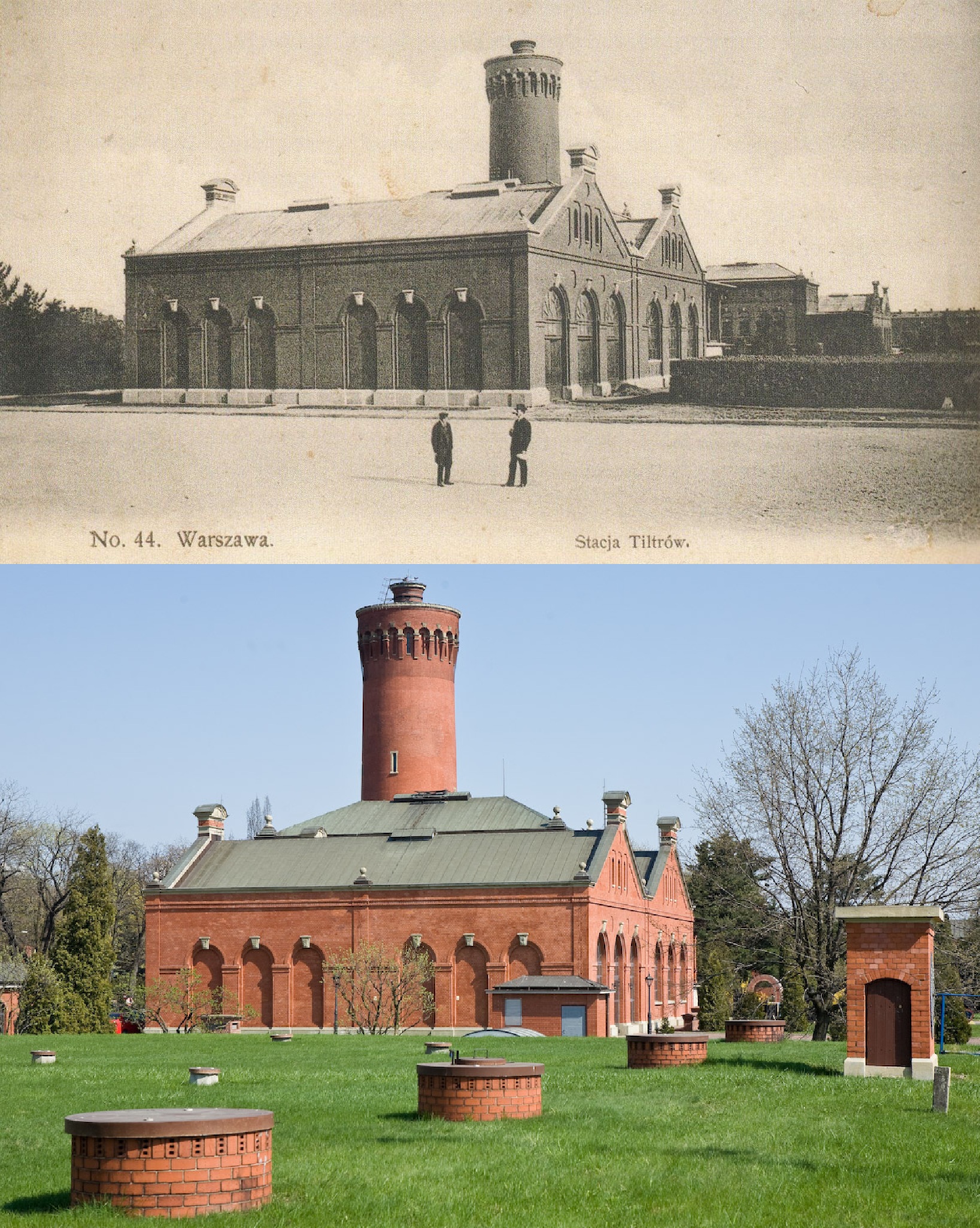
The Lindley Filters in 1908 and present day (Wikimedia Commons and MPWiK)
The choice of Lindley, a foreigner, to lead these modernisation efforts was not well-received by Warsaw’s local engineers, who competed with him for a lucrative contract with the city authorities. But Starynkevich was adamant that Lindley was the right choice for Warsaw, having visited his works in Hamburg and Frankfurt with a group of local engineers.
For almost half a century, Ryszard Żelichowski, a historian at the Polish Academy of Sciences, has been passionate about the impact of Lindley and his eldest son, William Heerlein Lindley, who oversaw the completion of the building of the Warsaw sewer system. As a student at Warsaw University in the 1970s, Żelichowski sought to restore the full story of the Lindleys’ contribution to his city.
Today, he is the founder of the Societas Lindleiana and holds reunions of the Lindley family, whose descendants today live in the UK, Germany, and Switzerland, places where their ancestors revolutionised public sanitation. It was thanks to Żelichowski’s initiative that a blue plaque was placed on the house in Blackheath, London, where the Lindleys lived.
“In the 19th and 20th centuries, engineers saved lives through sewer systems and other innovations, and yet there are hardly any monuments that commemorate them. Meanwhile, those rulers who sent hundreds of thousands to die in the trenches have plenty of monuments in every city,” Żelichowski told Notes from Poland, adding that Lindley was a pacifist.
Lindley designed the sewer systems in many cities in Germany (including Düsseldorf, Kiel, Frankfurt am Main, and Altona – now part of Hamburg) and other parts of Europe (Prague, Budapest).
In total, more than 30 European cities owe their sewer systems to the Lindleys. For his design of sanitation systems across Europe, William Heerlein Lindley was knighted. Lindley Sr’s two other sons, Joseph and Robert Searles, also participated in the design.
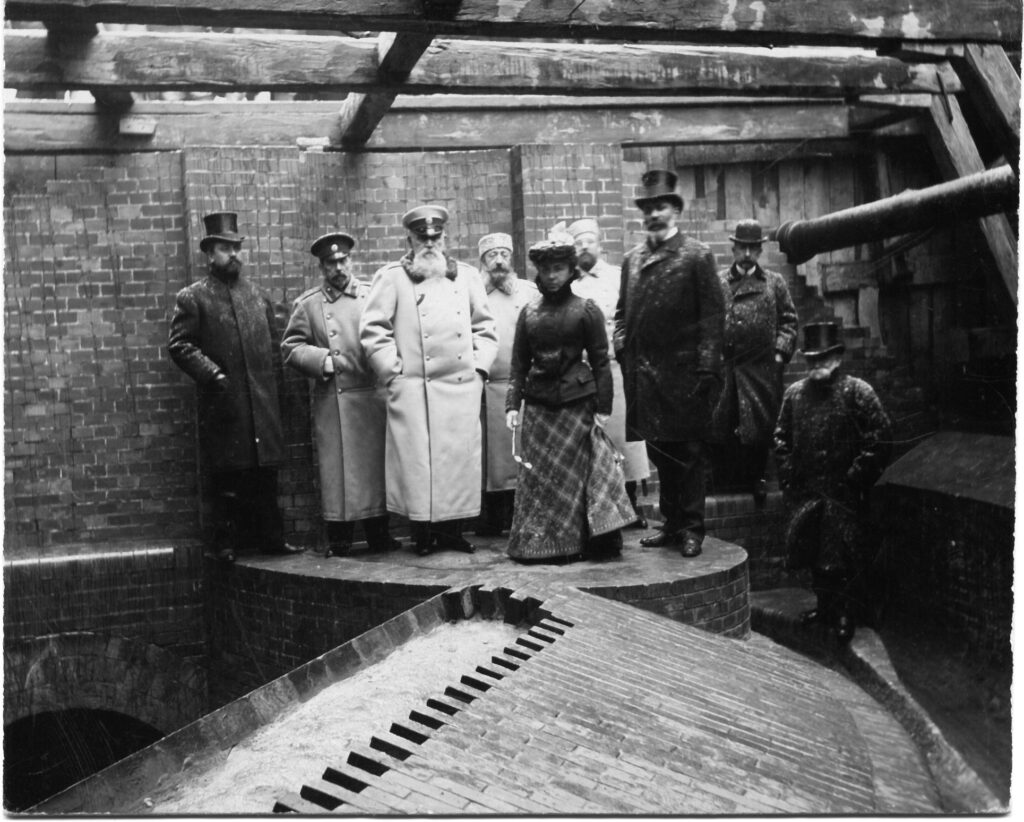
William Heerlein Lindley (third right) visiting the construction of the sewer system (Wikimedia Commons, under public domain)
The Lindleys’ design was very modern, with a pump station in the Ochota district. This purified water from the Vistula, which would then go directly to Varsovians’ taps. Warsaw became the first city in the Russian Empire with a modern sewer system.
Afterwards, the Lindleys would design sewer systems in Moscow, St Petersburg, Baku (now in Azerbaijan), Samara and other cities in Russian-ruled Poland, such as Łódź, Włocławek, and Radom.
An underground lifeline
During the Second World War, Warsaw experienced three major waves of destruction at German hands. During the September 1939 campaign, bombing by the Luftwaffe destroyed much of the city. In 1943, the entire Warsaw Ghetto was levelled to the ground when partisans in the Jewish district rose up against the German occupiers.
A year later, the citywide Warsaw Uprising took place, which resulted in the near-complete destruction of the city’s buildings. Warsaw’s major landmarks, such as the Royal Castle, Saxon Palace, St John’s Cathedral and the Grand Theatre, were reduced to nothing more than rubble.
“The only part of the city’s infrastructure that was largely intact was the sewers,” Żelichowski says, noting that it nevertheless suffered some damage during the German carpet bombing of Warsaw in September 1939. “While the Germans had no respect for Polish and Jewish life, they themselves needed clean water, much like the Russians decades earlier.”
The sewer system also played a crucial role as a means of passage for insurgents in both uprisings.
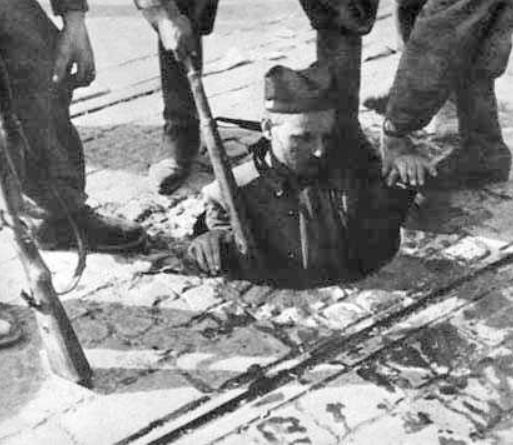
A participant in the Warsaw Uprising emerging from the sewers and surrendering, September 1944 (August Ahrens/Wikimedia Commons, under public domain)
This was depicted in Andrzej Wajda’s classic 1957 film Kanał (Sewer), part of a trilogy of war films. Kanał is a tragic, intensely psychological drama about a platoon of the Polish Home Army led by a lieutenant whose nom de guerre is Zadra (Scar) and that is fleeing the Mokotów district where the SS is committing mass war crimes through the city sewers to get to the safer inner city.
These Polish partisans must wade across kilometres of human waste and face German grenades and gas as well as challenges to their own sanity. When the film was shown at Cannes, where it won a Special Jury Prize, French critics erroneously thought that the use of sewers in guerrilla warfare was the director’s invention.
Meanwhile, after the suppression of the ghetto rising, Jewish partisans fled to the “Aryan side” of the occupied Polish capital underground. The Germans often threw grenades into the sewers to kill Polish and Jewish partisans, but the damage was nothing compared to the devastation above ground.
The 20th century was a period of great urbanisation in Poland and other European countries. Thus, in the interwar period, Warsaw’s area expanded as the capital of the reborn Polish state swallowed up nearby settlements, resulting in numerous additions to the Lindleys’ design.
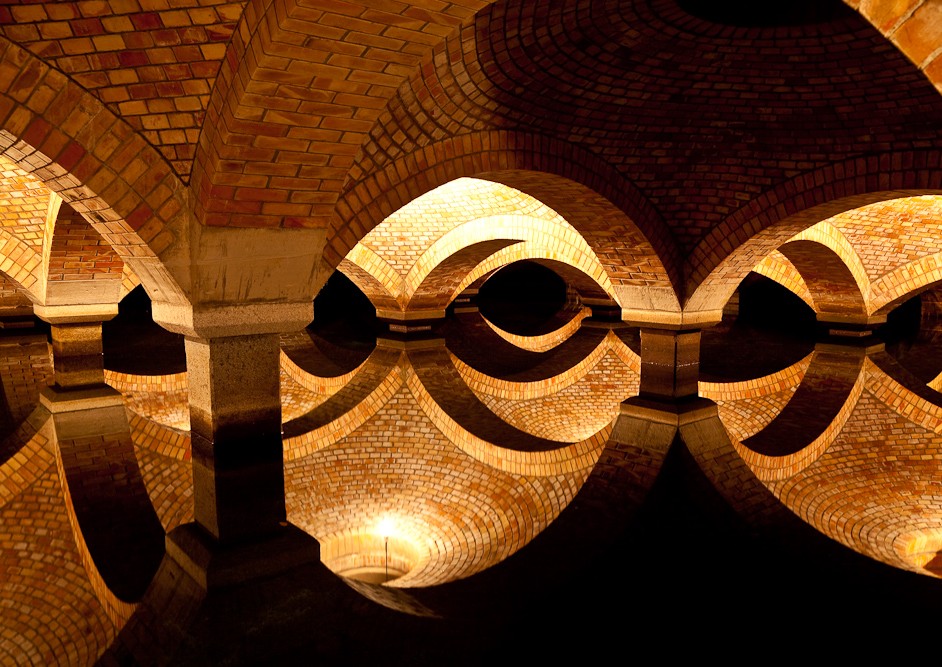
However, the sewerage system that continues to serve downtown Warsaw (Śródmieście) is still the Lindleys’ original sturdy project. While technology has changed, the Lindleys’ sand filters still function until the present day.
Today, the original design of the Lindleys’ slow sand filters, whose vault and columns bring to mind a neo-Gothic cathedral, remains intact. However, over the decades the sewer system has been expanded (to the right-bank Warsaw district of Praga in the 1950s, for instance), while new technologies have been introduced, such as pulsator valves in the 1960s.
Nevertheless, the Warsaw municipal government has taken care that throughout the years all changes were implemented respecting the architectural forms and vision of the Lindleys’ original blueprint.
Fitting monuments
The elder William Lindley died in 1900. His work was continued by his son, William Heerlein Lindley, who designed the water and sewerage system for the city of Łódź, which was also undergoing major industrialisation, in 1909.
When World War I broke out, as a British national, he had to leave Germany to avoid internment. He later went to Baku to design the city’s water supply system and died in London in 1917.
Today there are streets named after William Heerlein Lindley in Warsaw and Łódź (an “H” was added to the street name in the latter city in 2015 to emphasise the fact that it was the younger Lindley, not his father, who designed the city’s sewer system).
In Warsaw, an unusual monument commemorating William Heerlein was unveiled in 2011. This work by Norbert Sarnecki depicts Heerlein in a top hat next to a bench made out of pumps and water pipes.
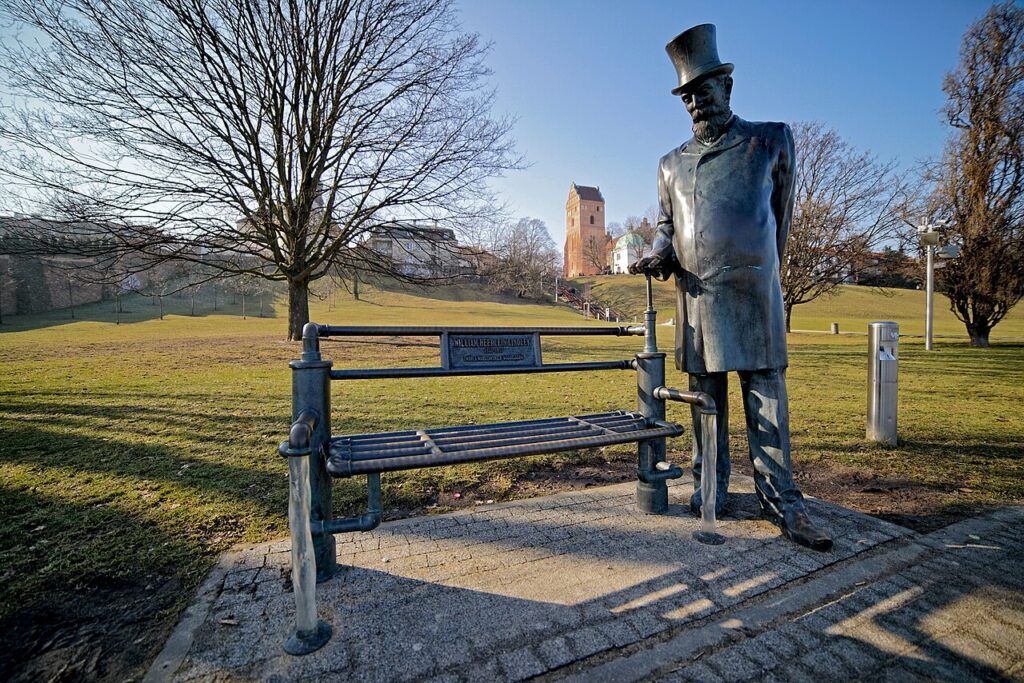
Monument to William Heerlein Lindley in Warsaw by Norbert Sarnecki (Arkadiusz Zarzecki/Wikimedia, under CC BY-SA 3.0)
Few cities had such turbulent and dramatic histories in the 19th and 20th centuries. Once dubbed the “Paris of the East”, Warsaw was, by the end of World War Two, a pile of rubble, only to become a phoenix city with, apart from the meticulously reconstructed Old Town, an entirely different architectural style.
Warsaw’s sewer system is the underground thread that connects the city’s prewar past to its vibrant present. While unseen by most and therefore overlooked, thanks to the Lindleys, many Varsovians, even in the late 19th century, could live longer and safer lives.
Notes from Poland is run by a small editorial team and published by an independent, non-profit foundation that is funded through donations from our readers. We cannot do what we do without your support.
Main image credit: Robert Parma/Wikimedia (under CC BY-SA 3.0)