
Keep our news free from ads and paywalls by making a donation to support our work!

Notes from Poland is run by a small editorial team and is published by an independent, non-profit foundation that is funded through donations from our readers. We cannot do what we do without your support.
The number of ultra-wealthy individuals in Poland has more than doubled over the last five years, a higher rate of growth than anywhere else in the world, according to a new study. Poland is also forecast to have the second-highest growth rate in the number of billionaires over the next five years.
The figures highlight Poland’s rapid economic growth in recent times, though they also raise concerns over potential inequalities.
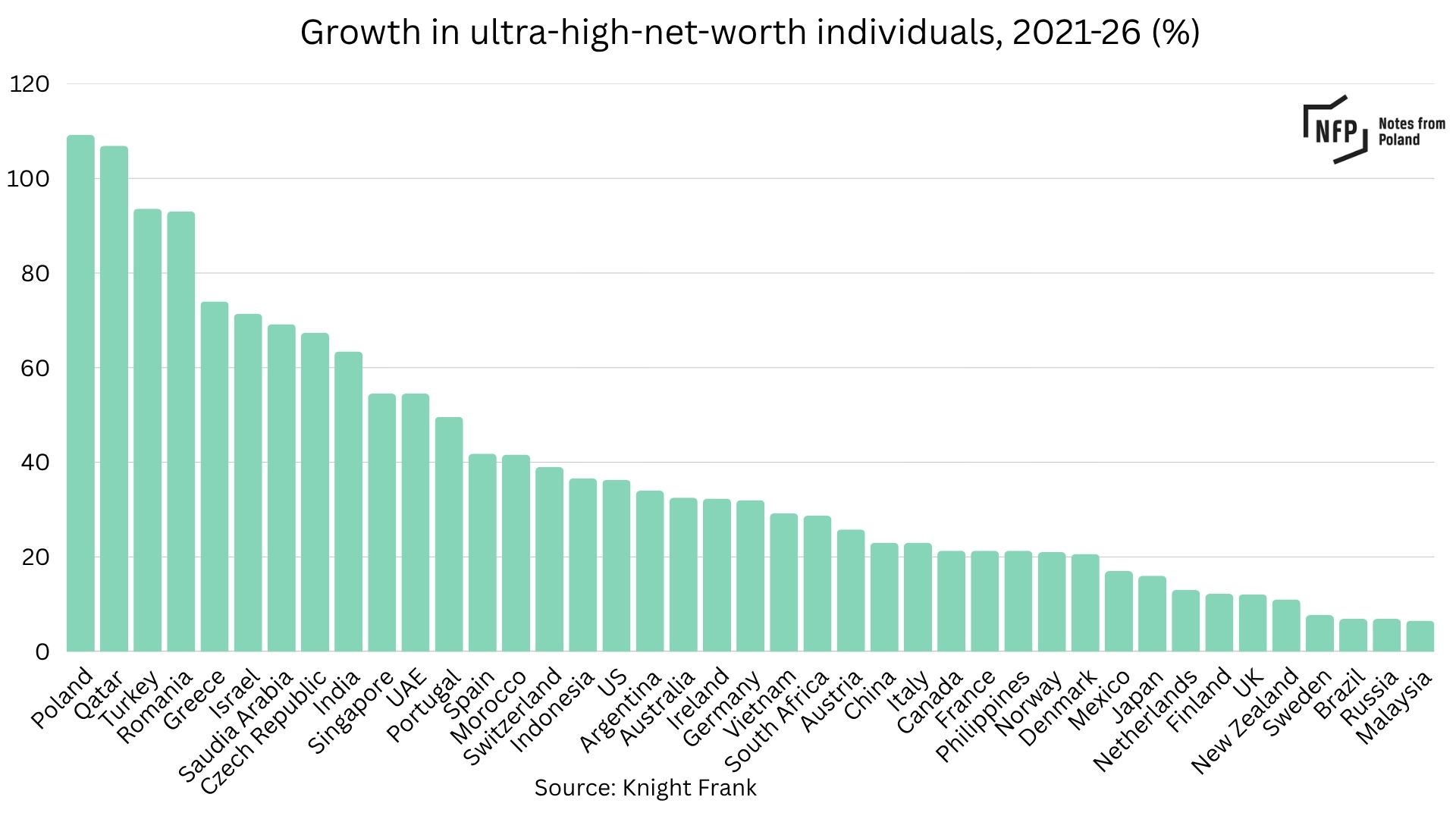
In its latest annual Wealth Report, Knight Frank, a global real estate consultancy, looked at the growth in the number of ultra-high-net-worth individuals (UHNWIs) between 2021 and 2026 in the 44 countries that currently have at least 500 such individuals.
It defines a UHNWI as someone with a net worth of at least $30 million (108 million zloty).
Poland’s population of UHNWIs rose by 109.2% over that period, from 1,442 to 3,017, which was a higher rate of growth than anywhere else. Qatar (106.9%) was next on the list, followed by Turkey (93.6%).
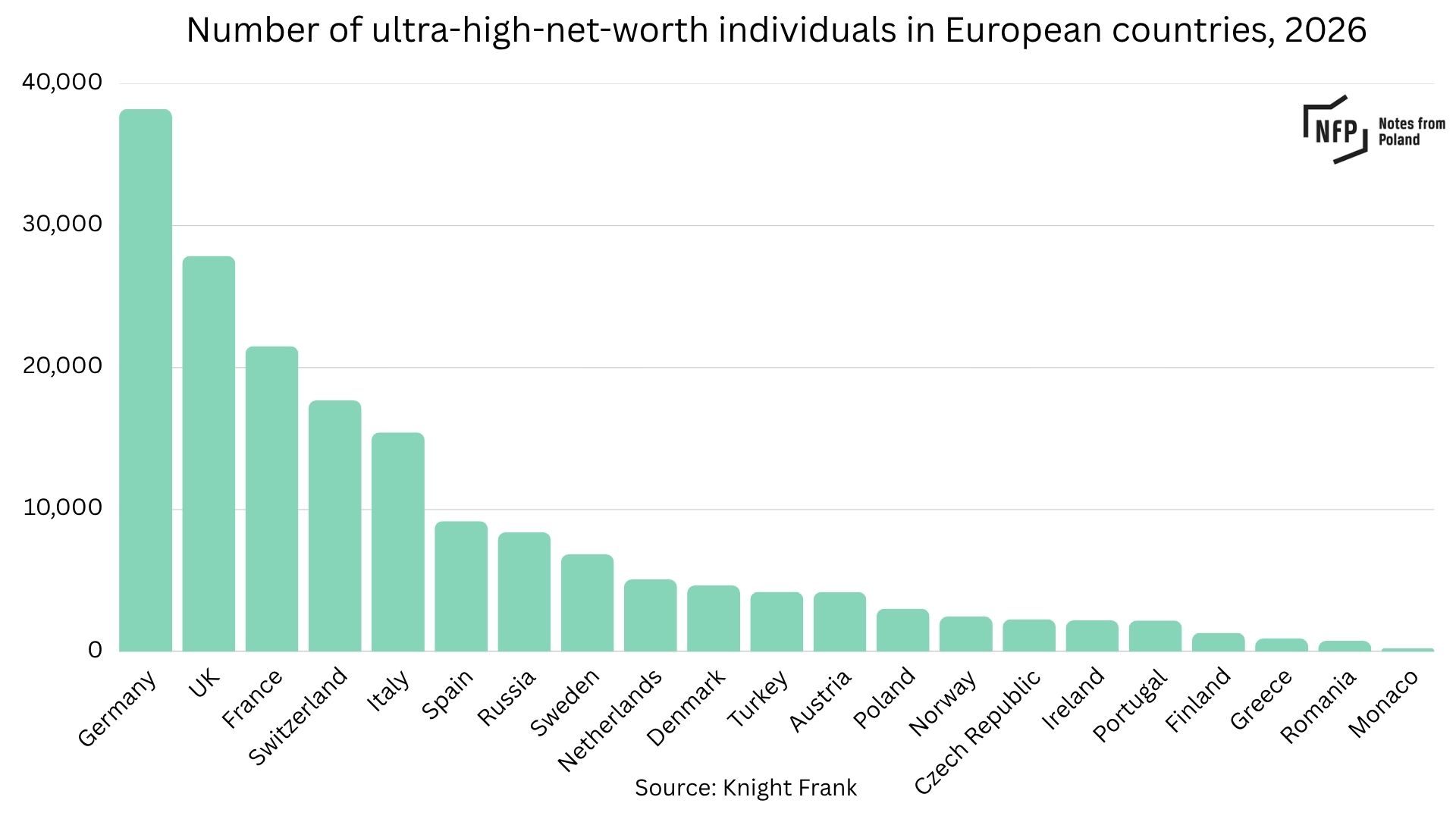
However, in terms of the absolute number of UHNWIs, Poland’s current figure of 3,017 remains much smaller than many other European countries, such as Germany (38,215), France (21,518), Italy (15,433), Sweden (6,845) and Denmark (4,657).
In its report, Knight Frank forecasts that the number of UHNWIs in Poland will rise to 4,906 by 2031, a growth rate of almost 63%. Only Indonesia (82%) and Saudi Arabia (63%) have larger expected rises.
The agency also found that the number of billionaires in Poland, currently 13, will reach 29 by 2031, a growth rate of 123%. Only Saudi Arabia (183%) has a larger forecasted rise, while Sweden (81%) is third. The data only include countries with more than five billionaires this year.
Knight Frank notes that it is now “rapidly maturing economies, such as Indonesia, Saudi Arabia, Poland, and Vietnam”, rather than “the usual suspects”, that are driving growth in ultra-high-net-worth individuals.
Poland has been one of the world’s fastest-growing economies in recent decades. By 2024, its GDP per capita stood at $25,060, compared to $2,700 in 1994, according to IMF figures. In absolute terms, its economy is forecast to overtake Switzerland’s to become the world’s 20th largest in 2028.
The proportion of people in Poland who say they are financially comfortable has this year risen to a record high of 39%, according to the latest findings from a long-running survey conducted by state research agency CBOS. The figure is up from 27% in 2023 and just 3% in the early 1990s.
The number of people in Poland with assets exceeding 4 million zloty ($1.1 million) has doubled in the last decade, from around 50,000 to 100,000, reported the Rzeczpospolita daily last year. Those with assets of more than 400,000 zloty tripled over that period to reach over four million.
The proportion of people in Poland who say they are financially comfortable has risen to a record high of 39%.
That is up from 27% in 2023 and just 3% in 1993.
For more on the findings, read our full report: https://t.co/6UimuA17he pic.twitter.com/O7eH27e8tp
— Notes from Poland 🇵🇱 (@notesfrompoland) April 28, 2026
However, growing wealth has also raised concern over rising inequalities. A recent poll by CBOS found that around three-quarters of Poles believe that Poland is not a country of equal opportunity.
But according to the World Bank, Poland’s Gini index, a common measure of income inequality, actually fell from around 34.9 in 2003 to 28.5 in 2023, meaning that inequality declined. However, the trend ended in 2019, since when the figure has been stable.
Last year, in a podcast on the subject, the Polish Economic Institute (PIE), a think tank, argued that “inequality in Poland is growing faster than official statistics show”. It noted that the wealthiest 1% of Poles earn around 13-14% of all income.
Yet data also suggest that poverty has fallen significantly. Statistics Poland (GUS), a state agency, reported earlier this year that only 2% of Poles are unable to meet the most basic of needs, the lowest figure on record.
Only 2% of Poles were living in severe deprivation last year, the lowest proportion on record and down from 7.8% a decade earlier, according to Poland’s statistical office, which calculates the figure based on whether people can meet a set of basic needs https://t.co/BqLL5tVTDK
— Notes from Poland 🇵🇱 (@notesfrompoland) April 1, 2026
Notes from Poland is run by a small editorial team and published by an independent, non-profit foundation that is funded through donations from our readers. We cannot do what we do without your support.

Olivier Sorgho is senior editor at Notes from Poland, covering politics, business and society. He previously worked for Reuters.