Keep our news free from ads and paywalls by making a donation to support our work!

Notes from Poland is run by a small editorial team and is published by an independent, non-profit foundation that is funded through donations from our readers. We cannot do what we do without your support.
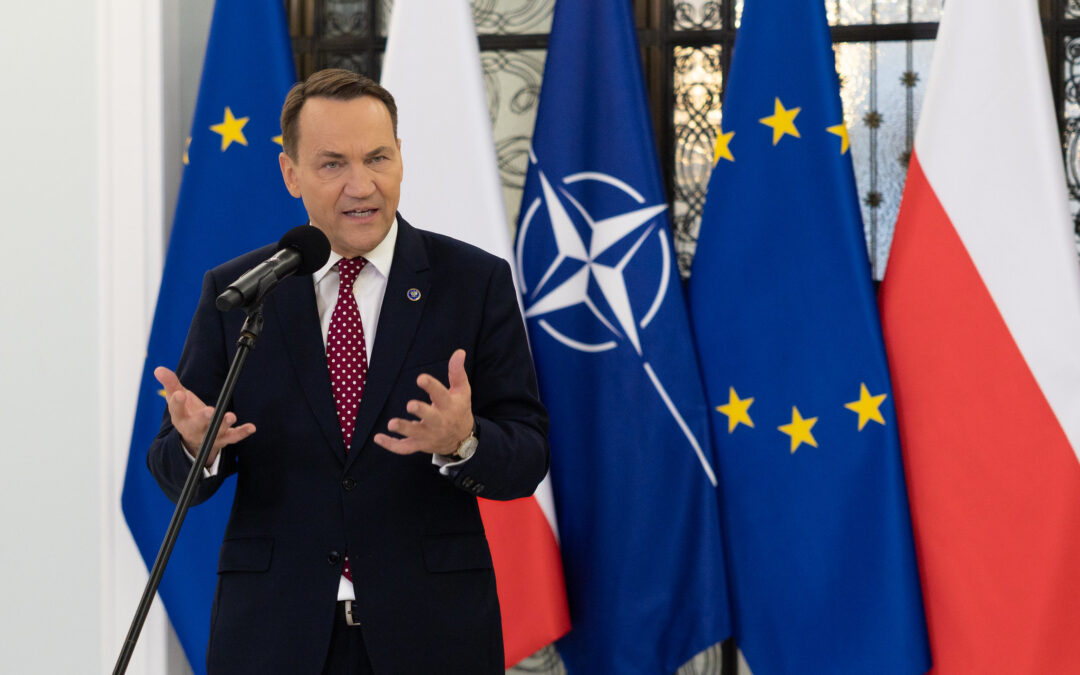
Poland’s foreign minister, Radosław Sikorski, says that his country would be willing to discuss calls by US President Donald Trump for NATO allies to help secure the Strait of Hormuz, “out of respect for our American ally”.
However, he notes that Polish President Karol Nawrocki, a Trump ally and commander in chief of the armed forces, has already ruled out direct Polish military involvement in the ongoing US operations in the Middle East.
Ochrona cieśniny Ormuz. Sikorski: Jeśli USA zwrócą się do NATO, rozważymy to https://t.co/yMZuzlddXn
— Forsal.pl (@forsalpl) March 16, 2026
In response to US and Israeli attacks against it, Iran has effectively closed off the Strait of Hormuz, a vital transit point for oil and gas being exported from the Middle East. That has in turn contributed to soaring global energy prices.
Trump has in recent days called on NATO allies, as well as China, Japan and South Korea, to help the US reopen the strait.
“It’s only appropriate that people who are the beneficiaries of the strait will help to make sure that nothing bad happens there,” he told the Financial Times on Sunday. “If there’s no response or if it’s a negative response I think it will be very bad for the future of NATO.”
“We’ve been very sweet. We didn’t have to help them with Ukraine. Ukraine is thousands of miles away from us…But we helped them. Now we’ll see if they help us. Because I’ve long said that we’ll be there for them but they won’t be there for us. And I’m not sure that they’d be there.”
Trump warns Nato faces ‘very bad future’ if allies fail to help US in Iran https://t.co/utDHYAj0hq
— Financial Times (@FT) March 15, 2026
Speaking in Brussels on Monday ahead of a summit of EU foreign ministers, Sikorski said that “it is a bit worrying that President Trump refers to NATO as ‘they’, as Europe, and not as ‘we'”.
However, he added that, “if there is a request to NATO to discuss the protection of the Strait of Hormuz, out of respect for our American ally, we will consider it”.
But Sikorski also noted that Nawrocki, who is aligned with Poland’s right-wing opposition and is a close ally of Trump, “has already ruled out the participation of the Polish army in this operation”.
He was most likely referring to comments by Nawrocki at the start of March, two days after the US and Israel had begun their attacks on Iran, in which the president said that Polish support for the US should not involve sending troops to take part in the conflict.
“We must be clear: the United States is our ally,” said Nawrocki. “[But] sending troops to this area of operations…isn’t the Polish state’s plan, nor do we currently have any direct interests there.”
Other European NATO countries have also been circumspect about the prospect of joining any operation to reopen and secure the Strait of Hormuz.
British Prime Minister Keir Starmer said today that the UK and its allies are working on a “viable, collective plan” to reopen the strait. However, he added that no decision had been made on British involvement and that London would avoid any actions that risked dragging the UK into a “wider war”, reports the BBC.
Germany’s defence minister, Boris Pistorius, was even more blunt, asking: “What does Trump expect from a handful of European frigates that the powerful US navy cannot do? This is not our war. We have not started it…Germany will not participate with its military in securing the Strait of Hormuz.”
🔴 The US war against Iran has “nothing to do” with Nato, Germany said after Donald Trump demanded help from members of the military alliance
Read the full story below 🖇️https://t.co/Kti3USfVSI pic.twitter.com/VrpfYsg8m5
— The Telegraph (@Telegraph) March 16, 2026
However, ahead of today’s summit in Brussels, the EU’s chief diplomat, Kaja Kallas, said that she would propose changing the mandate of the bloc’s naval mission in the Middle East because “it is in our interest to keep the Strait of Hormuz open”, reports Euronews.
Launched in 2024 and known as Aspides, the mission is intended to defend international shipping in the Red Sea from attacks by the Iran-backed Houthi rebels in Yemen. It only involves two or three EU ships at any one time.
Speaking after today’s meeting, Sikorski also said that he believes “it would not be a bad idea to enter into a dialogue with the American side about hypothetical possible modifications to these [EU naval] missions, as suggested by [Kallas]”.
But he emphasised that this would happen “when peace prevails” in the region and that “Poland has no plans to participate in such a mission”.
🗣️ "Prezydent Trump zwrócił się do NATO o pomoc, ale ileś krajów NATO już mu odpowiedziało. I żeby było jasne – Polska nie ma żadnych planów wzięcia udziału w takiej misji. ALE UE już ma dwie takie misje dość niedaleko Cieśniny Ormuz"
Wicepremier i szef MSZ @sikorskiradek ⤵️ pic.twitter.com/MTMzL7v4Y5
— tvp.info 🇵🇱 (@tvp_info) March 16, 2026
Notes from Poland is run by a small editorial team and published by an independent, non-profit foundation that is funded through donations from our readers. We cannot do what we do without your support.
Main image credit: MFA Poland/Flickr (under CC BY 4.0)

Daniel Tilles is editor-in-chief of Notes from Poland. He has written on Polish affairs for a wide range of publications, including Foreign Policy, POLITICO Europe, EUobserver and Dziennik Gazeta Prawna.