Keep our news free from ads and paywalls by making a donation to support our work!

Notes from Poland is run by a small editorial team and is published by an independent, non-profit foundation that is funded through donations from our readers. We cannot do what we do without your support.
Russia has protested to Poland over the vandalism of a Soviet war cemetery, which it says was defaced with “inscriptions and symbols glorifying Ukrainian Nazis”.
On Wednesday, the Russian embassy in Warsaw issued a statement saying that it had “learned of an act of vandalism at a Soviet soldiers’ cemetery in Gdańsk”, a city on Poland’s northern Baltic coast. It contains the remains of over 3,000 Soviet soldiers who died during World War Two.
⚡️Комментарий Посольства России в Польше
В марте 2026 г. Посольству России в Польше стало известно об акте вандализма на кладбище советских воинов в г. Гданьск (Поморское воеводство), на котором похоронено более 3 тыс. советских военнослужащих, погибших в годы Второй мировой… pic.twitter.com/oJ6imuaE1u
— Russian Embassy, PL (@rusemb_pl) March 11, 2026
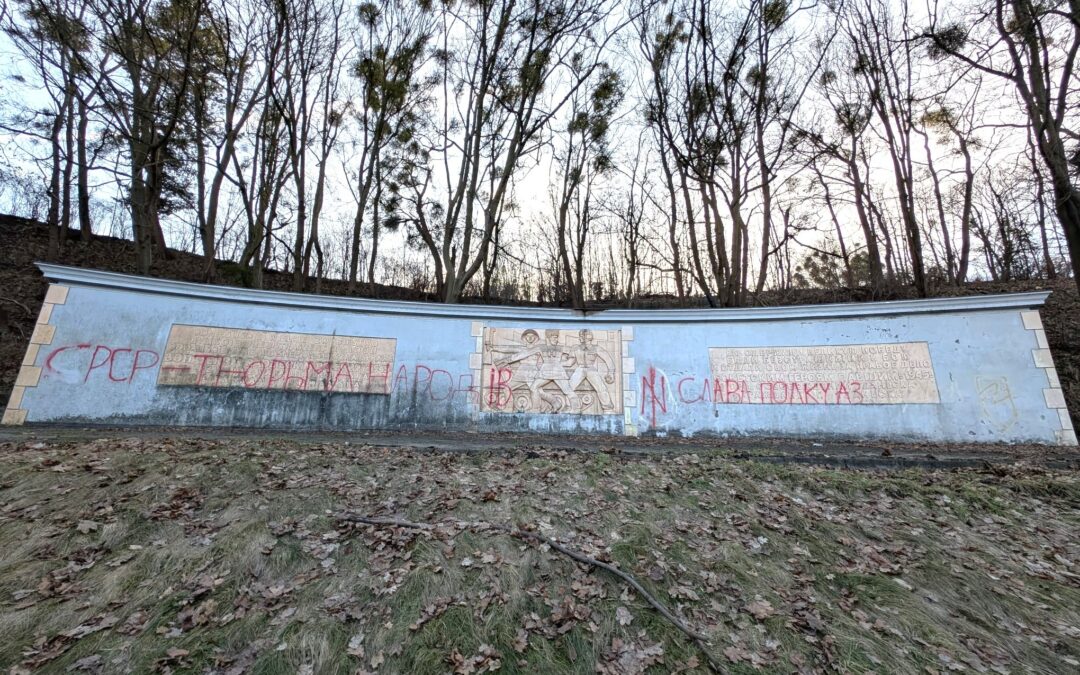
The embassy noted that the central feature of the cemetery, a long wall containing a sculpture and plaques, had been “defaced with inappropriate inscriptions and symbols glorifying Ukrainian Nazis”.
Notes from Poland today visited the site and confirmed that the vandalism had taken place. Two sentences have been painted onto the wall in Ukrainian. The first says “USSR prison of nations”. The second is unfinished, but appears to have been intended to say “Glory to the Azov Brigade”.
The Azov Brigade is part of the National Guard of Ukraine that has associations with far-right and neo-Nazi ideology. The brigade is often presented by Russia as evidence of the need for Ukraine to be “denazified”, which is used by Moscow as justification for its aggression against its western neighbour.
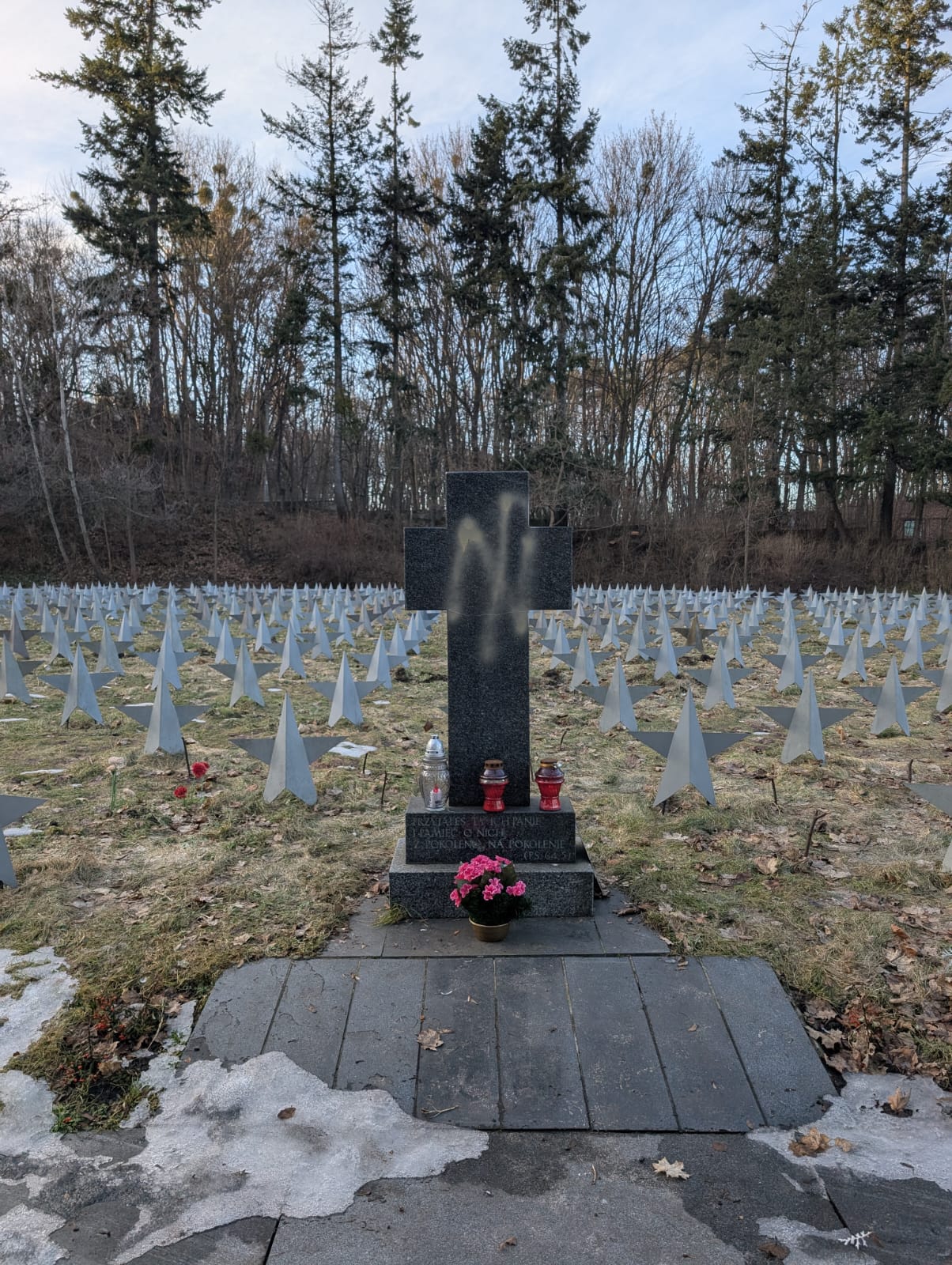
The graffiti on the cemetery’s memorial wall includes the “National Idea” symbol that is used by the Azov Brigade and other Ukrainian far-right groups. It was also painted onto another gravestone.
In its statement, the Russian embassy said that it had “sent a letter of protest to the Polish authorities demanding that the memorial be restored to its original appearance, that those responsible be identified and punished, and that similar acts be prevented in the future”.
Meanwhile, at a press conference on Thursday, Russian foreign ministry spokeswoman Maria Zakharova also condemned the incident, calling it a “disgusting example not only of Russophobia, but also of the rampant nationalism in Poland in general”.
“Warsaw is making every effort to remove from public space everything related to the history of the Soviet Union and the rescue of the Polish nation from Nazi captivity by the Red Army,” she added, quoted by Polish news website Onet.
Russia regularly accuses Poland of being a hotbed of “Russophobia” and criticises it for the demolition of Soviet monuments. In the Kremlin’s narrative, the Soviet Union “liberated” Poland from Nazi Germany, but Poles see that simply as the beginning of decades of Moscow-imposed communist rule.
Russia has warned its citizens against visiting Poland due to "a rise in Russophobic sentiments and cases of persecution of Russian citizens" https://t.co/epUN9asXRS
— Notes from Poland 🇵🇱 (@notesfrompoland) January 16, 2026
Under a 1994 agreement between Poland and Russia, the two countries have an obligation to preserve burial sites. Moscow argues that this also requires the protection of memorials, but Warsaw says it applies only to cemeteries.
Poland also points to the fact that Russia has violated burial sites associated with victims of the 1940 Katyn massacres, in which the Soviets murdered 22,000 Polish military officers, intellectuals and other prisoners.
At the time of writing, there had been no comment from local or national Polish authorities on the vandalism at the Soviet cemetery in Gdańsk.
Poland has condemned the removal of Polish military symbols from a cemetery in Russia of Poles murdered by the Soviets in WWII.
"We will defend these crosses because we do not accept Russian historical lies," says foreign minister @sikorskiradek https://t.co/syYLpdWG3N
— Notes from Poland 🇵🇱 (@notesfrompoland) May 21, 2025
Tensions have recently been particularly high between Warsaw and Moscow, in particular due to a campaign of sabotage, cyberattacks, disinformation and espionage carried out in Poland by operatives working on behalf of Russia.
In response, Poland has ordered Russia to close all of its consulates in the country, including one in Gdańsk. In a tit-for-tat move, Russia has also closed all of Poland’s consulates.
However, although Russia removed its diplomats from the consulate in Gdańsk last December, it has refused to hand over the building itself, prompting the local authorities to consider legal action in order to reclaim the site.
Poland has also been one of Ukraine’s strongest supporters in its defence against Russian aggression, and has welcomed large numbers of Ukrainian refugees. Almost a million remain resident in Poland, along with hundreds of thousands of Ukrainian economic migrants.
Notes from Poland is run by a small editorial team and published by an independent, non-profit foundation that is funded through donations from our readers. We cannot do what we do without your support.
Credit for all images: Alicja Ptak/Notes from Poland

Daniel Tilles is editor-in-chief of Notes from Poland. He has written on Polish affairs for a wide range of publications, including Foreign Policy, POLITICO Europe, EUobserver and Dziennik Gazeta Prawna.