Keep our news free from ads and paywalls by making a donation to support our work!

Notes from Poland is run by a small editorial team and is published by an independent, non-profit foundation that is funded through donations from our readers. We cannot do what we do without your support.
By Daniel Tilles
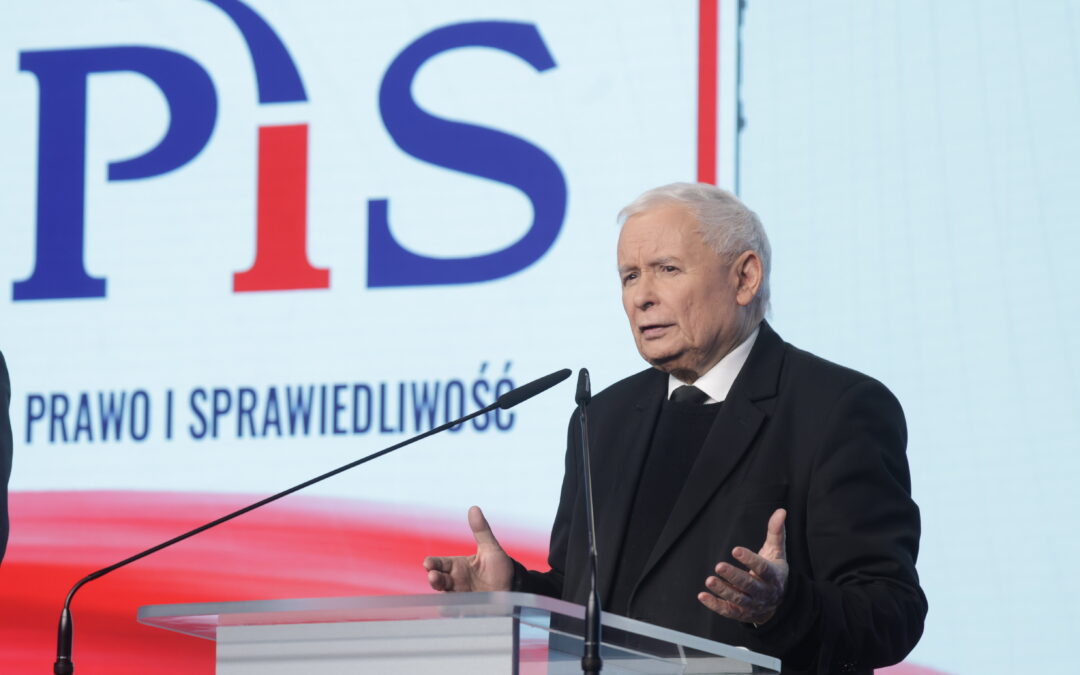
PiS’s level of support has fallen to its lowest level in 14 years, as the party grapples with internal division, the rise of far-right challengers, living in the shadow of President Karol Nawrocki, and the unpopularity in Poland of PiS ally Donald Trump.
The national-conservative Law and Justice (PiS), Poland’s ruling party from 2015 to 2023 and now its main opposition, is in trouble.
Its average support in polls fell to 25% in February, according to two leading aggregators, Politico Europe’s Poll of Polls and Polish service eWybory. That is PiS’s lowest figure since 2012 and 10 percentage points down from the 35.4% of the vote it won at the 2023 parliamentary elections.
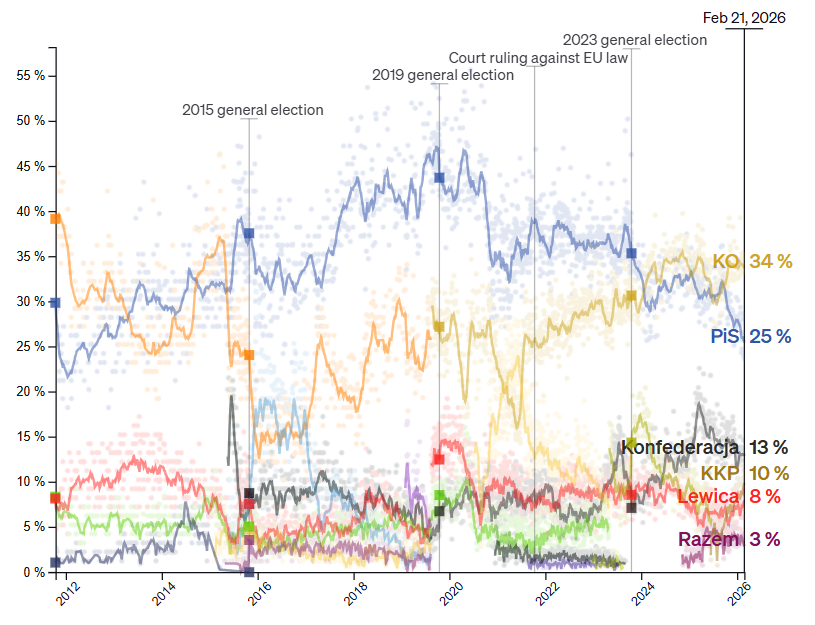
Politico Europe’s Poll of Polls for Poland
Meanwhile, factions within the party are openly at war, with leading figures attacking one another on social media, prompting leader Jarosław Kaczyński to threaten to suspend their party membership.
A number of factors, both internal and external, lie behind PiS’s current crisis. However, there remains plenty of time for PiS to turn things around before next year’s elections, with Kaczyński announcing that preparations will begin this Saturday.
Living in Nawrocki’s shadow
Paradoxically, one of the problems PiS has faced is the election last year of its candidate for the presidency, Karol Nawrocki.
His dramatic victory, having trailed in the polls right until the very end of the campaign, was rightly hailed as a success for PiS, which took a big gamble in backing a candidate who had never previously stood for elected office.
Yet it appears to be no coincidence that the party’s decline in the polls began in September, just after Nawrocki took office. The new president’s assertive style – clashing regularly with Prime Minister Donald Tusk and vetoing an unprecedented number of bills – has made him the face of the opposition and left PiS sidelined.
Whereas the previous president, Andrzej Duda, was also an opponent of Tusk’s government, he was very much seen as a PiS man – often even derisively called “Kaczyński’s pen”.
By contrast, Nawrocki, who has never been a member of PiS and technically stood for the presidency as an independent, is establishing the presidential palace as the main alternative centre of power to the government and replacing Kaczyński as the leader of the Polish right.
Karol Nawrocki has sought to redefine Poland's presidency and become the figurehead of the right-wing opposition.
So far, it is working, but questions remain over what his end goal is and whether these tactics will get him there, writes @danieltilles1 https://t.co/TNDRGGv2QT
— Notes from Poland 🇵🇱 (@notesfrompoland) December 22, 2025
Another issue for PiS has been that Kaczyński, who turns 77 this year, is increasingly showing his age. He appears to lack his former authority and energy, and has suffered a number of health problems in recent years.
At the turn of January and February, he was hospitalised for over a week and then homebound for a further period, with the party saying only that he had suffered an “illness”. Around that time, particularly bitter and public infighting between factions within PiS broke out, with senior party figures attacking one another on social media.
That prompted Kaczyński to issue a statement declaring that “such behaviour is extremely harmful to Poland and PiS” and warning that “anyone who joins in this harmful discussion, regardless of their merits and party position, will be suspended from the rights of PiS membership, which will also have an obvious impact on their political future”.
Szanowni Państwo, w związku z ostatnimi publicznymi wypowiedziami niektórych członków PiS informuję, iż każdy, kto zabierze w tej szkodliwej dyskusji głos, niezależnie od zasług i partyjnej pozycji, zostanie zawieszony w prawach członka PiS, co będzie miało oczywisty wpływ także…
— Jarosław Kaczyński (@OficjalnyJK) February 13, 2026
However, in a sign of Kaczyński’s declining authority, last week again saw open bickering between PiS officials, with two deputy party leaders, Mateusz Morawicki and Patryk Jaki, clashing on social media over the record of the former PiS government.
Both men have now been referred by Kaczyński to the party’s ethics commission for violating his ban on engaging in “harmful discussions” on social media.
It should be noted that Kaczyński’s leadership of PiS, the party he cofounded in 2001, has often involved allowing individuals and factions to compete with one another, which helps prevent challenges to his authority and keep a broad range of views represented within the party.
However, that strategy has also relied on PiS ensuring that it is the dominant force on the Polish right. That position is now being seriously challenged by not only Nawrocki, but also the rise of the far-right Confederation (Konfederacja) and the even more radical Confederation of the Polish Crown (KKP).
The rise of the far right
Confederation now enjoys support of around 13% in polls, almost double the vote share it achieved at the last parliamentary elections in 2023.
Meanwhile, KKP has recently surged in popularity following last year’s unexpectedly strong presidential campaign by its controversial leader, Grzegorz Braun. It now has support of around 8-10%.
That fragmentation of the right-wing electorate presents serious challenges for PiS, both in terms of policy (should it tack further to the right and compete with its rivals at the risk of losing more moderate supporters, or stay closer to the centre ground but risk losing out on the growing far-right electorate?) and strategy (what kind of relationship should it have with Confederation and KKPboth before and, crucially, after the next elections?).
If current polling averages were converted into an election result, PiS would probably only be able to form a majority government alongside both Confederation and KKP. However, Kaczyński has already twice this year ruled out working with Braun, who is vociferously antisemitic, anti-Ukrainian and anti-American.
“An alliance with him is like an alliance with Putin,” said Kaczyński in January. Last month, he reiterated that “there’s no question of an alliance with Braun’s party”.
While that stance may be a principled one, it potentially further boosts Braun’s credentials as an anti-establishment candidate while also severely restricting PiS’s chances of forming a government after the elections.
Too close to Trump?
Multiple media reports have indicated that Kaczyński’s decision to so strongly and publicly rule out an alliance with Braun came under pressure from the Trump administration, which has indicated it would not want to work with any Polish government that includes Braun.
More broadly, PiS’s strong attachment to Trump may also be contributing to the party’s dip in popularity.
Back in 2024, PiS enthusiastically celebrated Trump’s election victory, hoping that his return to the White House would provide it with both a powerful ally and political momentum.
However, at the time, I warned that aligning itself so closely with Trump also presented dangers for PiS, particularly if the US president pursued policies unpopular among Poles.
That has proved to be the case, with Trump’s friendly relationship with Vladimir Putin and his threats towards European allies raising concern in Poland. A poll published last week showed that Trump is the third most distrusted world leader in Poland, behind only Putin and Belarus’s Alexander Lukashenko.
A new poll shows that the most distrusted world leaders in Poland are:
1. Putin 🇷🇺
2. Lukashenko 🇧🇾
3. Trump 🇺🇸And the most trusted are:
1. Zelensky 🇺🇦
2. Macron 🇫🇷
3. Meloni 🇮🇹For more, read our full report: https://t.co/DKgnhQAYkY
— Notes from Poland 🇵🇱 (@notesfrompoland) February 26, 2026
Over half of Poles now say that the US is no longer a reliable ally. A report by the Pew Research Center published last year found that only 35% of Poles had confidence in Trump to do the right thing in world affairs, down from a figure of 75% a year earlier for Joe Biden.
Yet despite the growing evidence of Trump’s unpopularity in Poland, PiS has continued to take his side on a variety of issues.
After the US ambassador cut off ties with the speaker of Poland’s parliament, citing unspecified “outrageous insults” against Trump, PiS criticised the speaker (who is part of Tusk’s coalition) for harming relations with Washington.
In January, Kaczyński called for Poland to join Trump’s Board of Peace, even if it meant paying $1 billion and sitting on the body alongside Putin.
Opposition leader Jarosław Kaczyński has called for Poland to join Donald Trump’s Board of Peace so as to remain "on the best possible terms with the US".
Poland should also pay $1bn for a permanent seat as "there's no point joining as a poor country" https://t.co/OEtXChP3Bw
— Notes from Poland 🇵🇱 (@notesfrompoland) January 26, 2026
PiS has recently campaigned vociferously against Poland accepting €44 billion in loans through the EU’s SAFE programme for defence spending, arguing, among other things, that the requirement to spend most of the money in Europe will harm relations with the US.
In each of these areas, PiS’s position does not align with the majority of the Polish public, according to polls. But even more dangerously, it gives the impression that the party is representing the interests of a foreign country, rather than those of Poland.
What next for PiS?
On Saturday, Kaczyński issued a public call for unity and announced that the party’s preparations for the autumn 2027 parliamentary elections would begin on 7 March. He did not specify what will happen on that day, but rumours suggest PiS will present either its candidate to be the next prime minister or a new party platform.
That may help provide more policy clarity and leadership, both of which have been lacking since PiS lost power in 2023. During that time, the party has constantly attacked the government’s policies, but often without offering a positive alternative of its own.
However, naming a new figurehead or platform also raises the risk of discontent from those elements who feel sidelined by whichever direction Kaczyński chooses.
Receptą na zwycięstwo jest jedność, a wszelkie próby jej podważania to realizowanie scenariusza obecnej koalicji rządzącej.
Pokazaliśmy, że działając wspólnie, potrafimy zwyciężać.
Przed nami wytężony czas pracy i przygotowania do właściwej kampanii parlamentarnej.
Marsz…— Jarosław Kaczyński (@OficjalnyJK) February 28, 2026
This kind of period of internal reckoning was always to be expected after PiS was removed from office following a decade in power. The process has been delayed in part because 2024 and 2025 then saw European, local and presidential elections, requiring focus and unity.
Now, with no elections taking place this year, the party has a chance to decide on its new direction.
Given that opinion polls show Tusk’s government is not popular – with 52% disapproval and 35% approval of its actions, according to a CBOS survey in February – PiS still has a good chance of winning back power in 2027. However, amid growing internal and external pressures, a lot is riding on the next few weeks and months.
Notes from Poland is run by a small editorial team and published by an independent, non-profit foundation that is funded through donations from our readers. We cannot do what we do without your support.
Main image credit: Kuba Atys / Agencja Wyborcza.pl

Daniel Tilles is editor-in-chief of Notes from Poland. He has written on Polish affairs for a wide range of publications, including Foreign Policy, POLITICO Europe, EUobserver and Dziennik Gazeta Prawna.