Keep our news free from ads and paywalls by making a donation to support our work!

Notes from Poland is run by a small editorial team and is published by an independent, non-profit foundation that is funded through donations from our readers. We cannot do what we do without your support.
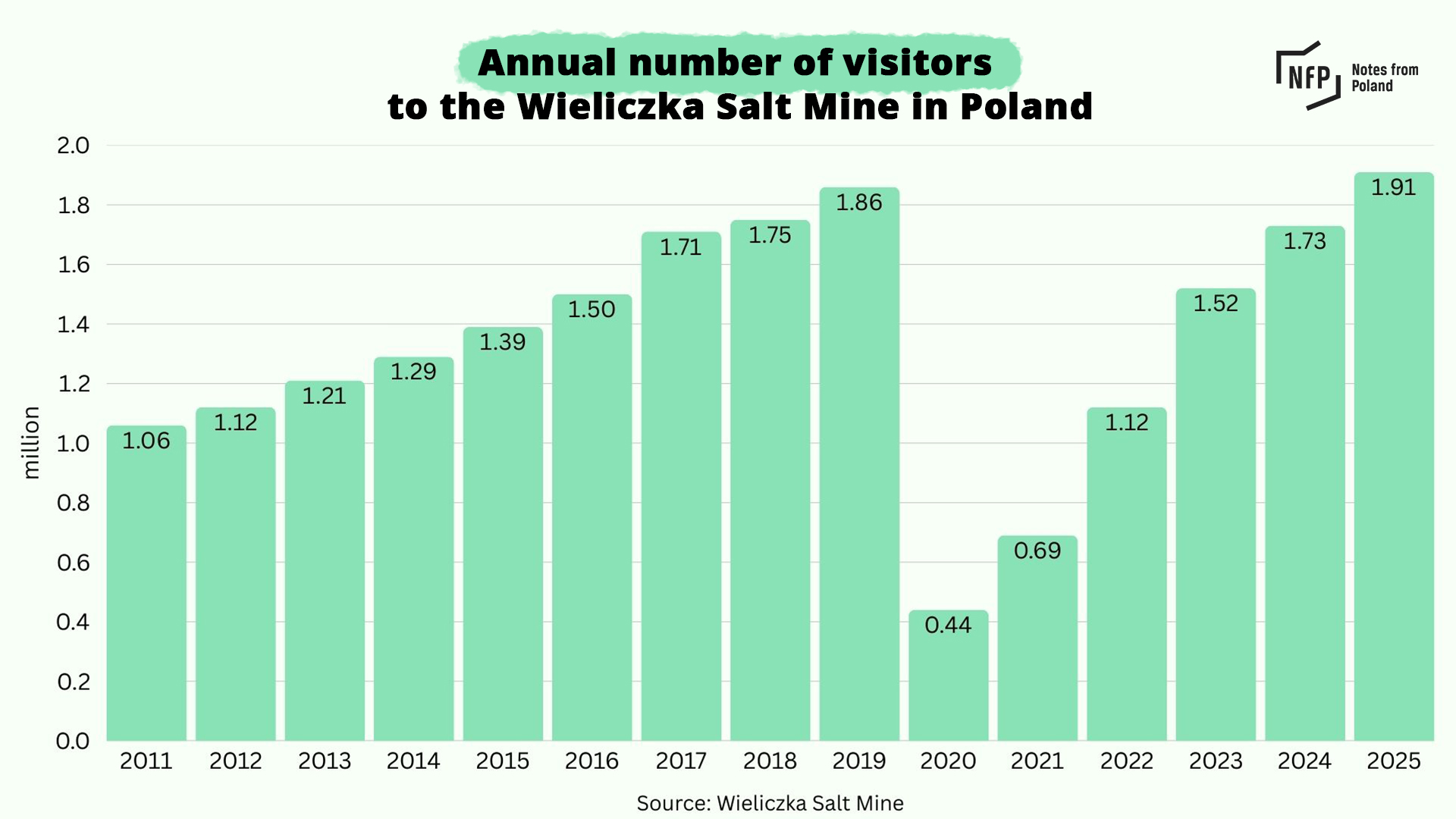
A record 1.91 million people, over 70% of them from abroad, visited the historic salt mine in Wieliczka, one of Poland’s biggest tourist attractions, last year. That figure is up 10% on 2024 and beats the previous record set in 2019.
Officials at the mine, a UNESCO World Heritage Site, say that the record shows they have bounced back from the lull in tourism caused by the pandemic as well as the war in neighbouring Ukraine.
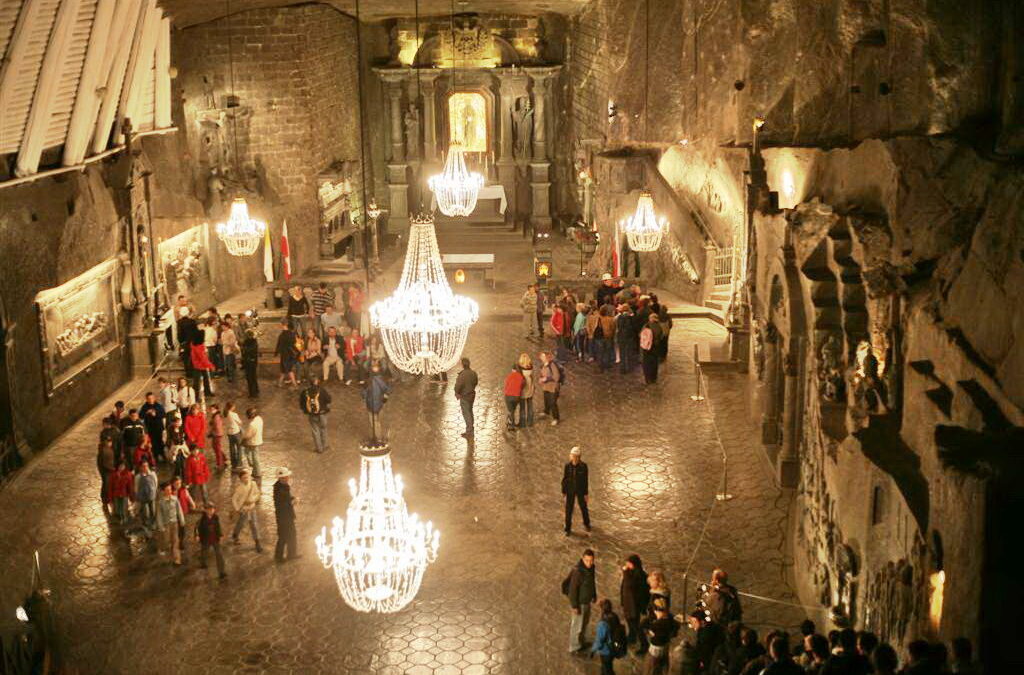
The salt mine in Wieliczka, a town near Kraków in southern Poland, began operation in the 13th century and produced table salt continuously until industrial production ended in 1996.
Reaching a depth of 327 metres across nine levels, the corridors of the mine stretch for some 245 kilometres underground. Tourists have been visiting the mine since the 18th century, and it was named on the original UNESCO World Heritage Site list in 1978.
Today, they follow a 2.2 km tourist route covering the mine’s first three levels, including attractions such as the cavernous St Kinga’s chapel, carved out of the rock salt by miners more than 100 metres underground and featuring a bas-relief version of Leonardo’s Last Supper carved in salt.
"Wieliczka" was the most mysterious place that I have ever seen.. #SaltMine #unesco #WorldHeritage @info_whc @unescowhc @mechtildrossler pic.twitter.com/DmOCXNOSlm
— Aytan Aliyeva (@aytan_aliyeva_) July 12, 2017
More than 70% of visitors in 2025 were from outside of Poland, led by those from the UK (272,000), Italy (143,000) and France (87,000), reports the Polish Press Agency (PAP).
In April 2025, the mine introduced AI-based chatbots to help manage increasing numbers of tourists. Created by the Kraków-based company ChatLab, the bots, which can answer questions in 20 languages, now deal with 17% of interactions with potential visitors.
“Chatbots are not a technological curiosity for us, but [offer] real support for our daily work,” says the mine’s spokeswoman Agnieszka Wolańska. “A virtual advisor answers questions at any time, helps with optimal trip planning, and makes the first contact with our institution quick and comfortable.”
Barbara Zięba-Godula, the mine’s CEO, told PAP that the new figures are “a historic result that shows that we have rebuilt the tourism whose growth was halted in 2019, first because of the pandemic, and later the war in Ukraine”.
Officials at the mine expect that it might welcome even more visitors this year, hoping to break 2 million for the first time. “We are hopeful and fully prepared to welcome such numbers,” Zięba-Godula said.
A record 40.8 million tourists – one fifth of them foreigners – stayed in registered accommodation facilities across Poland last year, up 11.8% compared to the pre-pandemic year of 2019, according to Statistics Poland (GUS), a state agency.
Last year, the Auschwitz Museum, a very different but equally popular site among visitors to Poland, announced new restrictions on entry amid a surge in numbers.
With its historic cities, natural landscapes and growing culinary scene, Poland is hoping to boost the role of tourism in its booming economy, writes Olivier Sorgho
The government wants tourism to contribute 9% of GDP within a decade, up from 4% now https://t.co/3wfyIkZMHm
— Notes from Poland 🇵🇱 (@notesfrompoland) December 2, 2025
Notes from Poland is run by a small editorial team and published by an independent, non-profit foundation that is funded through donations from our readers. We cannot do what we do without your support.
Main image credit: Cezary P/Wikimedia (under CC BY-SA 3.0)
Ben Koschalka is a translator, lecturer, and senior editor at Notes from Poland. Originally from Britain, he has lived in Kraków since 2005.