Keep our news free from ads and paywalls by making a donation to support our work!

Notes from Poland is run by a small editorial team and is published by an independent, non-profit foundation that is funded through donations from our readers. We cannot do what we do without your support.
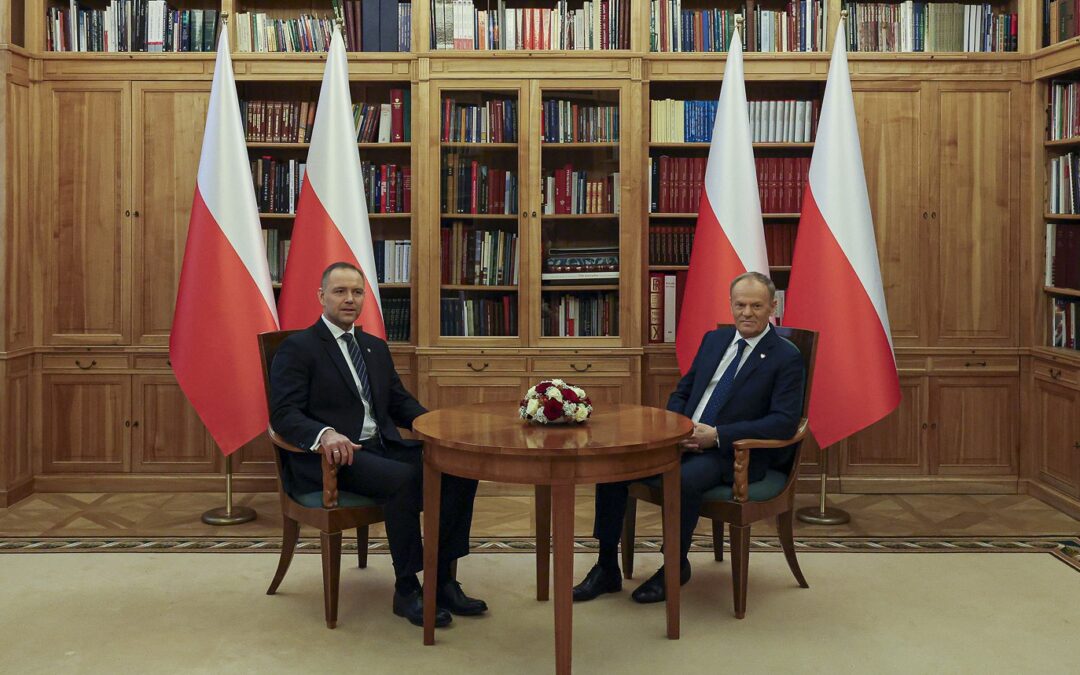
After holding their first meeting in months, Prime Minister Donald Tusk and opposition-aligned President Karol Nawrocki have agreed to put aside their differences in other areas in order to pursue a common line on security, including a potential peace deal in Ukraine.
“I proposed to the president that in matters directly relating to Poland’s security…there are certain points that require joint action by all Polish institutions,” said Tusk after being hosted by Nawrocki at the presidential palace. It was the first meeting between the pair since September.
“I welcome the president’s declaration that he shares this view on these matters,” he added. “This means that we are removing the issues of Ukraine, Russia and Poland’s security from disputes and internal political struggles.”
Speaking at a separate news conference, Nawrocki’s spokesman, Rafał Leśkiewicz, said that the meeting had been held in a “constructive atmosphere” and had “confirmed that…the prime minister and the president share the same view on matters concerning Poland’s security”.
💬 Premier @DonaldTusk ⤵️
Zwróciłem uwagę pana prezydenta na okoliczności związane z rozmowami o przyszłym pokoju w Ukrainie oraz na zobowiązania różnych państw, które będą z nich wynikać. pic.twitter.com/NjVV9Bf1tp
— Kancelaria Premiera (@PremierRP) January 9, 2026
The prime minister said that he had updated Nawrocki on developments from this week’s talks in Paris between the so-called Coalition of the Willing about ending Russia’s war in Ukraine and helping Kyiv rebuild.
“We agreed on the potential signing of documents such as the 20-point peace plan, the plan for the reconstruction of Ukraine, and security guarantees,” added Tusk, noting that such agreements would need to be ratified by Poland’s parliament and president.
Leśkiewicz, meanwhile, said that, when it comes to “direct talks with our American ally” about Ukraine, that is “the domain of President Nawrocki”, who is a close ally of Trump. “Talks at the European level are the domain of Prime Minister Tusk”, a former president of the European Council.
Both Tusk and Leśkiewicz confirmed that the president and prime minister are in agreement on most issues relating to Ukraine and the peace process.
Poland will be “the lead country” in logistical support for any peace deal in Ukraine, @donaldtusk has announced following today's Paris summit.
Tusk also reiterated that there will be no Polish troops on the ground in Ukraine as part of the peace process https://t.co/tqJDJ256xp
— Notes from Poland 🇵🇱 (@notesfrompoland) January 6, 2026
Since coming to power in early August, Nawrocki has taken an unprecedentedly hostile approach towards the government. By mid-December, he had vetoed 20 bills – more than his predecessor, Andrzej Duda, did during his entire ten years in office. Today, shortly before meeting Tusk, Nawrocki issued three more vetoes.
Speaking afterwards, the prime minister acknowledged that the government and the president would continue to differ on domestic policy issues, as well as many foreign policy ones.
In another sign of greater cooperation on security issues, last week the government ministers responsible for defence and the security services proposed to hold a meeting with Nawrocki in January. The president’s office later confirmed that he had accepted the offer.
In Poland’s political system, executive power mainly rests with the government. However, the president is commander-in-chief of the armed forces and also plays a role in foreign policy, as well as having the power to veto legislation passed by parliament.
Notes from Poland is run by a small editorial team and published by an independent, non-profit foundation that is funded through donations from our readers. We cannot do what we do without your support.
Main image credit: Mikołaj Bujak/KPRP

Daniel Tilles is editor-in-chief of Notes from Poland. He has written on Polish affairs for a wide range of publications, including Foreign Policy, POLITICO Europe, EUobserver and Dziennik Gazeta Prawna.