Keep our news free from ads and paywalls by making a donation to support our work!

Notes from Poland is run by a small editorial team and is published by an independent, non-profit foundation that is funded through donations from our readers. We cannot do what we do without your support.
By Daniel Tilles
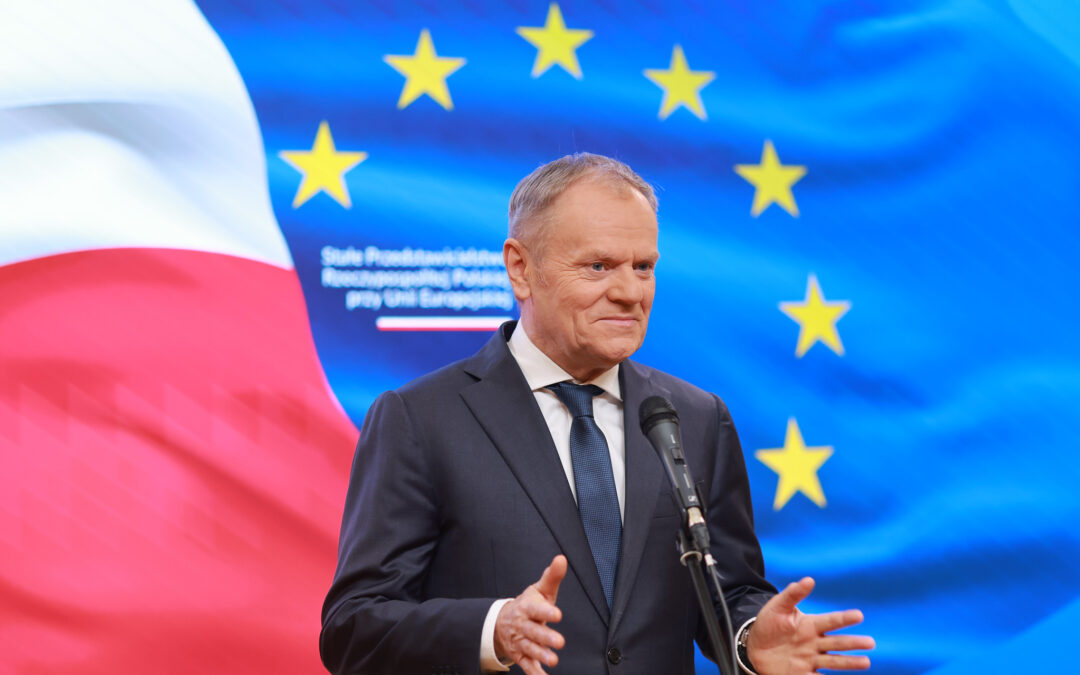
On the morning of 1 January, Polish Prime Minister Donald Tusk began 2026 with a video message listing ten of his country’s successes in 2025, including on border security, military spending, the economy, energy transition and Ukrainian refugees.
He then called on the rest of Europe to “be like Poland” if it also wants to succeed.
Best wishes for Europe: be like Poland! pic.twitter.com/1lFeOMPEWh
— Donald Tusk (@donaldtusk) January 1, 2026
Below, we outline each of the ten achievements proclaimed by Tusk and assess whether his words match up to reality.
1. “A secure and tight Polish-Eastern border, which is also Europe’s border, and a responsible and tough asylum policy – an example to follow for all Europe that has led to a more than 90% fall in the number of migrants crossing our borders.”
Tusk’s government has indeed toughened border security since coming to power in December 2023, in particular on the border with Belarus, where since 2021 the Belarusian authorities have been assisting tens of thousands of migrants – mainly from the Middle East, Asia and Africa – to cross into Poland.
In 2024, it made it easier for soldiers to use firearms to defend the border and introduced an exclusion zone intended to ease the work of border officers and make life harder for people smugglers. In 2025, it suspended the right to asylum for people who irregularly cross the Belarus border.
Has that policy been effective?
Data released this week by the Polish border guard show that there were 29,600 attempts to illegally cross the border from Belarus in 2025, which was only 2.6% less than the 30,400 recorded in 2024. Both figures were higher than in 2023, when there were 26,000 attempted crossings.
Poland says that “specialists from the Middle East” have been brought to Belarus to dig tunnels under the border for migrants to cross into Poland.
Four such tunnels have been discovered this year, including one last week that was used by 180 migrants https://t.co/4ConkQnj8z
— Notes from Poland 🇵🇱 (@notesfrompoland) December 16, 2025
However, while Poland has no direct control over attempted crossings, the success of its border security is measured by how many migrants actually manage to cross illegally.
In July, a leading fact-checking service, Demagog, noted that police in Germany, which is the destination for most of the migrants, have recorded a significant decline in migrants identified as having arrived after travelling through Belarus. In 2023, there were 11,900 of them, which fell to 4,900 in 2024.
In the first half of 2025, the figure fell again, to 856, representing a 90% decline from the rate seen in 2023 – which may be the source of Tusk’s claim in his video.
Meanwhile, the asylum ban for those who irregularly cross from Belarus has led to a fall in claims.
Border guard data cited by the Rzeczpospolita daily in May showed that, in the first two months of the ban being in place, only 23 asylum claims were filed by people who had crossed from Belarus. That was down from almost 800 applications in the same period a year earlier.
In October, the border guard announced that, overall, asylum claims were down 9% in the first nine months of 2025 compared to the previous year. However, that includes all types of claims, not just from those who crossed the Belarus border.
The border guard did say that there has been a “significant decrease” in asylum claims from migrants who crossed from Belarus, though it did not provide any figures.
2. “Building the biggest modern army in the EU, so that Poland and Europe can be kept safe from the east.”
Since Russia’s full-scale invasion of Ukraine in 2022, Poland has embarked on an unprecedented defence-spending spree, which began under the former Law and Justice (PiS) government and has been further expanded by the Tusk administration.
Defence spending reached 3.3% of GDP in 2023, the highest relative level in NATO, and then further increased to 3.8% in 2024 and an estimated 4.5% in 2025. A figure of 4.8% is planned for 2026.
Former PiS defence minister Mariusz Błaszczak said that the aim was for Poland to have “the most powerful land forces in Europe”, an ambition reiterated by Tusk.
NATO figures show that, in 2023, Poland overtook France to have the largest number of military personnel in Europe among members of the alliance (only Turkey and the US have more, with most of their troops based outside Europe). By 2030, Poland will have more tanks than Germany, France, the UK and Italy combined.
However, some analysts have raised questions about whether Poland’s defence spending is being well targeted, and in particular whether the country is properly preparing for modern, drone-heavy warfare.
3. “An effective and strict criminal policy that protects our towns and citizens, and thanks to which we can hunt criminals, including saboteurs, sent to us by Russia.”
Since 2023, Poland has been hit by a series of acts of sabotage carried out by operatives working on behalf of Russia, including arson attacks and, most recently, damage to a rail line.
Under both the former PiS government and the Tusk administration, the security services have identified and detained a number of individuals and groups planning or carrying out such actions.
However, the current authorities also faced criticism over the fact that rail saboteurs were able to enter and leave Poland via Belarus unchallenged, despite one of them having a conviction in Ukraine for sabotage on behalf of Moscow. Poland claims that Ukraine had not provided that information to Interpol.
Meanwhile, in 2025, Tusk’s government stepped up efforts to deport foreigners who have entered Poland illegally or committed crimes while in the country. As a result, the number of foreigners forcibly deported from Poland doubled last year compared to 2024.
4. “Forbes magazine has ranked Warsaw, and rightly so, as the most attractive European city to visit in 2026.”
Not quite. Forbes did not publish any such ranking. Rather, it reported on a ranking produced by an organisation called European Best Destinations, which promotes tourism and culture across the continent.
Warsaw did indeed come top of European Best Destinations’ list of “Europe’s most inspiring cities to watch in 2026”, which were “selected for the way they combine atmosphere, walkability, cultural life, gastronomy, safety, and overall ease of experience for visitors”.
5. “Thanks to our in-vitro programme, more than 8,000 babies were happily born this year.”
After Tusk’s government came to power in December 2023, one of the first things it did was restore national state funding for in-vitro fertilisation (IVF), which had been cut by the former national-conservative PiS government.
Last month, the health ministry confirmed that, up to the end of November, 8,085 children had been born in Poland in 2025 through the government’s IVF programme.
However, contrary to Tusk’s claim that this is an area in which the rest of Europe should “be like Poland”, Euronews noted last year that all other EU member states already had public funding for IVF.
6. “The average wage in Poland has risen by almost 10% in 2025.”
Full official data for 2025 are not yet available, but according to Statistics Poland (GUS), a state agency, in the third quarter of 2025, the average monthly salary was 8,771.70 zloty (€2,082.66), up from 8,038.41 zloty in the same period a year earlier – an increase of 9.1%.
Poland, however, still trails most European countries. Eurostat data show that, in 2024, the average annual salary for a full-time worker in Poland was €21,246, the sixth lowest in the EU.
7. “Poland’s GDP has exceeded 1 trillion US dollars. We are the second country in Europe with the lowest unemployment and the highest economic growth. Inflation has sharply gone down. This is why our economy is called the Goldilocks economy, because it is just right.”
Data from the International Monetary Fund (IMF) indeed show that Poland’s GDP was set to pass $1 trillion for the first time in 2025, meaning it has overtaken Switzerland as the world’s 20th-largest economy.
Tusk’s second sentence is a bad translation from Polish to English. He meant to say that Poland has the second-lowest unemployment in Europe. It is unclear if he also means it has the second-highest economic growth or the highest.
The latest Eurostat data, for October 2025, do indeed show that Poland has the joint-second-lowest unemployment rate among EU member states, at 3.2%.
Poland has emerged as Europe’s undisputed growth champion over the past 35 years.
In the first part of a new series of articles and podcasts, @AlicjaPtak4 explores the reasons behind Poland's rapid economic development, and the dangers that may lie ahead https://t.co/bW3bnV7Ozn
— Notes from Poland 🇵🇱 (@notesfrompoland) July 7, 2025
Regarding economic growth, EU forecasts indicate that, in 2025, Poland had the bloc’s joint-fourth-highest figure, at 3.2%, behind Ireland (10.7%), Malta (4.0%) and Cyprus (3.4%). Poland is forecast to have the second-highest figure in 2026 (3.5%), behind only Malta (3.8%).
However, comparing Poland’s large and diverse economy with those of Malta and Cyprus, which are small islands, or with Ireland, where data is skewed by a small number of multinational corporations, is not very instructive. Among large EU countries, Poland is forecast to have the strongest growth in 2025, 2026 and 2027.
Inflation in Poland did slow last year, reaching 2.4% in December 2025, down from 4.7% a year earlier and 6.2% in December 2023.
8. “Solidarity offered to two million Ukrainians who arrived here after Russia attacked Ukraine.”
Poland was the primary destination for refugees fleeing from Russia’s full-scale invasion of Ukraine in 2022. Millions crossed the Polish border, although most then moved on to other countries, while some also later returned to Ukraine.
The latest EU data show that there are around 965,000 Ukrainian refugees still in Poland, second only to Germany (1.2 million). In relation to population, Poland (26.4 Ukrainian refugees per 1,000 people) also has the second-highest figure, behind the Czech Republic (36.0 per 1,000 people).
In addition, Poland has hundreds of thousands of Ukrainian residents not classified as refugees, who are largely economic migrants but also include students.
Ukrainian immigrants pay more in taxes than they receive in benefits, a report by Poland's National Development Bank has concluded.
The research also indicated that Ukrainians contribute between 0.5% and 2.4% to Poland's annual GDP growth https://t.co/KhXxLtif5W
— Notes from Poland 🇵🇱 (@notesfrompoland) March 15, 2025
Poland has been widely praised for how it initially welcomed Ukrainian refugees, including the fact that many Poles initially hosted them in their own homes. However, 2025 saw growing anti-Ukrainian sentiment in Poland.
A poll in October by state research agency CBOS found that support for accepting Ukrainian refugees had fallen to 48%, the lowest level since such polling began and down from a high of 97% in 2022.
In September, a United Surveys poll for Wirtualna Polska found that 37% of Poles negatively view the presence of Ukrainians in Poland, up from 29.5% two years earlier. That same month, Poland passed a law restricting access to benefits for those who are not employed.
9. “Poland is a dynamic logistics hub, connecting Europe with the fastest-growing road and railway infrastructure.”
Since joining the EU in 2004, Poland has seen the bloc’s biggest rise in the length of new highways and expressways. Its network 5,200 km by the end of 2024, up from just 784 km in 2004, and continues to expand, adding 390 km in 2025 and with 290 km planned in 2026.
Poland has also invested heavily in its rail network, under both the former PiS government and the current Tusk administration, which is also seeking to enhance Poland’s role as a rail cargo hub linking the EU to Ukraine and Asia.
10. “Poland is undergoing a true energy revolution, with the biggest growth in green energy in Europe, and is engaged in building nuclear and offshore power plants.”
When Tusk’s government came to power, it pledged to accelerate and intensify Poland’s green transition. However, the results have so far been disappointing.
In 2025, Poland produced 29.4% of electricity from renewables, almost exactly the same figure as the 29% recorded in 2024. The share of coal in the energy mix did, however, fall from 56.6% in 2024 to 52.2% in 2025 (replaced largely by natural gas, which produces fewer emissions than coal).
Renewables generated 29.4% of Poland's electricity in 2025, almost exactly the same figure as in 2024, ending a period of strong growth since 2021.
Coal (52.2%) remained the dominant source, though its share declined.
For more, read our full report: https://t.co/XjD9hfhabo pic.twitter.com/WklP7dYL78
— Notes from Poland 🇵🇱 (@notesfrompoland) January 2, 2026
Poland also remains the only EU country not to have submitted a long-term plan for reducing emissions, prompting the European Commission to take legal action against it in October.
Tusk’s government is pushing ahead with plans, launched under PiS, to build Poland’s first nuclear power stations and offshore wind farms.
Meanwhile, the number of fully electric passenger cars in Poland passed 100,000 for the first time in 2025 after growing at one of the fastest rates in Europe, thanks in large part to new state subsidies to buy such vehicles. However, Poland’s overall figures are still far behind most other EU countries.
Construction of Poland’s first nuclear power plant is now set to begin after the @EU_Commission approved Warsaw’s request to allocate 60 billion zloty (€14.2 billion) in state aid for the project https://t.co/Z7BJpRRKnq
— Notes from Poland 🇵🇱 (@notesfrompoland) December 9, 2025
Notes from Poland is run by a small editorial team and published by an independent, non-profit foundation that is funded through donations from our readers. We cannot do what we do without your support.
Main image credit: KPRM/Flickr (under CC BY-NC-ND 4.0)

Daniel Tilles is editor-in-chief of Notes from Poland. He has written on Polish affairs for a wide range of publications, including Foreign Policy, POLITICO Europe, EUobserver and Dziennik Gazeta Prawna.