Keep our news free from ads and paywalls by making a donation to support our work!

Notes from Poland is run by a small editorial team and is published by an independent, non-profit foundation that is funded through donations from our readers. We cannot do what we do without your support.
State rail operator PKP Intercity has launched a tender for the purchase of trains that can reach speeds of up to 320 km/h (199 mph), making them the fastest ever to travel on Polish tracks.
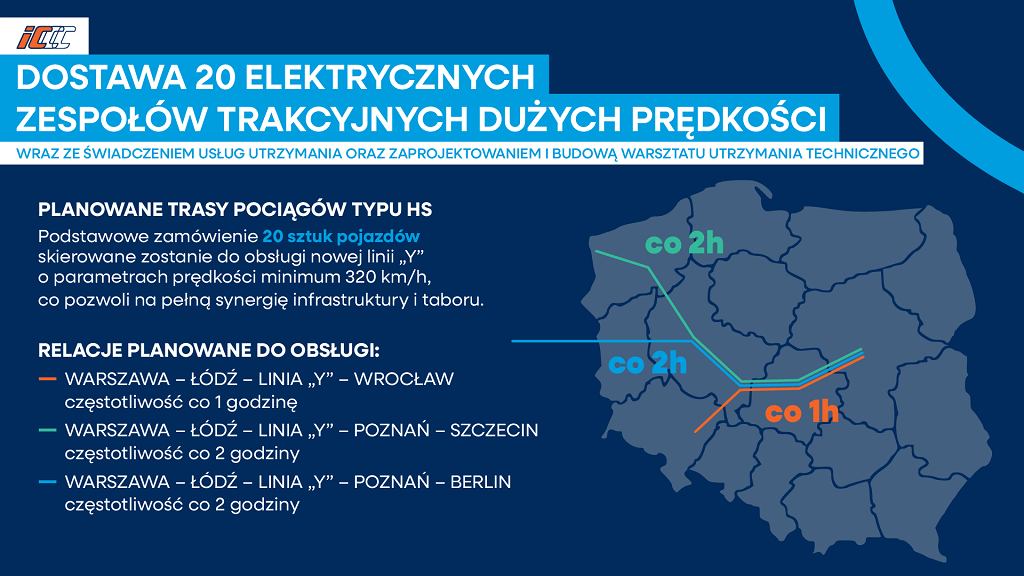
PKP Intercity, which is responsible for long-distance rail transport in Poland, announced on Tuesday that it was seeking to buy 20 electric multiple-unit trains capable of such speeds, with the possibility to later purchase 35 more.
🚄Ogłosiliśmy pierwszy w Polsce przetarg na pociągi o prędkości 320 km/h⚡
Postępowanie obejmuje zakup 20 elektrycznych zespołów trakcyjnych 🚆, wraz z ich utrzymaniem oraz zaprojektowaniem i budową zaplecza technicznego 🏗️.
Przewidzieliśmy również możliwość zamówienia… pic.twitter.com/C2fl8TZAxf— PKP Intercity (@PKPIntercityPDP) December 30, 2025
The firm says that, before making its announcement, it spoke with nine manufacturers, including Polish ones, who confirmed their planned participation in the tender.
Interested parties have until the end of April 2026 to submit applications to participate in the tender, with bids then due to be accepted until May 2027 and the process completed by August 2027.
Currently, the fastest trains in Poland are Pendolinos manufactured in Italy by French firm Alstom. Though they can in theory reach maximum speeds of 250 km/h, the fastest they are able to run on current Polish tracks is 200 km/h.
The 20 planned new 320 km/h trains would run on upgraded lines between Warsaw, Łódź, Poznań and Szczecin in Poland, as well as onwards to Berlin in Germany.
“Just as Pendolino trains changed Polish railways 10 years ago, in a few years high-speed trains will introduce a new quality of travel on domestic and international routes,” said infrastructure minister Dariusz Klimczak at the announcement of PKP Intercity’s tender.
Deputy infrastructure minister Piotr Malepszak said that the tender was the start of “a golden decade for the railway industry” in Poland.
However, the opposition Law and Justice (PiS) party has previously criticised plans for rail speeds of 320 km/h, arguing that this effectively excludes Polish manufacturers from tenders. The former PiS government had planned speeds of up to 250 km/h.
Former PiS deputy infrastructure minister Rafał Weber said on Tuesday that the result of the new tender will be “rolling stock supplied by a company that is not Polish, and that does not contribute to our economy”.
He also argued that “there is no need to develop such [high] speeds in our country”. A speed of 250 km/h allows faster travel while also “ensuring access to the stops [in] medium-sized cities”, said Weber, quoted by Radio Maryja.
Earlier this month, former PiS culture minister Piotr Gliński said that 320 km/h speeds were undesirable “because people will be afraid to board such trains”.
.@PiotrGlinski: Po co nam pociągi jadące 350 km/h? Ludzie się będą bali do nich wsiąść! @marcinfijolek: Dość… kontrowersyjny argument. @PiotrGlinski: Tak Pan uważa? Ja wolę spokojnie sobie pojechać w warunkach przewidywalnych. pic.twitter.com/LqvyEuGAHi
— Graffiti_PN (@Graffiti_PN) December 17, 2025
Passenger numbers on Poland’s rail network have been booming in recent years. In the first half of 2025, a record 40.4 million passengers travelled with PKP Intercity, which was 9% more than a year earlier and 31% more than two years ago.
By the end of this year, the figure is forecast to reach 89 million, up from 78.5 million in 2024 and 68 million in 2023.
Last month, PKP Intercity signed the biggest contract for rolling stock in Polish history, ordering 42 double-decker trains – the first of their kind in Poland – in a deal worth 6.9 billion zloty (€1.6 billion). However, those trains – manufactured in Poland by Alstom – will not begin to arrive until 2029.
In order to meet current surging demand for rail travel, earlier this month PKP Intercity announced the purchase of 50 second-hand rail carriages from Germany.
Poland has bought 50 used rail carriages from Germany to meet surging demand for train travel.
The opposition has criticised purchasing “German scrap”. But rail operator PKP says the deal was necessitated by poor planning when the opposition was in power https://t.co/ivZk4APnWs
— Notes from Poland 🇵🇱 (@notesfrompoland) December 7, 2025
Notes from Poland is run by a small editorial team and published by an independent, non-profit foundation that is funded through donations from our readers. We cannot do what we do without your support.
Main image credit: Adrian Grycuk/Wikimedia Commons (under CC BY-SA 3.0 PL)

Daniel Tilles is editor-in-chief of Notes from Poland. He has written on Polish affairs for a wide range of publications, including Foreign Policy, POLITICO Europe, EUobserver and Dziennik Gazeta Prawna.