
Keep our news free from ads and paywalls by making a donation to support our work!

Notes from Poland is run by a small editorial team and is published by an independent, non-profit foundation that is funded through donations from our readers. We cannot do what we do without your support.
A new opinion poll has shown a rise in the proportion of Poles opposed to Poland’s membership of the European Union, with almost a quarter now favouring “Polexit”.
The findings come from a survey by IBRiS, a leading research agency, on behalf of the Wirtualna Polska news website. It asked respondents if they believe “Poland should in the near future begin the procedure of leaving the European Union”.
A total of 24.7% said that they think it should. However, a significant majority, 65.7%, were opposed to the idea of Polexit.
When results were broken down by political preference, there was a clear difference between supporters of the government – a pro-EU coalition ranging from left to centre right – and the opposition, made up of the national-conservative Law and Justice (PiS) and far-right Confederation (Konfederacja).
Among those who voted for the ruling coalition at the last parliamentary election, only 3% favour Polexit while 95% are opposed. Meanwhile, there was an almost even split among supporters of the opposition: 43% want to begin the process of leaving the EU while 44% do not.
There has been particular criticism of the EU on the Polish right in recent years regarding its policies on migration, agriculture and climate, as well as accusations that Brussels has tried to interfere in Poland’s domestic political and judicial affairs.
Commenting on the findings, the head of IBRiS, Marcin Duma, noted that, “just a dozen or so years ago, [the idea of] Poland’s exit from the European Union was a political fantasy”.
Now, however, “we are in a completely different place” amid “a profound social change that is only just beginning to emerge”, he added. In particular, for many on the right, “Polexit has ceased to be politically exotic and has become a part of identity”.
Even as recently as 2022, state research agency CBOS found 92% support for EU membership among Poles. However, its most recent poll, conducted in July this year, found that figure was down to 81% while support for Polexit had risen 13%.
Earlier this month, a poll conducted in eight EU member states by Eurobazooka for the French Le Grand Continent journal also found that 25% of people in Poland supported leaving the EU. Only France itself (27%) had a higher figure.
Polish President @NawrockiKn has proposed plans to reform the EU so that it infringes less on national sovereignty, stops “dictating the terms” of member states’ political or judicial systems, and ceases trying to “regulate the entire lives of citizens” https://t.co/EUMuPfAkTL
— Notes from Poland 🇵🇱 (@notesfrompoland) November 25, 2025
Growing euroscepticism has gone hand in hand with rising support for the far right in Poland. Confederation, which won 7% of the vote at the 2023 elections, has been consistently polling above 13% this year. It does not explicitly support Polexit but is extremely critical of the EU.
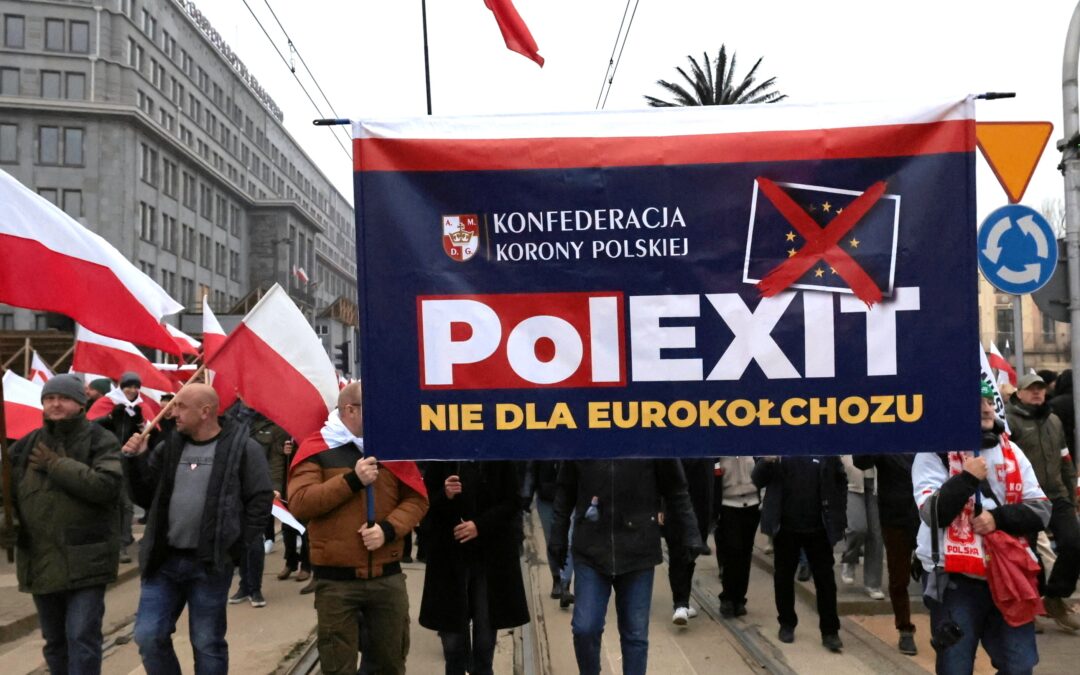
An even more radical group, Confederation of the Polish Crown (KKP), which broke away from Confederation at the start of this year, has also recently risen in the polls to support of around 7%. KKP directly calls for Poland to leave the EU.
Its leader, Grzegorz Braun, has regularly burned EU flags or wiped his shoes on them. Earlier this month, he claimed that Poland had more sovereignty under Soviet-imposed communist rule or as part of the Russian empire in the 19th century than it does now as part of the EU.
In this year’s presidential election, Braun finished fourth with 6% of the vote, while Confederation’s candidate, Sławomir Mentzen, came third with 15%. The election was eventually won by PiS-backed candidate Karol Nawrocki, who has called for reform of the EU to restore national sovereignty.
🧯Grzegorz Braun: Nie da się uzgodnić niepodległości Polski z Eurokołchozem.
Nie dało się uwzględnić suwerenności Polski z RWPG, ale w PRL władze warszawskie miały więcej suwerenności niż dziś.
Królestwo Kongresowe było stokroć bardziej suwerenne od Rzeczpospolitej Trzeciej i pół pic.twitter.com/pdmyMepJ6h— Korona Płock (@KoronaPlock) December 15, 2025
IBRiS’s new poll shows that men (28%) are more likely than women (21%) to favour leaving the EU. Polexit is most popular among those aged 30 to 49 (38%) and in rural areas (35%). Support for leaving the EU is low among the youngest, aged 18 to 29 (13%), and in the largest cities (15%).
Speaking to Wirtualna Polska, Barbara Brodzińska-Mirowska, a political scientist at Nicolaus Copernicus University in Toruń, said that the results “are not cause for panic” among those who support EU membership.
She noted that the proportion opposed to EU membership was similar when Poland joined the bloc two decades ago. “Considering everything that has happened over those years – the EU’s internal problems, the economic and geopolitical crises – the current result still shows that the ‘anti’ group does not prevail.”
The main current threat, she added, is “massive external disinformation inspired by Russia, aimed at reinforcing anti-EU attitudes”. As the case of Brexit showed, such disinformation can cause “the situation to quickly spin out of control”.
Notes from Poland is run by a small editorial team and published by an independent, non-profit foundation that is funded through donations from our readers. We cannot do what we do without your support.
Main image credit: Kuba Atys / Agencja Wyborcza.pl

Daniel Tilles is editor-in-chief of Notes from Poland. He has written on Polish affairs for a wide range of publications, including Foreign Policy, POLITICO Europe, EUobserver and Dziennik Gazeta Prawna.