Keep our news free from ads and paywalls by making a donation to support our work!

Notes from Poland is run by a small editorial team and is published by an independent, non-profit foundation that is funded through donations from our readers. We cannot do what we do without your support.
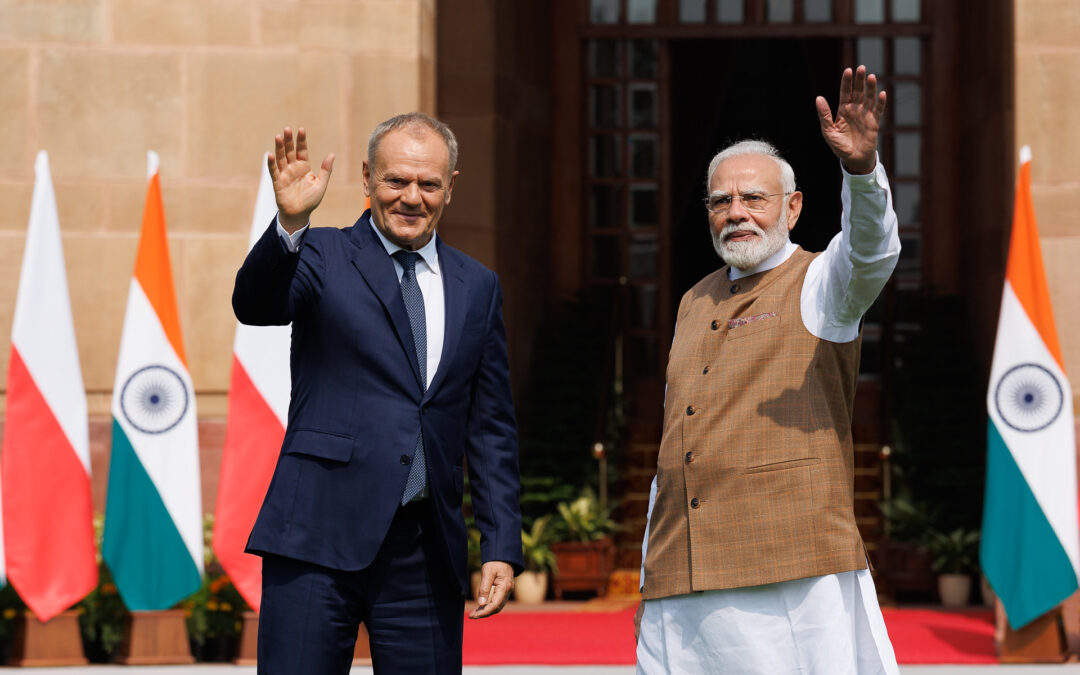
The prime ministers of Poland and India have, after a meeting in New Delhi, outlined aims to double bilateral trade by 2030 and expand cooperation in mining, shipbuilding, energy, space and defence technologies.
Donald Tusk’s visit, the first by a Polish prime minister to India in 16 years, follows the upgrading of bilateral ties between the two countries to a strategic partnership during Narendra Modi’s trip to Poland two years ago, which was the first by an Indian prime minister in almost five decades.
During a joint press conference with Tusk on Thursday, Modi said that his Warsaw visit had acted as a catalyst for the Polish-Indian relationship to “gain speed over the last two years”.
📍 New Delhi | Premier @donaldtusk spotkał się z Premierem Indii @narendramodi. pic.twitter.com/Y9HPLQsvf4
— Kancelaria Premiera (@PremierRP) October 22, 2026
Tusk added that the two leaders had now reviewed the results of their cooperation so far and outlined priorities for the coming years. They discussed, among other things, ways to deepen economic, investment and technological ties between the two fast-growing economies.
Poland’s GDP is set to grow by 3.5% this year, the second-fastest rate in the European Union, while India will see economic growth of 7%. Poland’s economy is also on the verge of becoming the 20th largest in the world, with the country hoping to join the G20.
“The economic strength of both countries offers a wealth of opportunities for strategic partnership,” Modi said.
Tusk, meanwhile, underlined that “Poland and India are countries that have much in common and nothing that divides them…[with] no conflicting interests or historical grievances.”
Poland hopes that the boost to bilateral trade will come from an EU-India trade deal expected to be signed in December. The agreement is designed to eliminate or reduce tariffs on goods accounting for 96.6% of the value of EU exports to the Indian market.
Tusk said Poland wanted to capitalise on the opportunities created by the deal, with the ambition of becoming “India’s gateway to Europe”. Modi expressed confidence that Poland’s and India’s “shared goal” of doubling bilateral trade by 2030 “will certainly be achieved”.
“Today, trade between Poland and India totals just over $6 billion,” said Poland’s finance minister Andrzej Domański, who joined Tusk on the trip to India. “We want this trade to grow, and the conditions for that are very favourable.”
However, “it is no secret that we have a significant trade deficit with India”, Domański added. Last year, Poland exported goods worth €1.4 billion to India, with machinery, mineral products and metals the largest categories. Meanwhile, it imported €4.3 billion, in particular textiles, machinery and metals.
The United States wants Poland to become a full member of the G20 "as soon as possible".
"Poland’s economic growth, combined with its growing leadership position in the international arena, make it an ideal participant," says the @StateDept https://t.co/OjpWly4FTw
— Notes from Poland 🇵🇱 (@notesfrompoland) October 12, 2026
According to the Polish prime minister’s office, the EU-India agreement could also help increase Polish investment in India, particularly in advanced manufacturing, food processing, biotechnology and mobility.
To help facilitate such investments, Tusk travelled with almost 100 Polish business representatives, hoping the visit will help them to enter the large and rapidly growing Indian market. His office described the delegation as the largest of its kind in the history of Polish-Indian relations.
Modi said he was “particularly happy” with Tusk’s decision to bring a business delegation and announced plans to strengthen links between startups in both countries, including through technology hackathons for young people.
The countries plan to expand cooperation in critical minerals, raw materials and coal gasification, a process that converts coal into gas for energy and industrial use. Shipbuilding, defence, space and advanced technologies are also among the priority sectors.
Indians are now the third-largest group of foreign workers in Poland, followed by Colombians, according to new data from the country’s Social Insurance Institute (ZUS).
Ukrainians remain by far the largest immigrant group, followed by Belarusians https://t.co/hNiOqmeUfX
— Notes from Poland 🇵🇱 (@notesfrompoland) August 11, 2026
The leaders also highlighted historical ties and people-to-people exchanges as a foundation for closer relations.
Modi recalled the role of Indian Maharaja Jam Saheb Digvijaysinhji Ranjitsinhji, known in Poland as the “Good Maharaja”, who provided shelter and care to around 1,000 Polish children evacuated from the Soviet Union during the Second World War.
“In 2022, Poland helped our Indian students, demonstrating that same spirit of humanity,” added Modi, referring to the support Poland provided to Indian students escaping from Ukraine following Russia’s full-scale invasion.
Modi said he hoped that the ongoing Jamsaheb Memorial Youth Exchange Programme, which recently took place for the second time, will “introduce the next generation to this Polish-Indian friendship”.
The strengthening of bilateral relations has also come amid a rapid rise in Indian migration to Poland in recent years. This year Indians became the third-largest group of foreign workers in Poland, numbering around 25,500, up almost 5% in a year.

Notes from Poland is run by a small editorial team and published by an independent, non-profit foundation that is funded through donations from our readers. We cannot do what we do without your support.
Main image credit: Kancelaria Premiera / Flickr (under CC BY-NC-ND 4.0)

Alicja Ptak is deputy editor-in-chief of Notes from Poland and a multimedia journalist. She has written for Clean Energy Wire and The Times, and she hosts her own podcast, The Warsaw Wire, on Poland’s economy and energy sector. She previously worked for Reuters.