Keep our news free from ads and paywalls by making a donation to support our work!

Notes from Poland is run by a small editorial team and is published by an independent, non-profit foundation that is funded through donations from our readers. We cannot do what we do without your support.
Leading figures from Poland’s ruling coalition have hit back at US Secretary of Defence Pete Hegseth over his recent remarks downplaying the contribution of America’s allies during the war in Afghanistan.
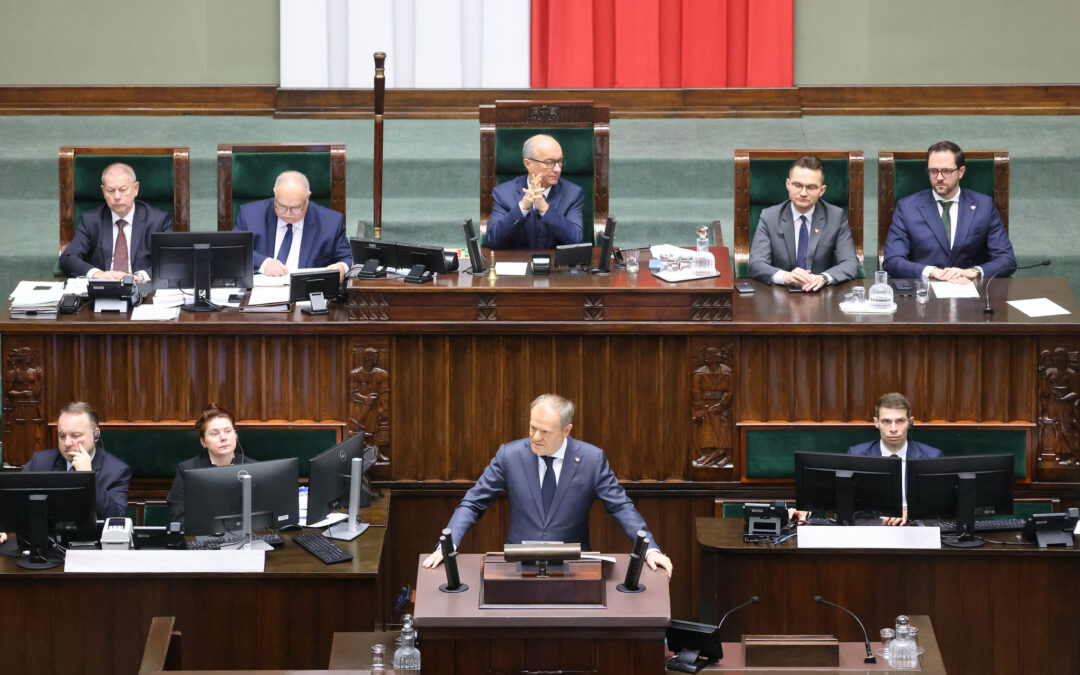
The speaker of parliament, Włodzimierz Czarzasty, called the comments “scandalous”, while Prime Minister Donald Tusk read out a message sent to him by a Polish army medic who had declared dead the last of the 44 Polish soldiers who died in Afghanistan.
💬 Premier @donaldtusk ⤵️
Chciałbym, żeby te słowa dotarły do naszych sojuszników, żeby już nigdy więcej nikt nie lekceważył wysiłku naszych żołnierzy. pic.twitter.com/gGJkh4Gnft
— Kancelaria Premiera (@PremierRP) October 20, 2026
The controversy stemmed from a speech the US defence secretary gave to US military cadets in Tennessee on Saturday. Hegseth referred to his time serving as a US Army officer in Afghanistan, where he recalled that the International Security Assistance Force (ISAF) headquarters had flags from over fifty countries.
“Except,” Hegseth said, “there were maybe five [countries] that contributed. It was actually closer to one or two that actually, by the end, were involved in kinetic operations. In fact, the patch ‘ISAF’ – we joked that it meant ‘I Saw Americans Fighting.'”
The comments earned quick reproach from Polish foreign minister Radosław Sikorski, who aimed a message at Hegseth on social media, saying: “Tell that to the families of 44 Polish soldiers who died securing the tough Ghazni province.”
Tell that, Mr @SecWar, to the families of 44 Polish soldiers who died securing the tough Ghazni province. https://t.co/vm4TM0sMJO
— Radosław Sikorski 🇵🇱🇪🇺 (@sikorskiradek) October 18, 2026
On Tuesday, the remarks earned even stronger reproach from Czarzasty, who is the speaker of the Sejm, the more powerful lower house of parliament, and the leader of The Left (Lewica), one of the groups that forms Poland’s ruling coalition.
At a press conference, Czarzasty said that Hegseth’s “scandalous” comments are “harmful to the families of Polish soldiers and to Polish national pride”.
He also criticised President Karol Nawrocki – an opponent of the government and conservative ally of Donald Trump – for not condemning Hegseth’s remarks.
It is “an insult to Polish soldiers” that Nawrocki, who serves as commander-in-chief, “is unable to stand up for their dignity and the dignity of those who died”, declared Czarzasty.
To skandaliczne, że prezydent Polski boi się potępić polityków amerykańskich za brak szacunku do polskich żołnierzy, którzy zginęli w Afganistanie. pic.twitter.com/uyv54yDvrI
— Włodzimierz Czarzasty 📚📖 (@wlodekczarzasty) October 20, 2026
Later on Tuesday, Tusk read out to his cabinet a text message he said he had received from a former military medic, whom he did not name.
“Please stand up for soldiers, I beg you,” wrote the medic. “During my tour in Afghanistan, we confirmed the death of the last Polish casualty, a platoon sergeant whose wife was pregnant in Poland at the time.”
“I received a medal from the Americans for helping them, for treating Americans. I didn’t have to do that. We treated them with our own Polish medicines,” they added.
Tusk then added his own remarks, stating: “I would like these words to reach our allies. So that no one will ever again downplay the efforts of our soldiers. Wherever our allies, including our closest ally, the Americans, have needed our participation, Polish soldiers stood shoulder to shoulder with them.”
Tusk also referenced Nawrocki’s silence on the matter. “Frankly, I was also counting on the president speaking out on this matter. But it seems I miscalculated.”
Tusk is the first European head of government to directly criticise Hegseth’s remarks, although a spokesperson for British Prime Minister Andy Burnham did say on Monday that it was “wrong to diminish the role” of British personnel, 457 of whom died in Afghanistan.
Of the 3,621 coalition deaths during the war in Afghanistan, around two thirds were Americans (2,461). The rest came from 31 different countries, with Poland’s 44 fatalities the seventh most of any nation.
Hegseth’s remarks are not the first time that the Trump administration has caused anger in Poland by downplaying allies’ role in Afghanistan. In January, Trump himself suggested that other countries had “stayed a little back, a little off the front lines”.
That prompted General Roman Polko, who commanded Poland’s GROM special forces unit in Iraq and Afghanistan, to call the US president “a coward who has never been on the front lines”.
The former commander of Poland's special forces in Iraq and Afghanistan has condemned Donald Trump for questioning the contribution of America's allies
"This is the cynicism of a coward who hasn’t been on the front lines himself," said General @PolkoRoman https://t.co/kElkAO5qX4
— Notes from Poland 🇵🇱 (@notesfrompoland) January 23, 2026
The Polish government has also clashed with the US on other issues. In January, Tusk joined other European leaders in calling for Greenland’s sovereignty to be respected, following Trump’s calls for the island to be brought under US control.
The following month, Tusk declared that Poland would not be a “vassal” of the US and suggested that Nawrocki wanted Poland to be too subservient to Washington. Czarzasty has twice this year clashed with the US ambassador over critical remarks he made towards Trump.
However, at the same time, the Polish government has sought to maintain positive relations with Washington, given America’s role as Poland’s most important security partner. In June, Poland formally requested that the US establish a new permanent military base on its territory.
Hegseth himself has praised Poland, calling it a “model ally” last year. The US State Department this month also announced that it was pushing for Poland to be allowed to join the G20 “as soon as possible”, pointing to its “growing leadership position in the international arena”.
Notes from Poland is run by a small editorial team and published by an independent, non-profit foundation that is funded through donations from our readers. We cannot do what we do without your support.
Main image credit: KPRM/Flickr (under CC BY-NC-ND 4.0)
Leo Greenberg is an assistant editor at Notes from Poland. Based in Kyiv, he writes about global politics, Europe and America, and the war in Ukraine.