Keep our news free from ads and paywalls by making a donation to support our work!

Notes from Poland is run by a small editorial team and is published by an independent, non-profit foundation that is funded through donations from our readers. We cannot do what we do without your support.
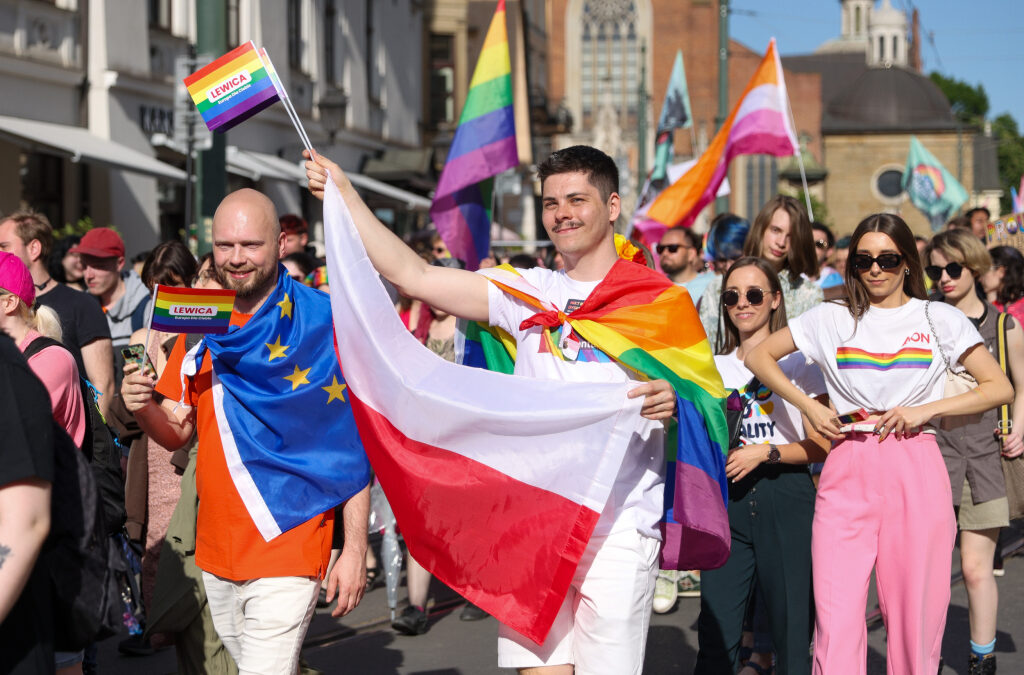
In one of his first policy announcements since being elected on Sunday, the new mayor of Kraków, Poland’s second-largest city, has declared that he will withdraw official patronage of its annual LGBT+ equality march.
Łukasz Gibała, who has been supportive of LGBT+ rights in the past and has previously attended the march, argues that the event has become too “partisan”. He stood for election as an independent and has pledged to depoliticise city hall.
His decision does not prevent the march from taking place. But it means that it no longer has the official support of the city.
Łukasz Gibała: Nie obejmę patronatem Marszu Równości. Polityka progresywna nie zawsze się sprawdza https://t.co/vIw8ZsSPQK
— Radio Kraków (@RadioKrakow) October 12, 2026
Kraków’s equality march, which was first held in 2004, draws thousands of participants when it takes place each year in May. The event is used to demand greater LGBT+ rights in Poland, which is ranked as one of the worst countries in Europe for LGBT+ people.
In 2021, the city’s former mayor, Jacek Majchrowski, became an honorary patron of the march. In 2024, his successor, Aleksander Miszalski, became the first mayor to attend the event, declaring that Kraków should be “a home for everyone”.
However, Miszalski was removed from office earlier this year in a recall referendum, necessitating a new election, which was won by Gibała. He beat Monika Piątkowska, who, like Miszaski, is a member of the centrist Civic Coalition (KO) party of Prime Minister Donald Tusk.
Kraków's new mayor has announced that he will attend the city’s LGBT parade next week, something his long-serving predecessor never did.
"I want to build a tolerant Kraków, a home for everyone," says @OlekMiszalski, who took office this week https://t.co/ZQ9SzZiHp4
— Notes from Poland 🇵🇱 (@notesfrompoland) May 9, 2024
The day after his victory, Gibała was asked by local broadcaster Radio Kraków if he would continue city hall’s patronage of the equality march. The new mayor, who takes office next week, declared that he would not, saying he “will avoid sponsoring events that have a partisan character”.
“I have the impression that, over the past three years or so, the community that organises equality marches has simply become partisan,” said Gibała. “These are people who ran for parliament and local government on the lists of specific political parties.”
Gibała did not indicate who he was referring to. However, one of the organisers of the equality march in Kraków is Magdalena Dropek, who has three times stood as a candidate for The Left (Lewica), one of the groups in Tusk’s ruling coalition, in elections to the Polish and European parliaments.
Gibała emphasised that he has himself attended equality marches in the past “and does not regret it”. He was previously an MP for both KO (when it was known as Civic Platform, PO) as well as for the liberal Palikot’s Movement (Ruch Palikota), later known as Your Movement (Twój Ruch).
During the recent mayoral election campaign, Gibała told broadcaster TVN that, as an MP, he had supported the introduction of same-sex civil partnerships in Poland, and said that his views had not changed.
When asked if that meant that, as mayor, he would continue the city’s practice of transcribing foreign same-sex marriages into the civil registry – as Poland was ordered to do last year by the Court of Justice of the European Union – Gibała said that he would.
However, he added that he was doing this as a “legalist” who respects the current legal situation. “If a different political party wins [parliamentary elections] next year and changes the law in Poland, it [recognition of foreign same-sex marriages] won’t happen,” he told Radio Kraków.
In fact, although the current government supports recognition of foreign-same sex marraiges, it has not changed the law in that regard. Polish law still does not recognise any form of same-sex union.
The government, aware that opposition-aligned President Karol Nawrocki would veto any change to the law, instead issued a regulation (which does not require presidential approval) empowering local authorities to transcribe foreign same-sex marriages into their registries.
Many municipalities, especially more liberal larger cities, have begun to do so (some even did before the regulation was issued). But others, especially in more conservative places, have refused to, often arguing that there are legal doubts around the issue.
Data provided to the Polish Press Agency (PAP) by the digital affairs ministry last week showed that 516 foreign same-sex marriages have so far been registered in Poland. The largest numbers were in Warsaw (209), Wrocław (73) and Kraków (46).
The Polish government has granted same-sex couples who married abroad the same tax rights as other married couples
It follows an EU court ruling ordering Poland to recognise such marriages even though domestic law does not allow any form of same-sex union https://t.co/3gE1PQU9AQ
— Notes from Poland 🇵🇱 (@notesfrompoland) September 25, 2026
In the same interview this week with Radio Kraków, Gibała was asked if he would “return to your political roots” and be a “progressive mayor”. He responded by saying that, while “there are some issues where progressive policies actually work, there are others where they don’t”.
Asked for an example of the latter, Gibała said that, “if we look, for example, at what’s happening in western European cities, there are entire neighbourhoods in which there is a fear of entering for people of our skin colour”.
Notes from Poland is run by a small editorial team and published by an independent, non-profit foundation that is funded through donations from our readers. We cannot do what we do without your support.
Main image credit: B. Swierzowski/Kancelaria Prezydenta Miasta Krakowa

Daniel Tilles is editor-in-chief of Notes from Poland. He has written on Polish affairs for a wide range of publications, including Foreign Policy, POLITICO Europe, EUobserver and Dziennik Gazeta Prawna.