Keep our news free from ads and paywalls by making a donation to support our work!

Notes from Poland is run by a small editorial team and is published by an independent, non-profit foundation that is funded through donations from our readers. We cannot do what we do without your support.
The government has updated Poland’s nuclear strategy for the first time in six years, with the new document acknowledging that the country’s first-ever nuclear plant will go online in 2036, three years later than previously planned, and the second in 2040, one year behind schedule.
The delays were widely anticipated, as Poland is already behind the schedule set out in the previous nuclear programme, adopted under the former Law and Justice (PiS) government in 2020.
However, the current administration says the country is still on track for nuclear to become a major part of a more diversified energy mix, providing around 15-16% of electricity generation by 2040.
“This is not just a plan to develop new capacity, but also to build a strong Polish nuclear industry,” energy minister Miłosz Motyka wrote on social media. “We are building a nuclear sector that will drive the Polish economy and serve our security for decades to come.”
Rząd przyjął aktualizację Programu polskiej energetyki jądrowej 🇵🇱
To nie tylko plan rozwoju nowych mocy, ale także budowy silnego polskiego przemysłu jądrowego ⚡️
✅ W sumie do 9 GWe nowych mocy jądrowych;
✅ coraz większy udział polskich firm – docelowo nawet 70 proc. przy… pic.twitter.com/8DorRLUWUj— Miłosz Motyka (@motykamilosz) September 29, 2026
Under the updated Polish Nuclear Power Programme (PPEJ), Poland plans to develop two nuclear power plants with a combined capacity of around 6 GW to 9 GW, using large-scale Generation III+ reactors.
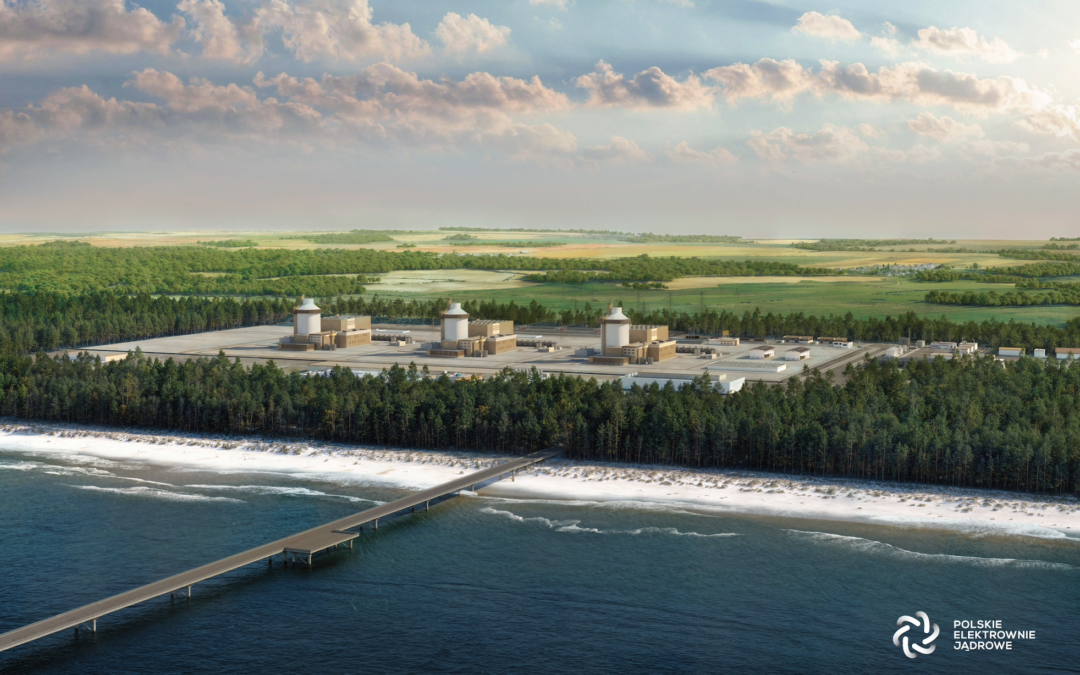
The first plant, which will have a total capacity of about 3.75 GW, is being built in partnership with an American consortium made up of Westinghouse and Bechtel in the municipality of Choczewo on the Baltic coast. Preparatory work at the site is already underway.
The European Commission last year approved Polish state aid for the project, which is set to receive 60.2 billion zloty (€13.8 billion) in public support between 2025 and 2030
In March 2026, the investor submitted an application to the president of the National Atomic Energy Agency for a permit to construct the plant, with the pouring of the first nuclear concrete scheduled for 2028. The first reactor is now expected to enter commercial operation in 2036, three years later than previously planned.
Construction of Poland’s first nuclear power plant is now set to begin after the @EU_Commission approved Warsaw’s request to allocate 60 billion zloty (€14.2 billion) in state aid for the project https://t.co/Z7BJpRRKnq
— Notes from Poland 🇵🇱 (@notesfrompoland) December 9, 2025
Plans are already underway for a second nuclear power plant, with construction scheduled to begin in 2032 and the first unit expected to come online around 2040, one year later than previously planned.
Bełchatów and Konin in central Poland remain the preferred locations for that plant, with both areas offering existing energy infrastructure and extensive experience in electricity generation.
Companies from the United States, France and Canada are currently competing to supply the technology and build it, with Poland to choose its partner next year.
Alongside expanding nuclear capacity, the programme aims to increase the role of Polish companies in the sector. Domestic firms are expected to account for about 40% of the value of the first reactor project, according to the government.
That share could rise to as much as 70% for subsequent units as Polish companies build up expertise, experience and the necessary certifications.
The government also plans to develop the broader skills base needed to support the nuclear industry, involving universities, research institutes, technical schools and businesses.
A group of prominent Polish businesspeople – including @RBrzoska of @InPostPL and @mati Staniszewski of @ElevenLabs – are investing in a project to develop small modular nuclear reactors being led by Poland's richest man, Michał Sołowow https://t.co/NFoCh9JmYz
— Notes from Poland 🇵🇱 (@notesfrompoland) October 1, 2026
The expansion of nuclear power is part of a broader effort to reduce Poland’s traditional reliance on coal, which currently generates around half of the country’s electricity. That is by far the highest figure in the EU.
Poland has already been diversifying its energy mix. Coal has declined from supplying 87% of power a decade ago. Meanwhile, the share of renewables has risen from 9% to 29% over the same period.
Under a national energy and climate plan approved in June, Poland aims by 2040 for coal to account for only 0-5% of the energy mix. Around 15-16% will come from nuclear, 7-8% from gas, with most of the rest from renewables: onshore wind (22-27%), offshore wind (18-21%) and solar (14-18%).
Poland’s first offshore wind farm has begun to deliver electricity, with Prime Minister @donaldtusk celebrating the development as a "key element of our energy security and sovereignty".
The government wants 20% of power to come from offshore wind by 2040 https://t.co/EodvInFmrn
— Notes from Poland 🇵🇱 (@notesfrompoland) July 10, 2026
As well as traditional large-scale nuclear power plants, Poland is also pursuing small modular reactor (SMR) projects.
SMRs, which are prefabricated in factories before being installed onsite, are much smaller than traditional reactors, and proponents say they provide a faster and more cost-effective way of adding nuclear capacity.

Notes from Poland is run by a small editorial team and published by an independent, non-profit foundation that is funded through donations from our readers. We cannot do what we do without your support.
Main image credit: PEJ press materials

Alicja Ptak is deputy editor-in-chief of Notes from Poland and a multimedia journalist. She has written for Clean Energy Wire and The Times, and she hosts her own podcast, The Warsaw Wire, on Poland’s economy and energy sector. She previously worked for Reuters.