Keep our news free from ads and paywalls by making a donation to support our work!

Notes from Poland is run by a small editorial team and is published by an independent, non-profit foundation that is funded through donations from our readers. We cannot do what we do without your support.
Four men have gone on trial in Warsaw accused of being part of a criminal group that carried out a series of arson attacks in Poland and Lithuania on Russian orders.
The accused – three Ukrainians and one Belarusian – can be named only as Oleksandr H., Stepan K., Vitalii K. and Pavlo T. under Polish privacy law and their trial is taking place behind closed doors for security reasons.
Polish prosecutors say that they were part of an organised group tasked with “committing acts of sabotage and terrorism” on behalf of Russia’s foreign intelligence service in April and May 2024.
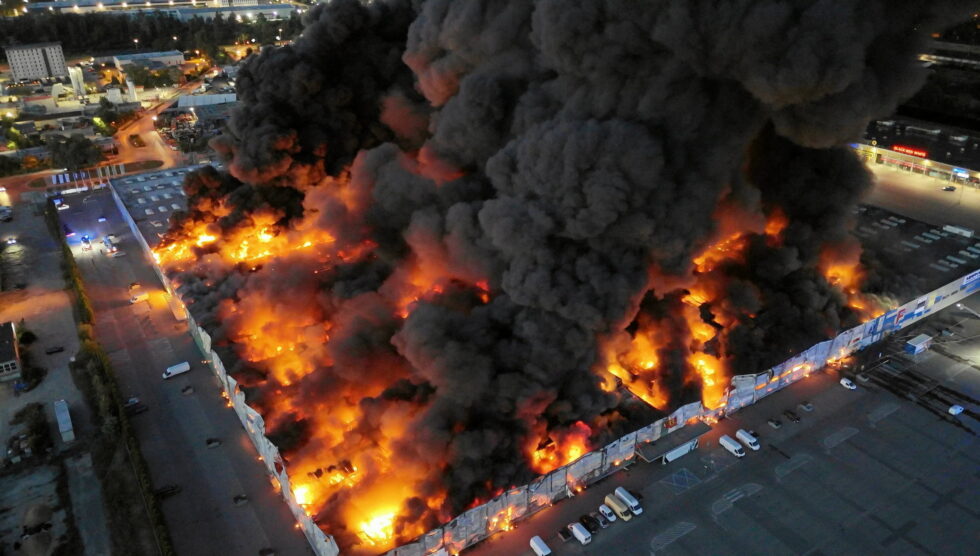
Those included a fire that burned down Warsaw’s largest shopping centre, Marywilska 44; another at a store in Warsaw belonging to home improvement chain OBI; and a third at an IKEA store in Vilnius. They also allegedly planned an arson attack on an IKEA store in the Latvian capital of Riga.
W Sądzie Okręgowym Warszawa-Praga ruszył proces grupy przestępczej, która miała na zlecenie Federacji Rosyjskiej podpalać markety wielkopowierzchniowe, w tym centrum handlowe przy Marywilskiej w Warszawie.https://t.co/0CFl1RyJvq
— TVN Warszawa (@tvnwarszawa) October 12, 2026
According to an indictment issued against the men in March this year, Stepan K., the Belarusian, set fire to the OBI store. Oleksandr H. is accused of involvement in the arson attack on the IKEA store in Vilnius and preparations for further attacks.
The pair have been indicted under Poland’s espionage law for carrying out acts of sabotage and terrorism on behalf of foreign intelligence. That crime carries a minimum sentence of 10 years in prison, ranging up to life.
Another Ukrainian suspect, Daniil B., had also been due to stand trial today on the same charge, with prosecutors finding that he had received an order from a handler in Russia to go to Marywilska on the night the arson attack took place and record footage of the fire and the response of the emergency services.
However, Daniil B. was jailed in Lithuania last year for his role in the Vilnius IKEA fire and Poland has not yet managed to secure his extradition for the trial in Warsaw, meaning that it went ahead without his involvement.
Polish prosecutors say they have determined that the Marywilska fire was also carried out on the orders of Russian intelligence, but have not been able to identify which individuals actually perpetrated the attack.
Stepan K. and Oleksandr H. – as well as Vitalii K., whom prosecutors accuse of helping carry out the arson in Vilnius – are additionally charged with participating in an organised criminal group that aimed to carry out terrorist offences, a crime punishable by up to 10 years in prison.
Both Vitalii K. and Pavlo T. were also indicted in relation to an assault in the village of Wólka Kosowska, just outside Warsaw.
Pavlo T. was already convicted in Poland last year along with two other Ukrainian men, Serhii R. and Vladyslav Y., over their role in the same criminal group tasked with carrying out acts of sabotage and terrorism by Russia. They were handed jail terms ranging from 16 months to five and a half years.
Two other alleged members of the group, Serhii Chalyi and Oleksandr Varyvoda, who prosecutors say were involved in coordinating sabotage activities, remain wanted.
Three Ukrainians have been jailed in Poland for their role in a group tasked with carrying out sabotage and terrorism.
That included the fire that destroyed Warsaw’s largest shopping centre, which Polish prosecutors say was carried out on Russia’s orders https://t.co/xuFx5T4HH9
— Notes from Poland 🇵🇱 (@notesfrompoland) October 24, 2025
In response to evidence that Moscow was behind the Marywilska fire, Poland last year ordered Russia’s consulate in Kraków to close. It has since closed all Russian consulates due to Moscow’s ongoing campaign of sabotage, with Russia responding by shutting down all Polish consulates on its territory.
A report by the International Centre for Counter-Terrorism published earlier this year found that Poland is the “primary focus” of Russian sabotage in Europe.
Most recently, Poland has accused Moscow of being behind a fire at a drone factory that supplies the Polish and Ukrainian militaries. Last year, Ukrainian operatives working on behalf of Russia also used explosives in an attempt to derail a train in Poland.
Most acts of sabotage ordered by Russia in Poland have been carried out not by Russians themselves, but by Ukrainians and Belarusians, large numbers of whom already live in Poland and other countries in the region.
Notes from Poland is run by a small editorial team and published by an independent, non-profit foundation that is funded through donations from our readers. We cannot do what we do without your support.
Main image credit: Dariusz Borowicz / Agencja Wyborcza.pl

Alicja Ptak is deputy editor-in-chief of Notes from Poland and a multimedia journalist. She has written for Clean Energy Wire and The Times, and she hosts her own podcast, The Warsaw Wire, on Poland’s economy and energy sector. She previously worked for Reuters.