Keep our news free from paywalls by making a donation to support our work!

Notes from Poland is run by a small editorial team and is published by an independent, non-profit foundation that is funded through donations from our readers. We cannot do what we do without your support.
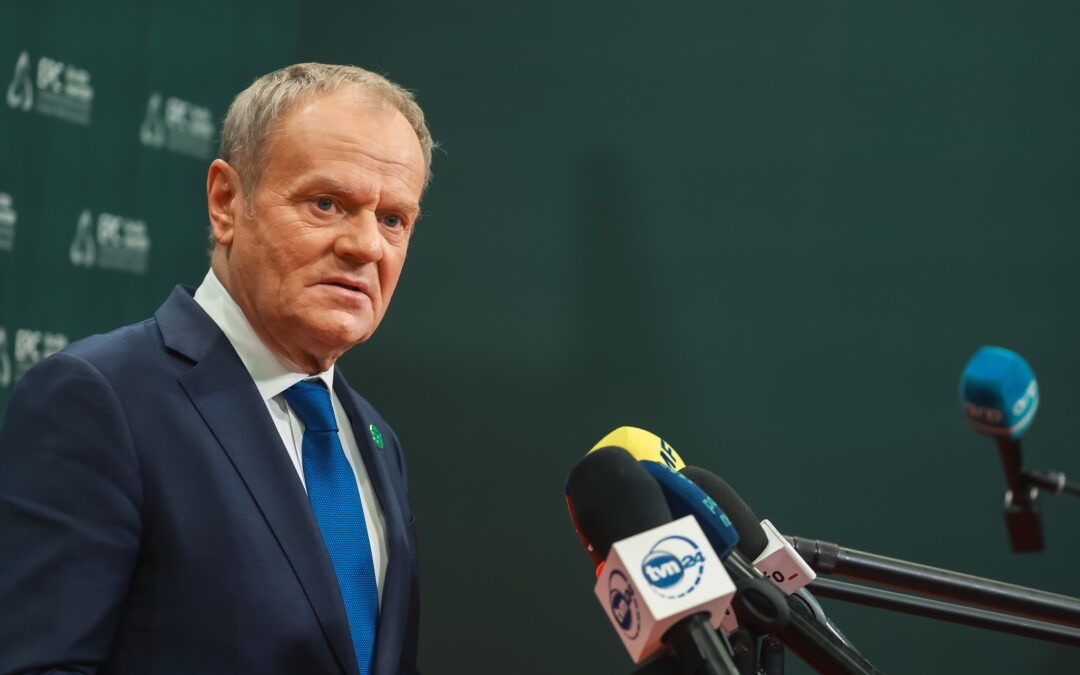
Prime Minister Donald Tusk has issued an order for the National Development Bank (BGK) to provide financing for the Constitutional Tribunal (TK) after Poland’s central bank froze the TK’s accounts following a disputed takeover of the court by government-backed judges.
The relevant funds for the TK to function will be allocated by the finance ministry, announced government spokesman Adam Szłapka on Thursday morning, a day after the cabinet approved a resolution authorising the move.
However, the ousted chief justice of the court has condemned the government’s actions as “completely unlawful” and said that they make the court’s current leadership “directly subordinate” to the prime minister.
Premier @DonaldTusk wydał dyspozycję, by Bank Gospodarstwa Krajowego zapewniał finansowanie Trybunału Konstytucyjnego, a środki na ten cel zabezpieczy minister finansów. Państwo musi działać.
— Adam Szłapka (@adamSzlapka) November 26, 2026
The move marks the latest twist in a long-running battle for control over the TK, which dates back around a decade, when, under the former national-conservative Law and Justice (PiS) government, three judges were unlawfully appointed to the court.
As a result, Tusk’s centrist government, which took power from PiS in 2023, had effectively ignored the court and its rulings until this year, when it began appointing new judges to fill a growing number of vacancies on the TK’s 15-person bench.
Events came to a head on 30 October, when the eight judges appointed by Tusk’s majority in parliament – five of whom opposition-aligned President Karol Nawrocki has refused to swear in – seized control of the court.
They announced that the chief justice, Bogdan Święczkowski, who was appointed under PiS, had been suspended. Święczkowski, backed by Nawrocki and PiS, rejected their actions as an illegal “coup d’état” and maintains he is the rightful head of the court.
The disputed status of the TK’s leadership led the National Bank of Poland (NBP) to announce earlier this month that it had frozen all outgoing transfers from TK accounts.
The central bank cited conflicting claims over who had the authority to manage the institution, saying it “has no authority to decide who is legally entitled to control the Constitutional Tribunal”.
The NBP is led by Adam Glapiński, who was appointed under PiS and is a longtime associate of party leader Jarosław Kaczyński. Tusk’s government condemned the bank’s decision as politically motivated and pledged to find alternative ways of securing the tribunal’s finances.
Meanwhile, both Święczkowski and Anna Korwin-Piątkowska, the government-backed judge who has assumed leadership of the court, each appealed to Glapiński to unblock the Constitutional Tribunal’s accounts and recognise their respective authority to manage the court’s funds.
Poland’s central bank has frozen outgoing transfers from the bank accounts of the Constitutional Tribunal, citing conflicting claims over who has the authority to manage the court following a takeover by a group of judges backed by the government https://t.co/ZYkzoneojO
— Notes from Poland 🇵🇱 (@notesfrompoland) November 17, 2026
On Wednesday, the government adopted a resolution “on taking measures necessary to prevent a crisis situation related to the functioning of the Constitutional Tribunal” due to the NBP’s decision to freeze its accounts.
“At a time when, after many years, an opportunity has arisen to overcome the constitutional crisis, restricting the Constitutional Tribunal’s ability to exercise its constitutional powers will negatively affect the level of legal certainty for individuals, including citizens,” the resolution reads.
It requires the prime minister and finance minister to take “appropriate measures to protect the interests of the State Treasury and to ensure the state’s internal security and public order.”
Szłapka subsequently announced that Tusk had instructed BGK, a state-owned development bank, to provide financing to the tribunal.
The dispute around Poland's constitutional court risks entrenching a system of legal dualism in which judicial authority depends on political allegiance rather than broad constitutional consent, writes @AleksSzczerbiak https://t.co/mtgutqSTQh
— Notes from Poland 🇵🇱 (@notesfrompoland) November 10, 2026
Jan Grabiec, head of the prime minister’s chancellery, on Thursday morning told broadcaster TVN24 that the tribunal had an “auxiliary account” at BGK. This would allow its day-to-day operations to be financed despite the NBP’s decision to block payment orders, he added.
“It is not just a matter of ordinary tribunal staff potentially not receiving their salaries,” said Grabiec. “The State Treasury also bears responsibility for contracts entered into by the tribunal’s previous leadership that include specific payment deadlines.”
“This creates a liability for damages, potentially amounting to losses of many millions of zloty,” he added. “We cannot allow the State Treasury to be exposed to losses resulting from such politically motivated decisions of the National Bank of Poland.”
The International Commission of Jurists has criticised the takeover of Poland’s constitutional court, saying it “contravenes international standards on the independence of the judiciary”
But it also criticised the president for refusing to swear in judges https://t.co/2kBv3GT20d
— Notes from Poland 🇵🇱 (@notesfrompoland) November 4, 2026
On Thursday, Święczkowski condemned the government’s decision to channel money to the TK through BGK, calling it “completely unlawful”, reports the Dziennik Gazeta Prawna daily.
“If this usurper Anna Korwin-Piotrowska accepts money from Tusk’s government, it will mean she is directly subordinate to Tusk,” he added.
At the time of writing, the NBP had not publicly commented on the government’s decision to channel funding to the tribunal through BGK. BGK, meanwhile, told PAP that it could not comment on the details of its arrangements with other parties, citing banking secrecy.
Notes from Poland is run by a small editorial team and published by an independent, non-profit foundation that is funded through donations from our readers. We cannot do what we do without your support.
Main image credit: KPRM/Flickr (under CC BY-NC-ND 4.0)

Alicja Ptak is deputy editor-in-chief of Notes from Poland and a multimedia journalist. She has written for Clean Energy Wire and The Times, and she hosts her own podcast, The Warsaw Wire, on Poland’s economy and energy sector. She previously worked for Reuters.