Keep our news free from ads and paywalls by making a donation to support our work!

Notes from Poland is run by a small editorial team and is published by an independent, non-profit foundation that is funded through donations from our readers. We cannot do what we do without your support.
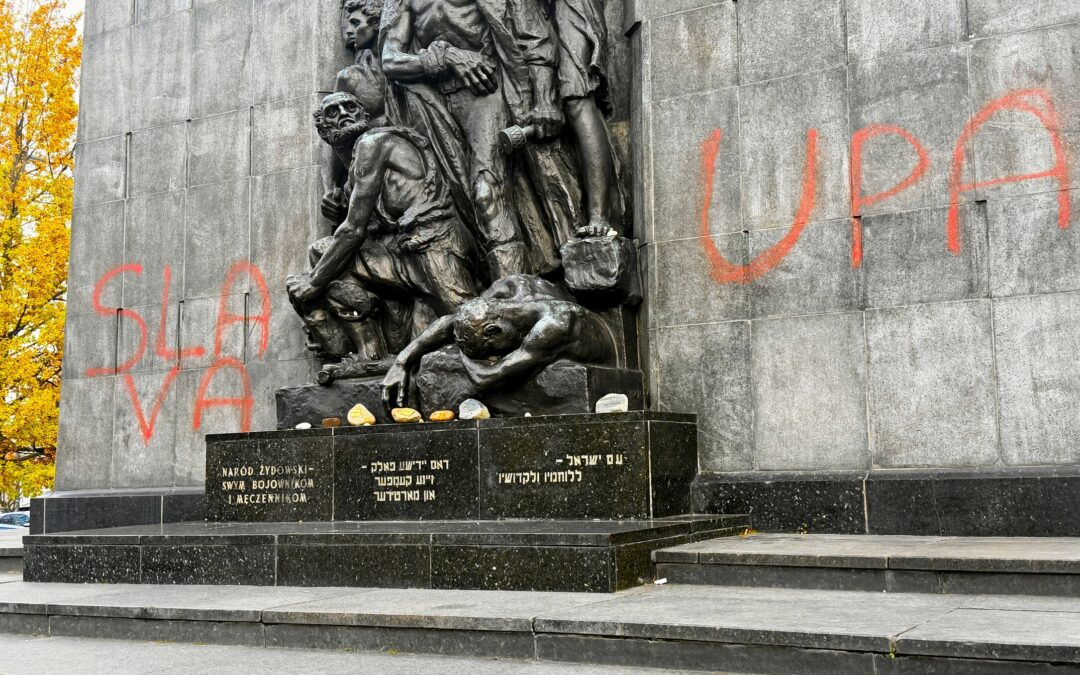
Around a dozen public monuments in Poland, including one dedicated to the Warsaw Ghetto Uprising, have been defaced with graffiti glorifying the Ukrainian Insurgent Army (UPA), a World War Two nationalist partisan group that was responsible for the massacre of Poles.
Ukraine’s embassy in Warsaw has condemned the vandalism and blamed it on Russia, which has previously been accused by the Polish authorities of orchestrating provocative graffiti on monuments.
W sobotę, 14 listopada, w Warszawie doszło do kolejnych dwóch dewastacji pomników. Napisy „Slava UPA” pojawiły się na Pomniku Bohaterów Getta przed Muzeum Historii Żydów Polskich POLIN oraz na Pomniku Żołnierzy 1 Armii Wojska Polskiego przy ulicy Andersa 13. To kolejna odsłona… pic.twitter.com/Y7NDsfpjxn
— Miejski Reporter (@MiejskiReporter) November 14, 2026
The latest spate of vandalism was first reported in early November in the western city of Poznań, where three World War two memorials were painted with graffiti saying “Glory to the UPA” (Slawa UPA).
While the UPA is remembered by many in Ukraine for fighting for independence from Moscow-imposed Soviet rule, in Poland it is primarily associated with leading the Volhynia massacres, in which around 100,000 Polish civilians, mostly women and children, were slaughtered as part of an ethnic cleansing operation.
Local police in Poznań told the Gazeta Wyborcza daily that they were searching for a young man dressed in black who is believed to be the culprit, but have so far not been able to identify him.
Similar graffiti was subsequently reported on seven monuments, including ones dedicated to Polish World War Two heroes and anti-communist protests that took place in 1970, in Gdańsk and Gdynia, neighbouring cities on Poland’s northern Baltic coast.
On Friday, local police in Gdańsk confirmed that they had detained a 17-year-old Ukrainian on suspicion of “painting the offensive slogans propagating hatred”. They shared blurred-out images of the suspect as well as cans of spray paint.
He has been charged with promoting fascist ideology, incitement to violence and hatred based on nationality, and desecration of monuments. If convicted, he could face up to three years in prison.
Previously, on Tuesday this week, MOST, a Polish-based Belarusian independent media outlet, published findings that an anonymous person on messaging service Telegram, which is popular among Russians, Ukrainians and Belarusians, had been offering $500 plus travel expenses for a job in Poznań.
When an undercover MOST journalist responded to the advert, he was told that the job would involve spray painting “Glory to the UPA” on monuments. The recruiter confirmed that the job was illegal, “but if you cover your face and do everything quickly, they won’t find you”.
They also revealed that similar jobs were available in other Polish cities, including Warsaw, Wrocław and Lublin.
Subsequently, similar inscriptions appeared in Warsaw on the Monument to the Ghetto Heroes, which honours the Jews who rose up against their German-Nazi oppressors in 1943; a monument commemorating the Polish First Army, which fought in World War Two; and a monument to sappers who served in the war.
The vandalism was condemned by Poland’s Jewish Historical Institute (ŻIH), which called it a “disgraceful attack on the memory of the victims of the Holocaust and the heroes of Jewish resistance”.
Noting MOST’s findings and the vandalism of other monuments, ŻIH said that “this points to the possibility of an organised provocation intended to incite hatred and divide society”.
Warsaw police told PAP that they are investigating and seeking to identify the perpetrator. An unnamed police source also told Gazeta Wyborcza they see the incidents in all four cities as related to one another, pointing to the similar style and spelling of the inscriptions.
On Sunday afternoon, Warsaw’s mayor, Rafał Trzaskowski, condemned the vandalism and shared images of the municipal authorities cleaning the graffiti off the Ghetto Heroes Monument.
“Given the scale of similar incidents in other cities, we must consider the possibility that this is a planned provocation,” added the mayor. “Let us not let ourselves be divided – the authorities are working to identify both those who carried out these acts and those who ordered them.”
Nie ma zgody na wandalizm w Warszawie.
Minionej nocy służby miejskie wyczyściły pomniki oszpecone przez wandali – między innymi Pomnik Bohaterów Getta. Sprawców szuka policja.
Patrząc na skalę podobnych incydentów w innych miastach, musimy brać pod uwagę, że mamy do czynienia… pic.twitter.com/5xMgPhnHf8
— Rafał Trzaskowski (@trzaskowski_) November 15, 2026
A day earlier, on Saturday, the Ukrainian embassy had also condemned the acts of vandalism, calling them a “disgraceful provocation”.
“In our view, these unlawful acts are a manifestation of the hybrid war that Russia is attempting to wage by any means in European states, and in Poland in particular,” wrote the embassy. “The objective is clear: to incite hostility between Poles and Ukrainians, undermine mutual trust, and weaken support for Ukraine.”
Writing in both Polish and Ukrainian, the embassy appealed to Ukrainians “not to be tempted by offers of ‘easy money’ in exchange for painting graffiti, damaging property, or carrying out other illegal tasks” and to report any such offers to the Polish police.
“Let us respect the laws of the country in which we reside, as well as historical memory and each other’s dignity,” they added. “Polish-Ukrainian solidarity is our shared strength. Let us not allow the enemy to destroy it.”
Poland has been a primary target for Russia’s so-called hybrid actions in Europe, which have included acts of sabotage, espionage, disinformation and efforts to stir hostility towards Ukrainians.
Such operations are rarely carried out by Russian operatives themselves. Instead, Russia often recruits people already on the ground, often members of Poland’s large Ukrainian and Belarusian migrant communities, as well as Poles themselves in some cases.
In July this year, a Ukrainian teenager was indicted by Polish prosecutors on charges of painting dozens of pro-UPA slogans in public places, including on a monument to victims of the Volhynia massacres.
An 18-year-old Ukrainian will stand trial in Poland accused of working on behalf of Russia to stir tension between Poland and Ukraine by painting dozens of inscriptions in public places glorifying the Ukrainian Insurgent Army, which massacred Poles in WWII https://t.co/0w0gVYiGpp
— Notes from Poland 🇵🇱 (@notesfrompoland) July 16, 2026
There have long been tensions between Poland and Ukraine over the massacres, which Poland recognises as a genocide. Ukraine rejects that label, and also continues to honour the UPA for its role in fighting for independence.
The issue has recently flared up again this year after President Volodymyr Zelensky named a Ukrainian military unit after the “heroes of the UPA”. That sparked widespread anger in Poland and prompted Polish President Karol Nawrocki to strip Zelensky of his country’s highest honour.
Notes from Poland is run by a small editorial team and published by an independent, non-profit foundation that is funded through donations from our readers. We cannot do what we do without your support.
Main image credit: Dariusz Borowicz / Agencja Wyborcza.pl

Daniel Tilles is editor-in-chief of Notes from Poland. He has written on Polish affairs for a wide range of publications, including Foreign Policy, POLITICO Europe, EUobserver and Dziennik Gazeta Prawna.