Keep our news free from ads and paywalls by making a donation to support our work!

Notes from Poland is run by a small editorial team and is published by an independent, non-profit foundation that is funded through donations from our readers. We cannot do what we do without your support.
The foreign ministers of Poland and Belarus have met for the first time in a decade, as both sides indicated that they are open to thawing their long-frosty relations.
The two countries have regularly clashed in recent years, in particular over Minsk’s alliance with Moscow, the migration crisis Belarus has engineered on the Polish border, and the persecution of Belarus’s ethnic Polish minority. Warsaw, meanwhile, has supported the Belarusian democratic opposition.
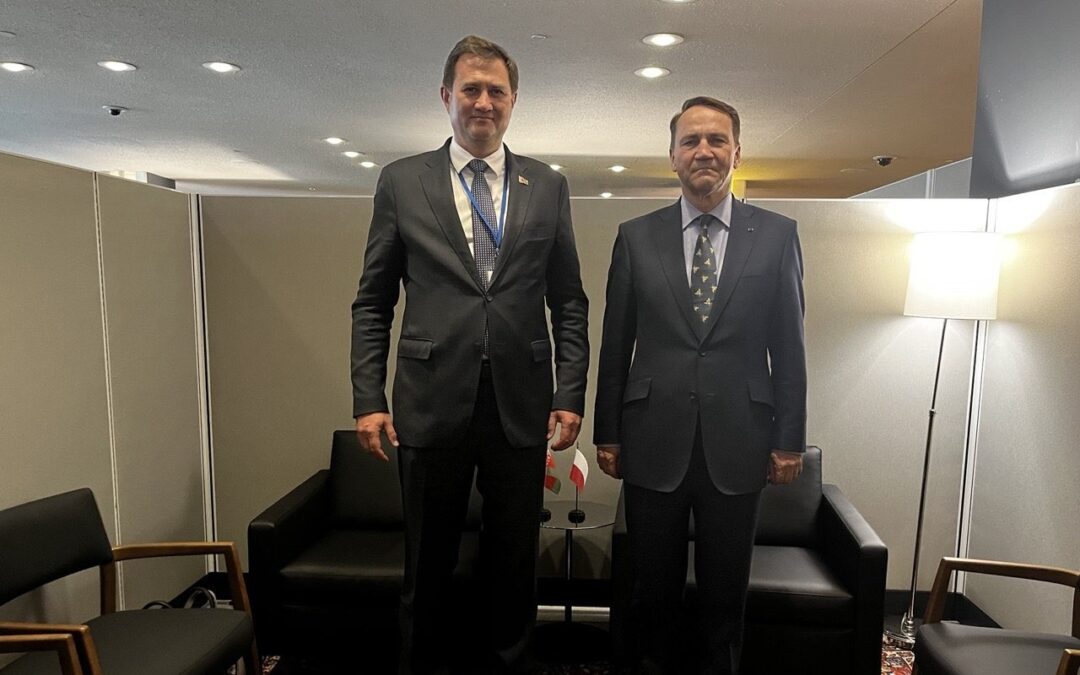
However, on Tuesday this week, Polish foreign minister Radosław Sikorski confirmed to reporters that he had met with his Belarusian counterpart, Maxim Ryzhenkov, on the sidelines of the United Nations General Assembly in New York. Sikorski said that the initiative had come from the Belarusian side.
Przełom w relacjach z Białorusią? Sikorski potwierdza "spotkanie zapoznawcze" https://t.co/uDUPM9CiHo #swiat #radoslawsikorski #bialorus #aleksanderlukaszenko #msz #andrzejpoczobut
— Onet Wiadomości (@OnetWiadomosci) September 23, 2026
“When a neighbour wants to unfreeze and improve relations, Poland is the first to reach an agreement,” said Sikorski, quoted by broadcaster RMF.
“This is a first, introductory meeting, but meetings with other ministries and at other levels are also taking place,” he added, noting that Poland will also “soon be opening a new embassy building in Minsk”.
When asked what topics had been discussed, Sikorski said that they had included the border situation and regional security. Asked if he had requested that Belarus not allow Russia to fly drones and missiles through its territory, he said that this was discussed “among other things”.
The last known time that the Polish and Belarusian foreign ministers met was in October 2016, when Belarus’s Vladimir Makei visited Witold Waszczykowski in Warsaw.
Sikorski said that this week’s meeting with Ryzhenkov had been possible because the situation on their shared border – where Belarus has since 2021 encouraged and assisted tens of thousands of migrants, mainly from Asia and Africa, to cross into Poland – is now “more normalised”.
Poland has installed physical and electronic barriers along the border, sent thousands of armed officers to guard it, and has banned asylum claims by migrants who cross irregularly. Following those measures, the number of attempted crossings has fallen dramatically this year.
Sikorski also noted that relations have been improved by Belarus’s recent decisions to release political prisoners, including Polish ones. Most prominent among them is Andrzej Poczobut, a leader of the Polish community in Belarus, who had been imprisoned on trumped-up charges for five years.
The number of attempted illegal crossings by migrants from Belarus to Poland fell from 15,500 in the first half of 2025 to 235 this year – a drop of over 98%
Poland also now claims a 100% success rate in apprehending migrants who manage to cross illegally https://t.co/RFZkd7CeIk
— Notes from Poland 🇵🇱 (@notesfrompoland) July 20, 2026
Minsk’s recent actions have provided “more freedom and greater reasons to try to stabilise relations”, said Sikorski. “A snowdrop can bloom if the weather is favorable.”
Belarus’s foreign ministry continued that metaphor in a post on social media on Wednesday, sharing a photo of Sikorski meeting with Ryzhenkov and writing that “snowdrop diplomacy is a nice restart”.
“But we’re in it for the harvest,” added the ministry. “Let’s plant an orchard – it needs nurturing every year, not once a decade. Minsk is ready to host.”
Last year, Belarus called for “dialogue” with Poland in order to “reduce the risk of armed clashes” amid a military build-up around the border. However, it also issued a formal protest to Poland over a demonstration in Warsaw organised by exiled opponents of Belarusian President Alexander Lukashenko.
.@sikorskiradek, snowdrop diplomacy is a nice restart. But we’re in it for the harvest. Let’s plant an orchard 🍎 – it needs nurturing every year, not once a decade. Minsk is ready to host 🇧🇾🇵🇱 pic.twitter.com/WSN5n4uOtE
— Belarus MFA 🇧🇾 (@BelarusMFA) September 23, 2026
News of Tuesday’s meeting was criticised by Stanisław Żaryn, who served as spokesman for the Polish security services under the former Law and Justice (PiS) government and later as an advisor to President Andrzej Duda.
In a social media post, he said that Sikorski and media outlets are “forcibly pushing us into another reset with Belarus (and perhaps even with Russia)”. However, “Belarus chose its strategic path long ago and won’t turn away from Russia”, he added.
He asked if Poles are meant to forget about the death of Mateusz Sitek, a Polish soldier killed by a migrant from a group trying to force its way over the border from Belarus. His suspected killer, a Moroccan national, is believed by Polish prosecutors to still be in Belarus, which has refused to extradite him.
Should “we just move on as if nothing happened regarding Belarus’s involvement in the war against Ukraine and the intelligence war against Poland?” continued Żaryn.
⚠️Radosław Sikorski spotkał się z Szefem MSZ Białorusi. Media już piszą o „przełomie”, a Sikorski zapewnia, że „Polska jest pierwsza do zgody”. Na siłę wtłaczają nas w kolejny reset z Białorusią (a być może i Rosją). Na czym mają polegać przełomy i „zgoda” w stosunkach z… pic.twitter.com/DZ41wSgjL0
— Stanisław Żaryn (@StZaryn) September 23, 2026
Francišak Viačorka, a leading figure in the exiled Belarusian democratic opposition, also expressed scepticism in an interview with Polish newspaper Fakt.
“We believe that the authorities in Minsk cannot be trusted,” he said. “Of course, when the authorities communicate with Western partners, they promise that everything will be fine, that they want dialogue, but then their words fail to match their actions.”
“I understand that Minister Sikorski is doing everything to protect Polish interests and the sovereignty and security of his country, but I think that in Minsk they see it differently.”
Notes from Poland is run by a small editorial team and published by an independent, non-profit foundation that is funded through donations from our readers. We cannot do what we do without your support.
Main image credit: Belarus MFA/X

Daniel Tilles is editor-in-chief of Notes from Poland. He has written on Polish affairs for a wide range of publications, including Foreign Policy, POLITICO Europe, EUobserver and Dziennik Gazeta Prawna.