Keep our news free from ads and paywalls by making a donation to support our work!

Notes from Poland is run by a small editorial team and is published by an independent, non-profit foundation that is funded through donations from our readers. We cannot do what we do without your support.
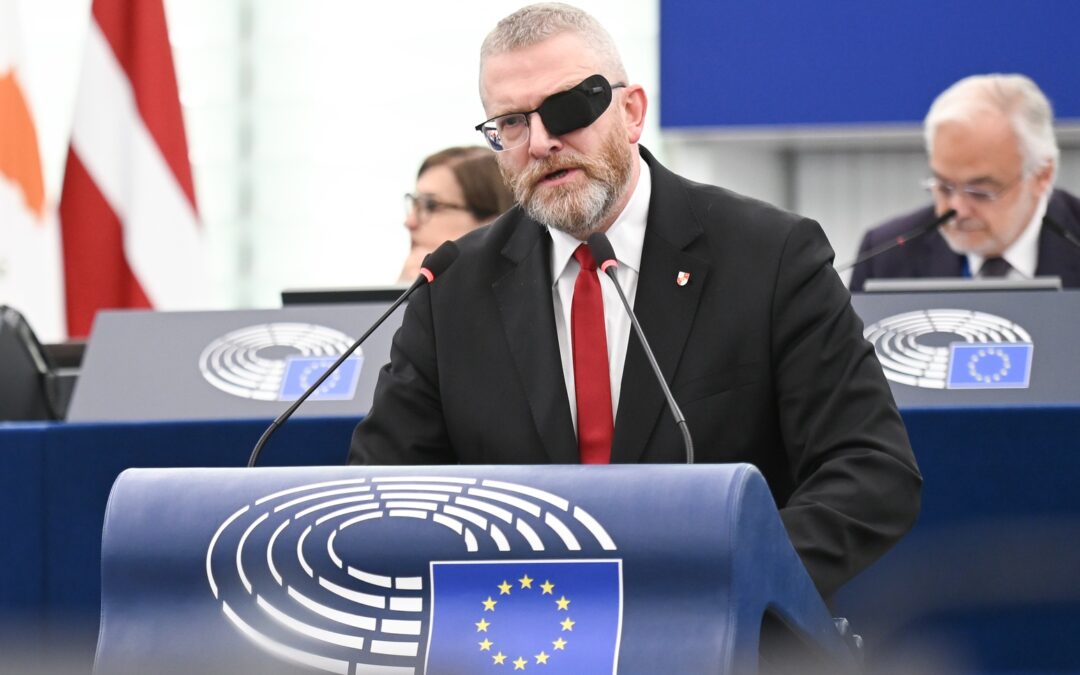
The European Parliament has again stripped Polish far-right leader Grzegorz Braun of legal immunity to face charges in his homeland of denying Nazi crimes, an offence that carries a potential prison sentence of up to three years.
The decision marks the sixth time that the European Parliament has lifted Braun’s immunity, and the second time for charges of Holocaust denial. Braun is already on trial in Poland for an attack on a Jewish religious celebration in parliament and is facing a number of other legal cases.
Parlament Europejski w głosowaniu w Strasburgu uchylił immunitet europosła Grzegorza Brauna. Sprawa dotyczy negowania przez niego Holokaustu. Więcej: https://t.co/rB3UPUiS8o pic.twitter.com/icRLEqsWmF
— Gazeta.pl (@gazetapl_news) September 15, 2026
In a vote on Tuesday, a majority of MEPs voted in favour of a request, submitted in February by Poland’s justice minister, Waldemar Żurek, to lift the immunity enjoyed by Braun as an MEP. He has sat in the European Parliament since being elected in 2024.
In his request, Żurek said that Polish prosecutors wish to charge Braun in relation to “denial of genocide crimes committed by functionaries of the Third Reich in the Auschwitz-Birkenau concentration camp and the Lublin concentration camp (Majdanek)”.
Poland’s Institute of National Remembrance (IPN), a state historical body that has prosecutorial power, also revealed that the accusation relates to the use of gas chambers at those two camps.
Neither the IPN nor Żurek confirmed at the time what specific words Braun had said that prompted the planned charges against him. However, the IPN noted that they had come at a live event broadcast online on 27 September 2025.
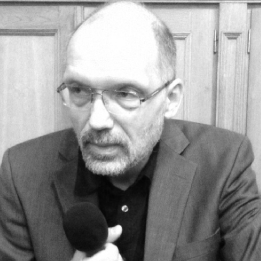
On that date, Braun took part in a discussion with Jan Żaryn, a right-wing historian and former senator for the national-conservative Law and Justice (PiS) party, titled “The Polish Underground State and the Jewish Issue”. A recording of the event is still available online.
During his remarks, Braun referred to the “fake gas chambers of Majdanek and Auschwitz”, calling them “a dark, monstrous fantasy that has no satisfactory historical or academic support”.
He suggested that the idea of the gas chambers had been invented as part of “propaganda and black PR operations conducted by the Soviet and Anglo-Saxon security services during World War Two”, and that the false claim continues to be exploited by Jews today.
The European Parliament has again voted to strip Polish far-right leader Grzegorz Braun of immunity to face further charges for Holocaust denial as well as various antisemitic, anti-Ukrainian and anti-LGBT incidents during last year's presidential campaign https://t.co/4EHVEuSDnM
— Notes from Poland 🇵🇱 (@notesfrompoland) March 26, 2026
In actual fact, historians estimate that around 900,000 people were killed in the gas chambers at Auschwitz. The vast majority were Jews, but victims also included Roma, Soviet prisoners of war, and ethnic Poles.
Meanwhile, gas chambers at Majdanek were used to kill tens of thousands, again mainly Jews. Today, the ashes of the camp’s cremated victims are preserved in a memorial at the site of the former camp.
Braun, who has a long history of promoting antisemitic conspiracy theories, has repeatedly sought to cast doubt on the veracity of Nazi crimes against Jews. Last month, he was charged with denying Nazi crimes in a separate case over earlier comments in which he called Auschwitz’s gas chambers “fake”.
Polish far-right leader Grzegorz Braun has been charged with denying Nazi crimes, a criminal offence in Poland that carries a prison sentence of up to three years, for statements he made suggesting that the gas chambers at Auschwitz are "fake" https://t.co/PCssZt5eXD
— Notes from Poland 🇵🇱 (@notesfrompoland) August 25, 2026
In December, Braun went on trial over a separate set of charges relating to four other incidents, including his attack on a celebration of the Jewish festival of Hanukkah in parliament in December 2023 and his disruption of a lecture by a Holocaust scholar.
“I am standing before this court because I dared to defend myself against oppression and the ritual manifestation of Jewish supremacy,” declared Braun at the start of the trial, which remains ongoing.
Braun is also facing various legal cases relating to his anti-Ukrainian and anti-LGBT actions. Last week, he posted a video of himself using a hammer to vandalise a monument in Poland dedicated to the Ukrainian Insurgent Army (UPA). Police are investigating that incident.
Polish far-right leader Grzegorz Braun has published a video of himself using a hammer to attack a monument in Poland to soldiers from the Ukrainian Insurgent Army, a WWII group that fought against the Soviets but was also responsible for massacring Poles https://t.co/oCYRtNRO9N
— Notes from Poland 🇵🇱 (@notesfrompoland) September 11, 2026
Braun’s high-profile stunts have seen his popularity surge among a section of the electorate. He finished a surprise fourth in last year’s Polish presidential election, with over 6% of the vote, and his Confederation of the Polish Crown (KKP) party is now polling around 8-9%.
If it manages to secure that level of support at next year’s parliamentary elections, KKP could become a key player in deciding what kind of government can be formed after what looks likely to be a very close contest between the ruling coalition, which ranges from left to centre right, and the right-wing and far-right opposition.
An MEP from the ruling coalition, Michał Kobosko, welcomed Tuesday’s decision to lift Braun’s immunity, saying that the far-right leader “deliberately and consciously…stokes hatred.
Kobosko said that such actions are particularly dangerous at a time when Russia is “actively waging hybrid and cognitive war against Poland”. He noted that Braun and his party have taken a sympathetic position towards Russia, including calling for Poland to “normalise” relations with Moscow.
Figures from Polish far-right leader Grzegorz Braun's party celebrated Russia Day at the Russian embassy and presented a letter hailing Russia's development, blaming "globalists" for the Ukraine war and calling for normalisation of Polish-Russian relations https://t.co/SU3gEdVod0
— Notes from Poland 🇵🇱 (@notesfrompoland) June 13, 2026
Notes from Poland is run by a small editorial team and published by an independent, non-profit foundation that is funded through donations from our readers. We cannot do what we do without your support.
Main image credit: Christian CREUTZ, © European Union 2026 – Source : EP

Daniel Tilles is editor-in-chief of Notes from Poland. He has written on Polish affairs for a wide range of publications, including Foreign Policy, POLITICO Europe, EUobserver and Dziennik Gazeta Prawna.