Keep our news free from ads and paywalls by making a donation to support our work!

Notes from Poland is run by a small editorial team and is published by an independent, non-profit foundation that is funded through donations from our readers. We cannot do what we do without your support.
A new study shows that, while most Poles were angered by President Volodymyr Zelensky’s recent decision to name a military unit after a group that massacred Poles in World War Two, they still overwhelmingly support cooperation with Ukraine and believe that Russia benefits from the dispute.
The study, carried out by Polish state research agency CBOS, also finds that a large majority of Poles believe good relations with Ukraine will only be possible once historical issues are resolved.
The polling was carried out this month in response to the ongoing diplomatic crisis that began in May, when Zelensky named a military unit after the “heroes of the Ukrainian Insurgent Army (UPA)”.
The UPA is widely revered in Ukraine for its role in fighting against Moscow-backed Soviet rule. However, in Poland it is associated with the Volhynia massacres, in which around 100,000 Polish civilians – mostly women and children – were slaughtered during World War Two, often with great brutality.
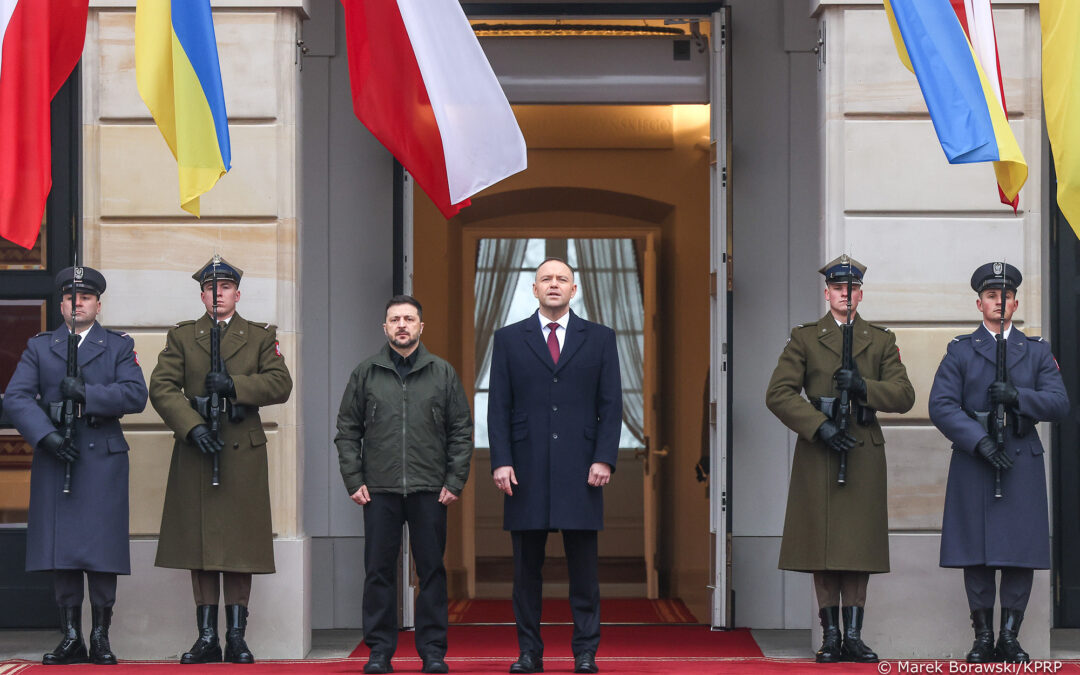
Zelensky’s decision sparked anger in Poland, where the massacres are regarded as a genocide (though Ukraine strongly rejects that label). In June, Polish President Karol Nawrocki stripped Zelensky of the Order of the White Eagle, Poland’s highest honour, which he had received in 2023.
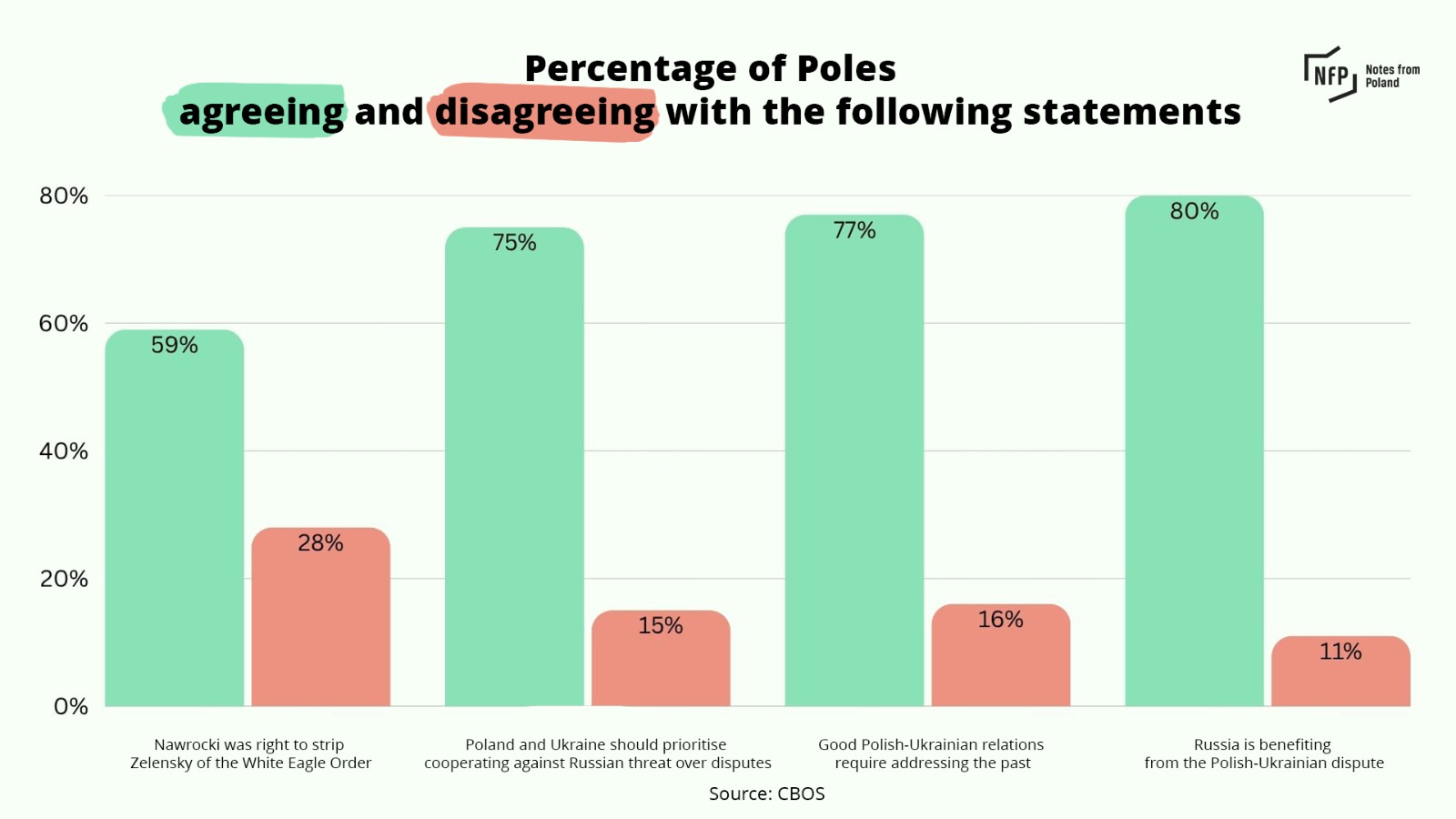
In its new survey, CBOS found that 59% of Poles support Nawrocki’s decision, while only 28% oppose it. However, they were divided over the consequences, with 41% saying it would bring Poland more losses than benefits and the exact same proportion saying the benefits would outweigh the costs.
More broadly, 84% said the Polish state should react when another country glorifies historical figures responsible for crimes against Poles.
However, when asked if Ukrainians have the right to honour their own historical heroes, even if those figures left a negative mark on Polish history, 44% agreed and 42% disagreed.
At the same time, over three quarters of respondents (77%) said that good Polish-Ukrainian relations could not be built without addressing the past, but a similar proportion (73%) also believe that politicians on both sides “fuel conflicts between Poles and Ukrainians for their own political gain”.
Poland has cautiously welcomed President @ZelenskyyUa's announcement of a five-point plan to alleviate the diplomatic crisis triggered by his earlier decision to name a military unit after a group that led massacres of Poles during WWII https://t.co/M3GXD9vtAr
— Notes from Poland 🇵🇱 (@notesfrompoland) July 18, 2026
Yet the survey also showed that, for Poles, historical disputes have not displaced security concerns, and in particular the view that, for Poland and Ukraine, Russia is a shared enemy.
Some 75% of respondents agreed with the statement that “Poland and Ukraine should, above all, cooperate in the face of the threat from Russia, rather than focus on the issues that divide them”.
The most frequently cited priorities in relations with Kyiv were security cooperation (61%), building good neighbourly relations (46%), commemorating victims of the Volhynia massacres (43%), strengthening Poland’s regional leadership (41%), and ensuring Polish companies participate in Ukraine’s reconstruction (40%).
Just over half of Poles (52%) agree that “Poland and Ukraine have more common aims and interests than conflicting ones”, while 32% disagreed. A huge majority (80%) agreed that “Russia benefits from the Polish-Ukrainian dispute”.
W ocenie społecznej zdecydowanym priorytetem w relacjach z Ukrainą powinna być współpraca na rzecz bezpieczeństwa – wskazało ją 61% badanych.📊
➡️Więcej w komunikacie #CBOS "Wokół polsko-ukraińskiego sporu o imponderabilia i nie tylko":https://t.co/pIvYbu8gyz#Ukraina #relacje pic.twitter.com/LOpmAKNnXn
— CBOS (@CBOS_Info) July 23, 2026
Based on the answers in the survey, CBOS identified three broad groups of respondents classified by their views of the dispute.
The largest, described as “moralists”, accounted for 46% and placed greater emphasis on historical grievances. Among this group, 99% supported Nawrocki’s decision and said good Polish-Ukrainian relations could not be built without addressing the past.
“Pragmatists”, who made up 34% of respondents, placed greater emphasis on future cooperation. Some 96% said Poland and Ukraine should cooperate against the Russian threat rather than focus on historical disputes.
The smallest group, labelled by CBOS as “withdrawn”, represented 20% of respondents who were more likely to lack a clear view on Polish-Ukrainian relations.
Long-simmering tensions between Poland and Ukraine over WWII massacres have finally boiled over, prompting a diplomatic crisis.@danieltilles1 looks at how we got here and what it may mean for the two countries and Europe more broadly https://t.co/a8tiYJJHRr
— Notes from Poland 🇵🇱 (@notesfrompoland) June 22, 2026
Recent weeks have seen moves from Ukraine towards finding a diplomatic solution to the crisis. In early July, foreign minister Andrii Sybiha visited Warsaw to propose an “anti-crisis package” of measures.
Last week, Zelensky himself outlined a five-point plan to alleviate the dispute, including opening up Ukrainian historical archives and permitting more exhumations of victims of the massacres, most of whom remain buried in mass graves in Ukraine.
The Polish authorities have cautiously welcomed Zelensky’s announcement, though also emphasise that they are waiting to see concrete action. Meanwhile, there is no indication that Zelensky will change his decision to name a unit after the heroes of the UPA.
Notes from Poland is run by a small editorial team and published by an independent, non-profit foundation that is funded through donations from our readers. We cannot do what we do without your support.
Main image credit: Mikołaj Bujak/KPRP

Alicja Ptak is deputy editor-in-chief of Notes from Poland and a multimedia journalist. She has written for Clean Energy Wire and The Times, and she hosts her own podcast, The Warsaw Wire, on Poland’s economy and energy sector. She previously worked for Reuters.